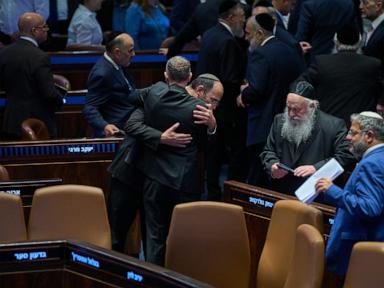
The mainstream media is suffering from a collective delusion about the dissolution of Israel’s parliament.
Open any major news outlet right now. You will see the exact same lazy consensus. They tell you that Prime Minister Benjamin Netanyahu is cornered. They point to the polls showing a groundswell of support for former Prime Minister Naftali Bennett and former military chief Gadi Eisenkot. They treat the scheduled October 27 election as a long-awaited democratic reckoning for a leader swimming in political quicksand.
They are completely misreading the board.
What happened in the Knesset wasn't a panicked collapse. It was a calculated, institutional scorched-earth campaign. By successfully dragging his coalition across the finish line to complete a full four-year term—a feat no Israeli government has achieved since 1988—Netanyahu did not just survive. He weaponized the closing moments of the legislative session to systematically dismantle the state's remaining checks and balances, rigging the playing field so thoroughly that the upcoming election is practically irrelevant.
Whether Netanyahu wins or loses the popular vote on October 27 is the wrong question entirely. The real story is that he has already pre-engineered the post-election reality. He has left behind an institutional minefield designed to blow up any center-left or centrist opposition government before it can even form.
The Myth of the Rare Four-Year Term
Knesset Speaker Amir Ohana stood before the parliament and beamed about the "achievement" of maintaining a full four-year term. The press parroted this as a rare moment of political stability in a country that went to the polls five times between 2019 and 2022.
This is an absolute farce.
Surviving a full term while presiding over three years of grinding war and historic domestic polarization is not a sign of institutional health. It is a damning indictment of the political opposition. I have watched parliamentary coalitions across Europe and the Middle East dissolve over minor budgetary disputes. For an Israeli opposition led by centrist generals to hold a structural majority in national sentiment for three years, yet fail to force early elections, reveals an unprecedented level of political toothlessness.
Netanyahu did not maintain a four-year term through governing competence. He maintained it by turning the legislative process into an ongoing hostage negotiation. Every single day the coalition stayed alive was another day used to pass structural laws that permanently alter the DNA of the Israeli state. The fact that the Knesset ran right up to its summer recess before dissolving was entirely by design. It allowed the ruling bloc to exhaust the clock, ensuring the opposition has zero legislative recourse to undo the damage before the public heads to the ballot box.
The Institutional Landmines the Press Ignored
The media is hyper-focused on the horse race, but the real action happened in the marathon legislative sessions right before the lights went out. The bills crammed through the Knesset are not desperate bones thrown to far-right or ultra-Orthodox coalition partners to keep them happy until October. They are permanent structural transformations.
Consider the two bills that effectively halt the enlistment of ultra-Orthodox men in the military. The mainstream press frames this as a controversial short-term maneuver to secure the loyalty of the Haredi parties for the next coalition. It is far worse than that. By passing the Basic Law on Torah Study and codifying these exemptions, Netanyahu has decoupled a massive, rapidly growing segment of the population from the core civic obligation of the state.
Imagine a scenario where Gadi Eisenkot or Naftali Bennett takes power after October 27. They inherit a state legally mandated to exempt an entire demographic from military service during an ongoing security crisis. To reverse this, an opposition government would have to pass a new Basic Law—a task requiring a coalition consensus that the fractured centrist and left-wing parties simply do not possess. Netanyahu has essentially handed the ultra-Orthodox a permanent veto over Israeli domestic policy, ensuring they will never need to negotiate in good faith with a centrist government again.
Then there is the structural assault on the legal system. The Knesset passed legislation to explicitly split and weaken the role of the Attorney General. For years, the Attorney General has acted as the ultimate internal check on executive overreach, routinely blocking illegal cabinet appointments and unconstitutional directives. By stripping that office of its unified authority, the coalition has castrated the state's internal defense mechanism.
Add to this the newly minted laws increasing government control over broadcast media, and the picture becomes terrifyingly clear. Netanyahu is not preparing to lose gracefully. He is constructing an illiberal playground. If the opposition wins the election, they will walk into a prime minister's office stripped of its institutional levers, facing a weaponized state media, and bound by Basic Laws designed to protect the right-wing bloc's core constituencies.
The Flawed Premise of the Polling Groundswell
The current media narrative relies entirely on public polling. They scream that Eisenkot’s Yashar party is leading Likud, or that a Bennett-led center-right alliance could sweep the board.
Here is the brutal truth about Israeli polling data: it measures national mood, not coalition math.
Israel does not use a constituency-based electoral system. It uses strict national proportional representation. Seats are allocated out of 120 based purely on the percentage of the total vote a party receives, provided they cross the 3.25% electoral threshold.
In this system, a party winning 24 seats compared to another’s 23 means absolutely nothing. What matters is the total block capability. Let's look at the mathematical reality of the Israeli electorate:
| Political Bloc | Core Components | Structural Advantages |
|---|---|---|
| Right/Ultra-Orthodox Bloc | Likud, Religious Zionism, Shas, United Torah Judaism | Total ideological alignment on judicial changes, solid voter retention, unified leadership under Netanyahu. |
| Centrist/Opposition Bloc | Yashar, Yesh Atid, Yisrael Beiteinu, Democrats | Massive internal ideological divides, conflicting egos (Bennett vs. Lapid vs. Eisenkot), no shared vision for the state. |
Even if the center-left opposition wins a plurality of seats, their path to building a stable 61-seat majority coalition is a mathematical nightmare. They refuse to sit with the Arab joint lists, and they cannot satisfy the budgetary demands of the ultra-Orthodox without alienating their own secular voter base. Netanyahu, conversely, has a completely frictionless path to 61 if his bloc hits the numbers. He has already given the ultra-Orthodox everything they wanted on the draft and Torah study. They have zero incentive to betray him.
The media is cheering for an opposition victory that is structurally incapable of governing.
Dismantling the Democracy Question
People routinely ask: Can democracy survive the October 27 election?
The question itself is fundamentally flawed. It assumes that democracy is merely the act of voting. The more pressing, uncomfortable reality is that the democratic process is being leveraged to insulate the executive branch from accountability permanently.
If a leader can use a parliamentary majority to weaken the judiciary, muzzle independent broadcasters, and legally entrench unequal civic obligations just days before an election, the election itself ceases to be a meaningful check on power. It becomes a rubber stamp.
The opposition is running a conventional campaign based on security competence and anti-corruption ethics. They are bringing a knife to a structural gunfight. While Bennett and Eisenkot give speeches about healing the nation, the current coalition spent its final hours rewriting the rulebook of the state.
Do not be fooled by the optics of a dissolved parliament or the promises of a fresh campaign. The Knesset didn't break under the weight of its own failures. It adjourned because its architects finished building the trap. October 27 isn't the beginning of a new chapter for Israel; it is the execution of a strategy that was finalized the moment the final gavel fell.


