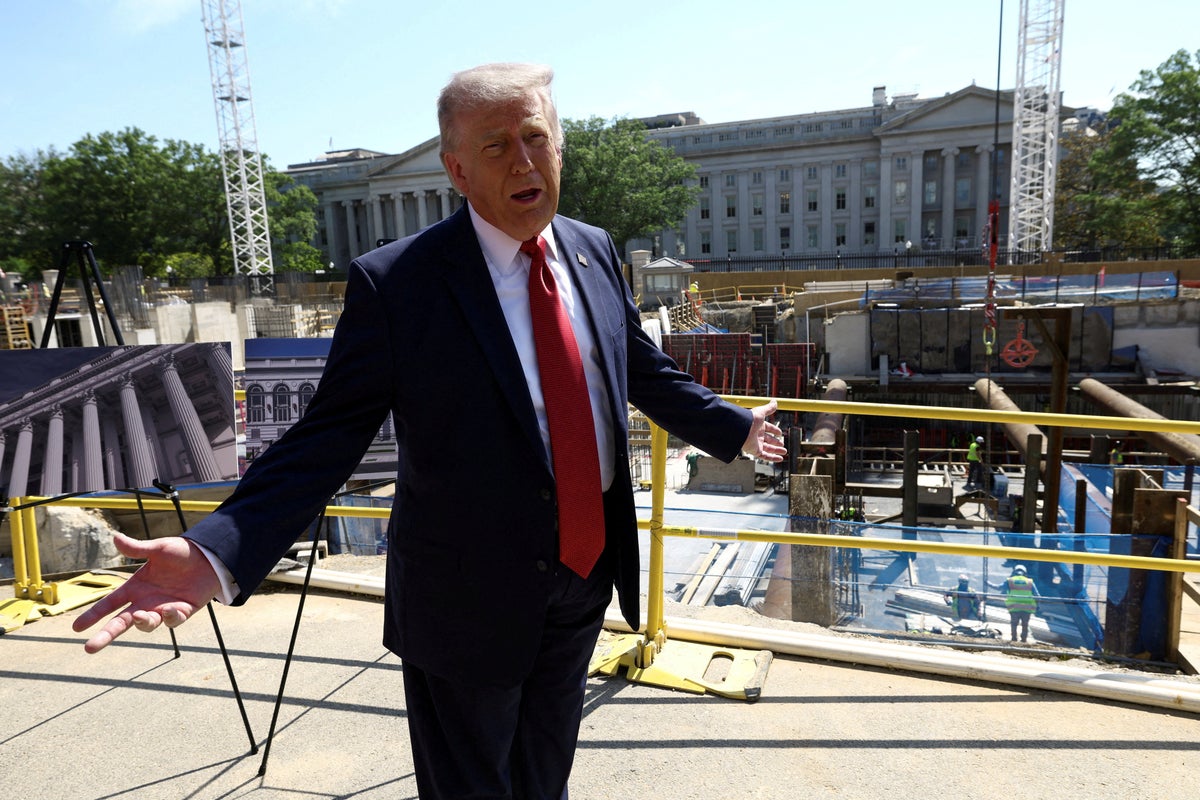
Watchdog organizations are losing their minds over a spreadsheet. The outrage machine is firing on all cylinders because Public Citizen dropped a report claiming that corporate donors who chipped in for Donald Trump’s $400 million White House ballroom project walked away with $50 billion in federal contracts over the last six months.
The headlines write themselves. They scream about "quid pro quo," "blatant corruption," and "pay-to-play" dynamics. It sounds terrifying until you actually look at who is on the list and understand how federal procurement works.
I have spent years watching massive corporations navigate the federal bureaucracy. I have seen how these entities secure capital, hunt for defense yields, and play the long game with Uncle Sam. The narrative that a multi-billion-dollar enterprise bought a massive defense contract by paying for a slice of a 90,000-square-foot ballroom is not just lazy journalism. It is a fundamental misunderstanding of corporate procurement and mathematical scale.
The Absolute Failure of Scale
The core argument of the watchdog groups relies on a logic model that ignores simple math. They point out that companies like Amazon, Palantir, NextEra Energy, and Lockheed Martin cut checks to the Trust for the National Mall to fund the ballroom, and then—shock horror—received federal contracts.
Let us look at the actual math. Lockheed Martin alone cleared over $190 billion in federal contracts over a five-year period. They are the single largest defense contractor on earth. They build the F-35 fighter jet. Do we honestly believe that the Department of Defense selected a primary fighter jet supplier because an executive sat at a gluttonous White House banquet dinner last October?
Imagine a scenario where the pentagon completely alters its national security infrastructure, drops its current military readiness protocols, and shifts a $10 billion defense allocation just because a corporate entity helped fund an excavation project. It is an absurd premise.
The federal procurement system is a massive, slow-moving apparatus governed by strict statutory guidelines. Contracts of this magnitude take years to formulate, bid, review, and award. The $50 billion in contracts awarded over the last six months did not materialize out of thin air because of a secret funding agreement. These allocations were grinding through the bureaucratic pipeline long before the East Wing was even demolished.
The Wrong Question Entirely
The media wants you to ask: Did these companies buy access?
That is the wrong question. The real question is: Could these companies even avoid getting federal contracts if they tried?
The truth is brutally simple: No. The corporate ballroom donors are the precise companies that dominate the infrastructure of the modern state. Look at the roster:
- Amazon runs the cloud computing architecture (AWS) that powers the intelligence community.
- Palantir provides the data analytics engines utilized by defense and law enforcement agencies.
- Lockheed Martin manufactures the actual hardware used in global defense logistics.
These entities do not need to curry favor to win contracts. They are the infrastructure. The government cannot run its daily operations without them. Suggesting that Amazon received an increase in contract funding because of a ballroom contribution ignores the reality that the federal government is aggressively expanding its cloud consumption across every single agency regardless of who sits in the Oval Office.
The Real Value Proposition for Donors
If these corporations do not need to buy contracts, why write the checks at all?
It is not about securing a specific contract. It is about corporate risk management and neutralizing friction. Major corporations are perpetually stuck in regulatory crosshairs. Many of the 27 corporate donors named in these reports face ongoing federal enforcement actions or complex merger reviews, such as Comcast or major domestic rail operators.
Writing a check to a high-profile presidential project is a standard corporate compliance maneuver. It is the corporate equivalent of buying insurance. It does not guarantee a favorable ruling on a pending merger, but it ensures that when an executive needs to explain a complex market position to a regulator, their phone call gets answered. It reduces administrative friction.
Corporate Contribution -> Institutional Goodwill -> Reduced Administrative Friction
To call this a "grift" implies that taxpayers are getting a raw deal. But let us look at the alternative. If the White House ballroom were funded through standard legislative channels, the administration would have forced Congress to allocate a billion dollars under an "East Wing Modernization Project" banner. Taxpayers would be entirely on the hook for the construction, cost overruns, and administrative delays.
Instead, private capital is footing the bill for a permanent asset on federal property. The asset remains long after the current administration departs. The corporate entities absorb the upfront capital expenditure, while the federal procurement machine continues to hand out contracts to the exact same vendors it has used for decades.
Dismantling the Watchdog Fallacy
People frequently ask how these secret agreements can be legal under federal lobbying guidelines. Watchdog groups argue that because the donations are routed through the Trust for the National Mall, it creates an unreviewable conflict.
But this is exactly how public-private partnerships have functioned for a century. Private philanthropy routinely funds the restoration of national monuments, museums, and infrastructure on the National Mall. When corporate leaders donate to the Kennedy Center or the Smithsonian, nobody runs a statistical analysis demanding to know if their tech company received a federal IT contract three months later.
The crossover between federal contractors and major philanthropic donors is nearly 100%. The companies with the capital to fund massive civic projects are, by definition, the companies large enough to execute massive federal contracts. Blaming the ballroom for a $50 billion contract flow is mixing up cause and effect. They did not get the contracts because they donated; they donated because they have the massive capital reserves that come from holding federal contracts.
Stop looking at the ballroom as a localized anomaly of corruption. It is simply the system operating exactly as designed: large, structurally indispensable corporations recycling a tiny fraction of their capital into high-profile civic infrastructure to maintain baseline institutional goodwill. It is cold, calculated corporate utility. And no amount of watchdog hand-wringing will change the reality that the government needs these companies infinitely more than it cares about a new dance floor.