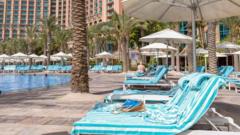
The headlines are dripping with a soft, patronizing sympathy. A German tourist, presumably nursing a bruised ego along with a sunburn, has successfully sued for a payout because he couldn't find a place to sit by the pool. The media is framing this as a victory for the "exploited" traveler.
They are wrong. Dead wrong.
What we are witnessing is the judicial sanctification of laziness. By awarding damages for a "lost sun lounger race," the courts are not protecting consumer rights; they are dismantling the last remaining vestige of true initiative in the modern vacation. If you didn't wake up at 6:00 AM to secure your territory, you don't deserve the prime real estate. You deserve the shade of a dusty palm tree near the service entrance.
The Myth of the Guaranteed Relaxation
The competitor's narrative relies on a flawed premise: that a hotel booking is a contract for total environmental control. It isn't. You are renting a room and access to shared facilities. "Shared" is the operative word.
When a court intervenes because a guest "felt stressed" by the competitive nature of pool seating, it sets a dangerous precedent. It suggests that personal disappointment is a compensable injury. This is the participation trophy culture reaching its final, absurd destination—the all-inclusive resort in Mallorca.
Travel is, by its very nature, an exercise in resource management. Whether it’s snagging a standby flight, getting a table at a Michelin-star restaurant without a reservation, or securing a lounger with a view of the infinity edge, the spoils go to the prepared.
The Economics of the Towel
Let’s talk about the "towel on the chair" phenomenon. Critics call it rude. I call it an informal property rights system that functions with remarkable efficiency.
In any closed ecosystem with high demand and low supply, a secondary market or a priority system emerges. Since resorts generally forbid guests from literally buying chairs (though some high-end clubs are smart enough to monetize this), the currency becomes effort.
- The 6:00 AM Stakeout: This is a physical commitment. It requires discipline.
- The Strategic Placement: Understanding sun angles and wind patterns.
- The Social Contract: Respecting the towel is the only thing keeping these resorts from devolving into actual gladiatorial pits.
When a tourist sues because they showed up at 11:30 AM—after a boozy breakfast and a lie-in—and found no chairs, they are essentially asking the law to subsidize their lack of hustle. It is the equivalent of showing up to a sold-out concert and demanding a front-row seat because you bought a ticket to the venue.
Why the Payout is a Poison Pill for Travel
This legal "victory" will inevitably trigger a cascade of unintended consequences that will make vacations worse for everyone.
- The Rise of the "Lounger Police": Hotels will now be forced to hire staff specifically to monitor chair occupancy. This cost will be passed directly to you in the form of "resort fees."
- Mandatory Reservations: Imagine having to book your pool chair via an app three months in advance, likely for a $50 daily premium.
- Sterilized Experiences: To avoid litigation, resorts will move toward "equalized" environments where every chair is equally mediocre, placed in a grid, with no view, just to ensure no one can claim they were "discriminated" against by a more motivated guest.
I have spent decades navigating the hospitality industry, from back-of-house operations to luxury consulting. I have seen resorts spend millions trying to "solve" the chair problem. The only solution that actually works is the one the courts just gutted: the free market of effort.
The Mathematical Reality of Occupancy
Let’s look at the numbers. A typical 400-room resort might have 600 guests. Due to physical space constraints and aesthetic requirements, they might only have 300 sun loungers.
The math doesn't work for 1:1 parity. Nor should it.
If every guest had a guaranteed chair, the pool deck would look like a warehouse. The "scarcity" is what creates the value of the experience. By suing for a payout, this tourist is effectively demanding that the resort defy the laws of physics or ruin the atmosphere with overcrowding.
The Unconventional Truth: Embrace the Chaos
The best vacations aren't the ones where everything is handed to you on a silver platter. They are the ones where you navigate the local quirks and win.
If you want a chair, get up earlier. If you don't want to get up early, pay for a private cabana. If you can't afford a cabana and you're too lazy to wake up, sit on your balcony.
The court’s decision to reward a guest for their own passivity is a slap in the face to every traveler who understands that a holiday is what you make of it. We are commoditizing "comfort" to the point where we are litigating the sun.
How to Actually Win the Vacation Game
Stop looking for the law to protect your feelings. If you want to dominate the resort landscape, follow these rules:
- Ignore the "No Reservaton" Signs: They are rarely enforced because staff don't want the confrontation. Unless a security guard is actively removing towels, the chair is yours once the fabric touches the plastic.
- Identify the "Dead Zones": Most tourists flock to the main pool. The "quiet" pools or the beach stretches often have better equipment and zero competition.
- Tip the Pool Boy on Day One: Not five dollars. Twenty. Fifty. You aren't tipping for service; you are buying an ally. This is the "grey market" of travel that the lawsuit-happy crowd is too blind to see.
The tourist who won this payout didn't win a victory for "the little guy." He won a victory for the person who wants the rewards of effort without the exertion. He has paved the way for a future where travel is a series of bland, guaranteed, and overpriced "units" of relaxation, stripped of all spontaneity and merit.
If you can't handle the heat of a sun lounger race, stay in the air conditioning. The rest of us will be at the pool, towels down, watching the sunrise.
The judge should have dismissed the case with five words: Get there earlier next time.