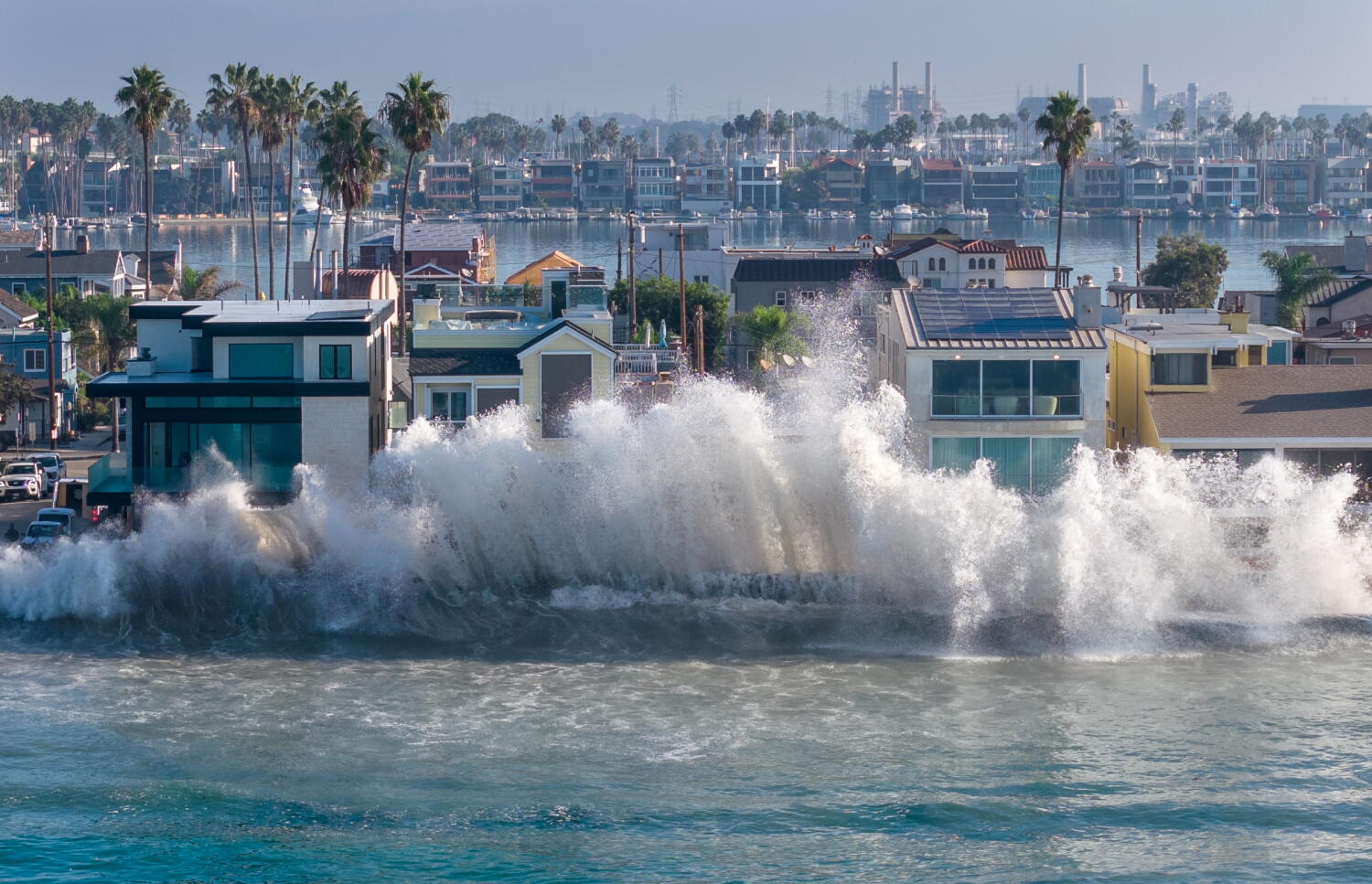
Every winter, local news crews put on yellow rain slickers, stand ankle-deep in saltwater on the Embarcadero or Pacific Coast Highway, and read the same tired script. They call it a terrifying preview of our sunken future. They tell you the ocean is rising, California is getting swamped, and things are going to get worse before they get better.
It is lazy journalism. Worse, it is dangerous policy cover. Don't miss our recent article on this related article.
When headlines scream that "exceptionally high tides will swamp California," they absolve the real culprits of the flood damage. The ocean is not sneaking up on the Golden State like a thief in the night. King tides—properly known as perigean spring tides—are entirely predictable gravitational events caused by the alignment of the sun, moon, and Earth. We have known the exact dates and heights of these tides for centuries.
If a predictable astronomical event floods a multi-billion-dollar highway or a row of beachfront homes, the water is not the problem. The concrete is. California is not drowning because the Pacific Ocean suddenly got angry; California is flooding because we spent seventy years paving over natural shock absorbers, draining coastal aquifers until the dirt sank, and subsidizing real estate development in places that were underwater every Tuesday in 1850. If you want more about the background here, NPR offers an in-depth breakdown.
The Myth of the Surprise Surge
Mainstream coverage loves a simple villain. Blaming global sea-level rise exclusively for every puddle on Highway 1 makes for neat, fatalistic television. It requires zero investigation into municipal zoning boards, coastal commission exemptions, or crumbling storm drain infrastructure.
Let’s look at the actual physics of what happens during a California winter king tide.
A king tide occurs when the moon is at perigee (closest to Earth) and simultaneously aligns with the sun and Earth during a new or full moon. This gravitational tug-of-war pulls water roughly one to two feet higher than average daily tides. Add a low-pressure winter storm system—which physically lifts the ocean surface through the inverse barometer effect—and high-energy swell from the North Pacific, and water pushes inland.
None of this is a secret. The National Oceanic and Atmospheric Administration (NOAA) publishes tide tables years in advance with minute-by-minute precision.
Yet every single year, city planners, insurance actuaries, and reporters act shocked when salt water backs up through storm drains in Marin County, Newport Beach, and Imperial Beach. I have sat in municipal planning meetings where coastal engineers present ten-year hydrographs showing exact inundation thresholds, only for city council members to approve another luxury mixed-use development three feet above mean higher high water—and then act blindsided when the parking garage floods two winters later.
Calling this "getting swamped by climate change" is like building a house on a railroad track, ignoring the published train schedule, and blaming physics when the 4:15 express takes out your living room.
You Aren't Sinking Because the Water Is Rising—You're Sinking Because the Land Is Falling
If you want to understand why California’s coast is flooding faster than global averages suggest, stop looking out at the waves and start looking straight down at your boots.
Global mean sea level is rising at roughly 3.4 to 4 millimeters per year, according to satellite altimetry data from NASA and NOAA. That is a real, measurable trend driven by thermal expansion of warming water and melting land ice. Over a century, it adds up.
Over a single decade, however, four millimeters a year does not suddenly swamp a city. What does swamp a city is vertical land motion—specifically, subsidence.
According to radar interferometry research led by scientists at NASA’s Jet Propulsion Laboratory (JPL) and the U.S. Geological Survey (USGS), significant stretches of the California coastline are physically sinking faster than the ocean is rising.
- San Francisco Bay Area: Parts of the Bay shoreline, particularly areas built on uncompacted artificial fill like Foster City, Treasure Island, and sections of San Francisco’s Marina District, are sinking at rates of up to 10 millimeters per year.
- Southern California: Coastal basins in Los Angeles and Orange County experience complex vertical shifts driven by tectonic compression and decades of groundwater and oil extraction.
- The Central Coast: Agricultural pumping in coastal valleys compacts subterranean clay layers permanently, dropping the surface elevation of the land forever.
When the land drops ten millimeters a year and the sea rises four millimeters a year, the relative sea level jumps by fourteen millimeters annually. Yet media narratives lump the entire problem into a single bucket labeled "rising tides."
Why does this distinction matter? Because you cannot stop global thermal expansion from a city hall in Santa Barbara, so politicians throw up their hands, demand federal disaster bailouts, and do nothing locally. You can, however, stop overdrafting coastal aquifers, halt construction on liquefaction-prone bay mud, and penalize developers who build on sinking fill. Framing the crisis solely as an unstoppable oceanic force excuses local incompetence.
How We Destroyed Our Own Sea Walls
Before concrete seawalls and riprap boulders lined the California coast, the state had a sophisticated, self-repairing flood defense system. It was called coastal wetlands and barrier dunes.
Tidal marshes, estuaries, and kelp forests absorb wave energy the way a heavy carpet absorbs footsteps. Studies published in Nature and by researchers at the Scripps Institution of Oceanography demonstrate that intact coastal wetlands can reduce wave heights by over 60 percent and dissipate storm surge energy across miles of vegetation.
California destroyed roughly 90 percent of its historic coastal wetlands.
We drained them for ports, paved them for airports, bulkheaded them for marinas, and filled them for tract housing. Then, when the buffer vanished and waves began chewing directly into coastal bluffs and highways, we doubled down on the exact engineering strategy that made the problem worse: coastal armoring.
Seawalls do not stop erosion; they transfer it. When a massive winter swell hits a vertical concrete wall, the wave energy has nowhere to go. It reflects downward, scouring the sand right off the base of the wall, and shoots sideways, accelerating erosion on neighboring unprotected beaches. Over twenty years, a seawall turns a wide, energy-absorbing sandy beach into a deep-water trough slamming directly against concrete.
I have watched homeowners associations spend $15 million on emergency rock revetments only to discover five years later that they destroyed the very beach they bought the property to enjoy—and increased the wave run-up height slamming against their own foundations during king tides.
Answering the Questions Nobody Wants to Ask Properly
When king tides hit the headlines, search engines light up with frantic questions from coastal residents, taxpayers, and property buyers. Most answers coddle the reader with vague platitudes about "resilience" and "sustainability." Let’s cut through the noise.
Is California actually going to fall into the ocean?
No. Aside from being geologically absurd—California sits on a transform fault boundary, not a trapdoor—even extreme sea-level rise projections from the California Ocean Protection Council (1 to 2 feet by 2050, and potentially 3.5 to 7 feet by 2100 under high-emission scenarios) will not submerge the state. The cliffs of Big Sur, the hills of San Francisco, and the coastal ranges of Malibu sit hundreds of feet above sea level. What will go underwater are the flat, low-lying floodplains we foolishly built on: estuaries, reclaimed bay mud, river mouths, and barrier spits like Balboa Peninsula and Coronado.
Why don't we just build higher seawalls?
Because seawalls are a financial and ecological death spiral. Beyond destroying public beaches—which violates the core mandate of the California Coastal Act—seawalls do nothing to stop groundwater inundation. As sea levels rise, the freshwater table floating on top of denser saltwater gets pushed upward. Water simply bubbles up behind the seawall through lawns, basements, and sewer pipes. You cannot build a wall against water coming up from beneath your foundation.
Should you buy coastal real estate in California right now?
Only if you treat it as a depreciating asset with a known expiration date, or if you buy high-elevation bluff property with massive setback buffers. If you buy a zero-elevation canal home or a beachfront cottage relying on subsidized flood insurance and emergency sand replenishment, you are betting that California taxpayers will keep writing blank checks to save your private view. That bet is losing odds every year.
The Quiet Subsidy Keeping Flood Zones Alive
The most distorted part of the "swamped California" narrative is the assumption that coastal flooding is a shared tragedy. In reality, it is a massive upward transfer of wealth.
For decades, the National Flood Insurance Program (NFIP) priced policies far below actual actuarial risk. When a winter king tide plus a storm surge ruined a beachfront home, federal taxpayers paid to rebuild it in the exact same spot, using the exact same building codes, waiting for the exact same tide to destroy it again five years later.
Even with FEMA’s updated Risk Rating 2.0 methodology pushing premiums closer to reality, state and local governments still pour hundreds of millions of dollars into beach nourishment—dredging sand from offshore and pumping it onto eroding tourist beaches.
Beach nourishment is the urban planning equivalent of putting ice cubes on a hot sidewalk in July. Every major winter swell washes that multi-million-dollar sand right back into the submarine canyons offshore. In places like Solana Beach, Encinitas, and parts of Orange County, taxpayers repeatedly fund sand replenishment cycles that protect private oceanfront estates worth $10 million to $40 million each.
Meanwhile, working-class inland communities facing deadly urban heat islands and crumbling freshwater infrastructure fight for scraps of state climate adaptation funding.
The Uncomfortable Reality of "Managed Retreat"
If you want to watch a room full of California mayors break out into a cold sweat, say two words: managed retreat.
Managed retreat means acknowledging that certain roads, sewer plants, rail lines, and neighborhoods cannot be saved at any rational cost—and systematically relocating them inland while returning the shoreline to wetlands and dunes.
The competitor’s article warns that things will "get worse before they get better." That phrasing implies a temporary storm that eventually passes, leaving everything intact once the tide goes out. That is a lie. Things do not "get better" when your municipal wastewater treatment plant sits three feet above mean sea level next to a rising bay.
Consider the LOSSAN rail corridor in San Diego County—the second-busiest intercity passenger rail line in the United States. Sections of the track run right along crumbling coastal bluffs in Del Mar. Every king tide and winter storm undercuts the cliffs, forcing emergency shutdowns and tens of millions of dollars in band-aid stabilization. Moving that rail line inland into a tunnel will cost billions and take over a decade. Leaving it on the bluff means watching it fall into the Pacific in slow motion.
Yet whenever coastal planners propose rolling easements, buyout programs, or zoning bans on rebuilding after storm damage, wealthy beachfront coalitions sue them into paralysis. In Half Moon Bay, Pacifica, and Del Mar, local politics routinely prioritizes protecting existing private property values over rational long-term infrastructure survival.
Where the Contrarian Approach Hits a Wall
Challenging the "helpless victim of the ocean" narrative does not mean pretending coastal engineering has easy answers. Stripping away lazy climate fatalism forces us to confront brutal trade-offs that nobody wants to own:
- The Legal Minefield of Takings Claims: Under the Fifth Amendment of the U.S. Constitution, the government cannot simply declare private coastal land "wetlands again" without paying just compensation. Buying out even a few miles of California beachfront real estate at current market valuations would bankrupt state adaptation budgets overnight.
- Critical Infrastructure Stranded on the Edge: You cannot easily move a major international airport like SFO or Oakland, or massive coastal power and wastewater plants, without spending tens of billions of dollars and triggering decades of environmental litigation inland. Hard armoring will remain unavoidable for high-density urban cores and vital ports.
- Social Equity Traps: Low-income communities in places like East Palo Alto, Marin City, and South San Diego often sit in low-lying flood zones without the political clout or property values to command massive state seawall investments. Blanket "retreat" policies without massive relocation subsidies risk displacing vulnerable residents while wealthy enclaves buy their way out of rules.
Admitting these friction points is essential. Calling out bad urban planning does not magically generate $50 billion to relocate Highway 1.
What Needs to Happen Before the Next King Tide Hits
If California wants to stop looking pathetic every time the moon aligns with the sun, it needs to abandon the victim narrative and start enforcing adult rules on its coastline.
- End Public Bailouts for Repeatedly Flooded Private Property: Establish strict triggers—if a coastal structure suffers storm or tide damage exceeding 50 percent of its market value, rebuilding in the same footprint should be prohibited without private, unsubsidized catastrophe bonds.
- Tie State Infrastructure Grants to Groundwater Stabilization: Any coastal municipality requesting state flood-mitigation funds must prove it has halted local land subsidence through strict aquifer recharge mandates. Stop asking Sacramento to pay for rising water while you pump the ground out from under your own buildings.
- Deploy Living Shorelines Aggressive and Fast: Rip out obsolete concrete bulkheads along San Francisco Bay and Southern California estuaries and replace them with graded horizontal levees—wide, vegetated marsh slopes that eat wave energy alive and naturally accrete sediment as water levels shift.
- Re-Route Coastal Highways Now, Not After Collapse: Stop pouring asphalt back onto eroded cliffs along Highway 1 at Gleason Beach or Big Sur. Where inland alignments exist, build them immediately and surrender the crumbling coastal strip to public trails and natural erosion.
The Pacific Ocean is doing exactly what gravity and thermodynamics dictate it must do. It is not malicious, it is not unpredictable, and it is not negotiating.
Stop watching reporters stand in puddles pretending the tide is a surprise, and start holding the people who issued the building permits underwater instead.