Tectonic plates do not murder people. Shoddy concrete does.
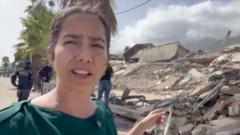
Mainstream media outlets love a predictable script. When two massive earthquakes ripped through Venezuela, the cameras rushed straight to La Guaira. Journalists stood before mountains of crushed aggregate, capturing raw, heart-wrenching footage of volunteers tearing through rubble. The reporting treats the flattening of hundreds of buildings as an unavoidable act of god, a cruel twist of geological fate.
That narrative is completely wrong. It actively covers up the real culprit.
The tragedy unfolding along the Venezuelan coast is not a natural disaster story. It is a structural engineering crime scene. When a 7.5 magnitude earthquake strikes a coastline, a well-engineered city sustains cracks, broken glass, and utility disruptions. It does not drop twenty-story apartment complexes directly into their own footprints like a controlled demolition.
I have spent twenty-five years auditing structural integrity in seismic zones across Latin America. I have stood in the ruins of collapsed infrastructure from Port-au-Prince to Concepción. The immediate response from international observers is always the same mix of shock and superficial pity. Media organizations treat every disaster as an isolated, unpredictable phenomenon.
They consistently ignore the math behind the collapse.
The Myth of the Unsurvivable Twin Quake
The lazy consensus dominating the news cycle claims that back-to-back quakes measuring 7.2 and 7.5 magnitude are fundamentally unsurvivable for coastal cities. This is a comforting lie for negligent regulators and corrupt contractors.
Seismic engineering figured out how to keep buildings upright during multi-shock events decades ago. Consider Tokyo or Santiago. These cities regularly absorb massive, sequential shocks without experiencing systemic structural failure. They survive because their engineering philosophies account for real-world physics, not just idealized, single-strike models.
To understand why La Guaira crumbled while other seismic-zone cities stand, you have to look at the mechanics of structural resonance and material degradation.
A building is an inverted pendulum. When the ground moves, the structure whips back and forth. If the building is flexible and properly dampened, it absorbs and dissipates that kinetic energy. If it is rigid, brittle, and structurally compromised from the day it was poured, the energy travels straight up the columns until the weakest point shears.
The second quake did not destroy La Guaira because it was too powerful. It destroyed La Guaira because the first shock exposed the complete lack of structural redundancy in the local building stock.
Imagine a scenario where a building's primary support columns lose their shear capacity within the first ten seconds of ground motion due to a total lack of internal steel reinforcement. The building does not fall immediately; it hangs by a thread, its internal geometry warped. When the second shock waves hit forty seconds later, the building has no structural reserve left.
This is not a failure of nature. It is a failure of execution.
The Corrupt Chemistry of Coastal Collapse
The media focuses on the drama of the rescue operations because evaluating concrete chemistry does not make for viral television. But the real answers lie in the material science.
In coastal environments like La Guaira, infrastructure faces a dual threat: high seismic activity and airborne chlorides from the ocean. This requires specific, non-negotiable engineering protocols.
- Carbonation and Chloride Penetration: Salt air penetrates porous concrete over time, reaching the internal steel rebar. Once the steel corrodes, it expands, causing the surrounding concrete to crack and flake away. This process destroys the bond between steel and concrete.
- The Aggregate Scam: Legitimate developers use washed, graded river sand for concrete mixing. Corrupt operations harvest cheap beach sand, which is loaded with salt and organic impurities. This guarantees internal structural rot before the concrete even cures.
- Inadequate Rebar Specifying: Seismic zones require high-ductility steel rebar with precise spacing of structural ties. When contractors skimp on steel to line their pockets, the concrete lacks the tensile strength to survive lateral shaking.
When you see a building pancake, you are looking at the direct result of these three factors. The concrete simply turns back into dust because it lacked the internal binding matrix to hold itself together under stress.
During my field investigations across vulnerable coastlines, I have repeatedly tested concrete core samples that failed to reach even half of their specified compressive strength. Contractors frequently dilute the mix with excess water to make it easier to pour quickly, saving on labor costs while permanently destroying the material's load-bearing capacity.
The buildings in La Guaira did not just fall down. They disintegrated from the inside out.
Dismantling the Prejudiced Poverty Alibi
Whenever an industrial observer points out these structural failures, a predictable counterargument emerges: Venezuela is facing severe economic hardship, so what do you expect? Critics claim it is unfair to hold a struggling economy to the same infrastructure standards as wealthy nations.
This argument is incredibly patronizing. It is also factually bankrupt.
Building safely is not a luxury reserved for billionaires. Simple, low-cost engineering adjustments save lives, regardless of a nation's GDP. Proper rebar detailing, strict enforcement of stirrup spacing in concrete columns, and basic quality control during mixing do not require multi-billion-dollar investments. They require basic professional competence and honest regulatory oversight.
The economic crisis did not prevent engineers from designing safe structures. The crisis created a lawless environment where political connection replaced technical compliance.
When international aid agencies flood into a disaster zone, they focus entirely on tents, blankets, and temporary medical clinics. They treat the symptoms of the collapse while ignoring the systemic corruption that guaranteed the building would fall in the first place. This approach ensures that when the region is rebuilt, it will be constructed using the exact same flawed methods, setting the stage for the next disaster.
The Flawed Premise of International Aid Responses
Look at the current international response to the Venezuelan crisis. Teams from Switzerland, Mexico, and various United Nations bodies are arriving to assist with search and rescue operations. This is necessary humanitarian work, but the political theater surrounding it avoids the critical questions.
The global community treats these events as tragic anomalies. They treat every flattened apartment block as an unpredictable casualty of geography.
This passive framing removes accountability. It allows local authorities to blame the earth's crust instead of explaining why municipal building inspectors signed off on high-rise residential structures that lacked fundamental seismic resistance.
If a commercial airliner crashes, international investigators do not just mourn the victims and blame gravity. They dissect the wreckage, review maintenance logs, and ground entire fleets to identify the mechanical or structural failure. Yet, when hundreds of buildings collapse and kill nearly a thousand people, the world accepts the explanation that the ground shook too hard.
We need to stop asking how we can better fund disaster relief and start asking why we are still allowing inhabited structures to function as death traps.
The Uncomfortable Blueprint for Real Resilience
Fixing this problem requires abandoning the emotional rhetoric of mainstream news reports and implementing cold, hard engineering accountability.
If a government wants to protect its citizens from seismic events, it must remove the human element from the inspection process. Human inspectors can be bribed, intimidated, or ignored.
The solution lies in structural health monitoring and independent material testing. Every major structural pour must be subjected to independent third-party laboratory verification, with the data recorded transparently. Buildings that fail to meet strict seismic ductility thresholds must be condemned and demolished before they can be occupied.
This approach is highly unpopular. It slows down development, cuts into the profit margins of powerful real estate interests, and exposes regulatory corruption. It forces cities to confront the terrifying reality that thousands of existing structures are unsafe for human habitation.
But the alternative is what we are seeing in La Guaira right now.
Until we stop treating structural failure as a natural inevitability, every earthquake report will remain a repetitive exercise in performative grief. The earth will move again. That is a geological certainty. Whether our cities stand or crumble depends entirely on our willingness to stop blaming nature for human negligence.