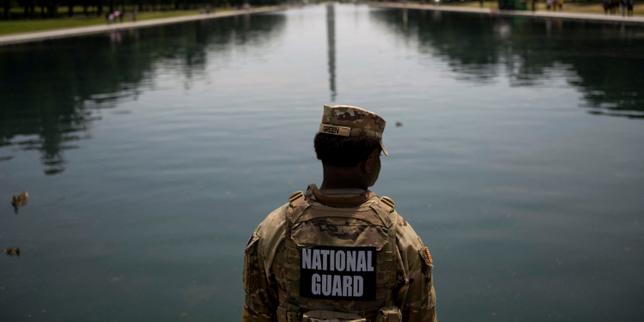
The marble underfoot at the Lincoln Memorial usually feels cool, even in the thick of a Washington summer. Millions of pairs of shoes have worn those steps smooth, each visitor shuffling upward to stand in the shadow of a nineteen-foot-tall Abraham Lincoln. They look at his face, carved with the exhaustion of a fractured nation, and they usually speak in whispers.
But a few years ago, the silence around these monuments shattered. The air grew thick with a different kind of tension, one fueled by spray paint, anger, and the sudden, heavy thud of a presidential pen.
When Donald Trump took to social media to announce that anyone defacing a monument in the nation’s capital would face an immediate, non-negotiable ten years in prison, it felt to many like a sudden lightning strike. He wasn't just issuing a warning; he was drawing a line in the granite. To understand how a country goes from debating historical context to threatening a decade behind bars for touching a statue, you have to look past the political grandstanding. You have to look at the stone itself, and the human hands that carved it.
The Night the Marble Felt the Heat
Consider a hypothetical young man named Marcus. He isn't a hardened criminal; he is twenty-one, angry, and swept up in the kinetic energy of a midnight protest. The air smells of smoke and adrenaline. In his backpack, a can of aerosol paint rattles. To Marcus, the monument in front of him isn't a sacred shrine to history—it is a symbol of a system he feels has failed him. He presses the nozzle. A hiss of black paint blooms across the white stone.
In that single, five-second action, Marcus is thinking about the present. He is thinking about his anger. What he isn't thinking about is the year 2030. He isn't thinking about spending his twenties in a federal penitentiary, watching his youth evaporate behind a steel door because of a chemical stain on a piece of rock.
That is the stark reality Trump invoked when he dusted off the Veterans’ Memorial Preservation Act. The law wasn't new, but the fierce, unyielding enforcement of it was. A decade in prison. That is the same amount of time handed down for federal bank robbery or major drug trafficking.
The announcement sent a shockwave through the legal world and the streets alike. It forced a raw, uncomfortable question into the public consciousness: What is the exact exchange rate between human liberty and historical stone?
The Anatomy of an Executive Order
The official narrative from the White House was rooted in an appeal to law and order. The argument was straightforward: if you do not protect the symbols of a nation's history, you lose the nation itself. The Lincoln Memorial, the statue of Andrew Jackson in Lafayette Square, the World War II Memorial—these are not just tourist stops. They are the physical anchors of the American story.
But the enforcement mechanism chosen was brutal in its simplicity. By bypassing the usual judicial nuance and demanding the absolute maximum penalty under the law, the administration sought to use terror as a deterrent.
Imagine the judicial system as a scale. On one side sits the damage done—perhaps five hundred dollars worth of pressure washing to remove graffiti from a plinth. On the other side, under this directive, the system places ten years of a human life. The balance broke. Defense attorneys argued that the punishment was wildly disproportionate, a political weapon deployed to silence dissent rather than a measured response to property damage.
Yet, for a large segment of the population, the move brought a sense of relief. They watched news broadcasts showing statues being pulled from their pedestals across the country with a growing sense of vertigo. To them, the lawlessness felt contagious. The ten-year threat was a firewall. It was a statement that some things remained sacred, untouchable, and permanent.
The Invisible Stakes of Shared Space
Monuments are strange objects. They are dead weight—literally thousands of tons of rock and bronze—yet they hold an immense amount of emotional electricity. They are where we go to celebrate, where we go to mourn, and where we go to fight.
When Martin Luther King Jr. stood on the steps of that very same Lincoln Memorial in 1963, he chose the backdrop deliberately. He was leveraging the moral weight of the Great Emancipator to frame his own dream for America. The stone gave his words a foundation. If you deface the stone, you alter the stage for every voice that comes after you.
That is the invisible stake in this battle. It isn't just about clean marble; it is about the preservation of a shared civic sanctuary. When a monument is damaged, it doesn't just cost taxpayers money for restoration. It chips away at the fragile, unwritten agreement that we can all inhabit the same public square without destroying it.
The tragedy of the maximum-penalty approach is that it treats the symptom while ignoring the rot underneath. Paint can be scrubbed away with baking soda and hot water. A fractured society, where citizens feel so alienated from their own history that they want to tear it down, requires a much deeper, more painful kind of restoration.
The Echoes in the Granite
Wandering through the monuments of Washington late at night, when the crowds have thinned and the spotlights cast long, dramatic shadows, the weight of the law feels palpable. The park rangers stand watch. The security cameras blink their tiny red eyes. The threat of those ten long years hangs in the humid air like a low fog.
We live in a culture that moves at lightning speed, where tweets disappear in seconds and news cycles refresh by the hour. Perhaps that is why we fight so fiercely over these statues. They are the only things that stay still. They are our attempts at permanence.
The pen has dried, the administrations have shifted, but the precedent remains etched into the legal landscape. The next time a crowd gathers in the shadow of Abraham Lincoln, they will do so knowing the immense gravity of the ground they stand on. The stone sentinels will continue to look out over the Reflecting Pool, silent, enduring, and incredibly expensive to touch.

/https://tf-cmsv2-smithsonianmag-media.s3.amazonaws.com/filer/c6/97/c697b065-e0bd-4970-81ea-819779296b91/u765404inp.jpg)
