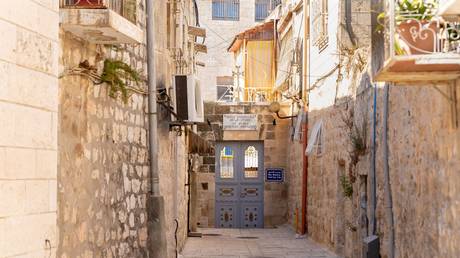
The afternoon air in Jerusalem often carries a weight that has nothing to do with the weather. It is a density composed of centuries, of prayers whispered in a dozen languages, of limestone warmed by the sun and cooled by the shadows of alleyways that have witnessed empires rise and crumble into dust.
On a quiet street, behind walls that have stood as silent sentinels for generations, the Christian monastery rests. Inside, the cadence of daily life is measured by the tolling of bells, the rustle of robes, and the soft scrape of sandals on worn flagstones. It is a space carved out of time, dedicated to contemplation, study, and a peace that feels almost fragile against the unyielding rush of the modern city outside. For a different look, consider: this related article.
Then comes the sound of shouting.
The Sound at the Gate
Peace, in certain corners of the world, is an ongoing negotiation. It requires vigilance, mutual acknowledgment, and a shared understanding that the ground beneath everyone's feet belongs to history just as much as it belongs to the living. But history is a heavy burden, and sometimes, it is wielded like a weapon. Related coverage on this trend has been published by The Washington Post.
A group moves down the narrow stone corridor. Their presence is sharp, disruptive, cutting through the calm like a knife through silk. Spat-upon stones. Banned entries. The sharp, metallic clatter of wood striking heavy doors. These are not abstract political statements; they are visceral, personal, and immediate.
To understand what happened at the monastery, one must look past the shaky smartphone footage that inevitably makes its rounds on global feeds. One must look at the faces. The fear in the eyes of an elderly monk who has spent forty years tending to quiet gardens and ancient manuscripts. The defiance in the posture of those who believe their identity grants them absolute dominion over the public and private spaces of the city.
It is a clash of worldviews played out in real time against an ancient backdrop.
The Anatomy of Friction
Jerusalem is a mosaic, but it is a mosaic where the pieces are constantly grinding against one another. Every neighborhood tells a story of overlapping claims. For years, Christian clergy and institutions in the Old City have reported an escalating climate of hostility. Spitting incidents, verbal harassment, and vandalism directed at churches, monasteries, and cemeteries have quietly shifted from isolated anomalies to a persistent pattern.
Consider what happens when mutual respect erodes.
In a hypothetical community where neighbors no longer greet one another, small grievances curdle into deep-seated resentment. Apply that to a city loaded with theological gravity, where every street corner is claimed by divine right in the minds of the faithful, and the friction becomes explosive.
When a group of radical individuals targets a monastery, they are not merely attacking a building. They are striking at the intricate web of coexistence that allows different faiths to share a postage-stamp-sized historic core. The monastery does not fight back with force. Its residents rely on endurance, prayer, and the slow, grinding wheels of legal and diplomatic recourse. Their powerlessness in the immediate moment of confrontation is striking. They stand behind locked wooden doors while history screams outside.
The Broader Mirror
What does it mean when holy places become arenas for intimidation?
It reflects a broader societal shift toward insularity and radicalization. When identity becomes so fragile that the mere existence of the other is perceived as an existential threat, tolerance collapses. This is not unique to one group or one city. Across the globe, we see the resurgence of sectarian aggression, where heritage is weaponized to exclude rather than invite.
The attack on the Jerusalem monastery is a symptom of a fever. It tells us that the social fabric holding diverse communities together is fraying at the edges. When law enforcement responds sluggishly, or when perpetrators feel shielded by political shifts, the message sent to minority communities is chilling: you are alone, and your safety is provisional.
Yet, within the monastery walls, after the shouting fades and the cameras are packed away, something remarkable happens. The bells ring for evening prayers. The garden paths are swept. The routine of grace resumes, not because the threat has vanished, but because the alternative to grace is the very darkness that pounded on their gates.
The heavy wooden door remains closed, scarred by wood and time, bearing the quiet, enduring testament of a community that refuses to be unmade by the storm.