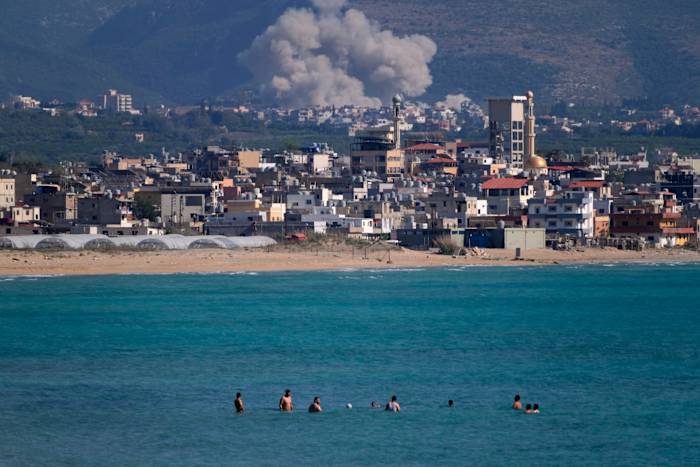
The sea is the only thing that does not hold its breath. It laps against the ancient stone walls of Tyre, indifferent to the panic rising with the midday heat. On normal days, the air here smells of salt, roasted coffee, and centuries of dust. Today, it smells like fear.
A smartphone screen glows in the shaded courtyard of a centuries-old church. The text on the screen is stark, a digital decree delivered via social media channel: an evacuation warning. For the people living in this UNESCO World Heritage city, the message turns the solid earth beneath their feet into a countdown timer. Meanwhile, you can explore related developments here: The Invisible Web Tying Mumbai and Beijing to the Front Lines of Ukraine.
To understand Tyre, you have to understand that history is not something found in textbooks here; it is something you trip over on your way to the market. Phoenician ruins sit side by side with modern apartment blocks. For generations, this has been a sanctuary where Christian and Muslim communities shared the same narrow alleys, fished the same waters, and listened to the overlap of church bells and the evening call to prayer.
But when the warnings come, history offers little shelter. To explore the complete picture, we recommend the excellent analysis by TIME.
The Weight of the Keys
Consider an old man named Michael. He is hypothetical, but his reality belongs to dozens of men currently standing in the arcades of Tyre’s Christian quarter. He holds a ring of iron keys in his palm. They are heavy, cold, and entirely useless against modern artillery.
His family has looked after the church property for longer than the modern state of Lebanon has existed. If he leaves, who locks the doors? If he stays, does the roof become his tomb?
This is the invisible calculus of displacement. It is not just about moving bodies from point A to point B. It is the sudden, violent severing of a person from their context. When international headlines report on evacuation orders, they map the movement of populations in broad, sweeping arrows. They rarely capture the stillness of a man staring at a wooden door, wondering if closing it today means never opening it again.
The local Christian leadership did not issue a call for weapons or retaliation. Their response was a plea directed outward, toward a global community that often feels impossibly distant. They called for immediate international intervention. They asked for protection not just for the people, but for the stones, the heritage, and the fragile pluralism that Tyre represents.
It is a desperate gamble. In the current geopolitical climate, a plea for international law can feel like whispering into a hurricane. Yet, when the skies threaten fire, words are the only shield left.
The Architecture of Shared Lives
The panic in the city spreads faster than any physical threat. Roads leading north toward Beirut choke with vehicles packed too tightly with mattresses, suitcases, and crying children. Fuel is scarce. Certainty is non-existent.
But the real problem lies elsewhere, far beneath the immediate chaos of the traffic jams. The true danger is the erosion of the social fabric that took centuries to weave.
Tyre has long been an anomaly, a place where coexistence survived even when the rest of the country fractured along sectarian lines. In the Christian quarters, neighbors know the rhythms of the Muslim fasting months; during Christian feasts, sweets are shared across courtyard walls. This is not the sanitized coexistence of peace conferences. It is the messy, daily, practical reality of people who need each other to survive the harsh economic winters of Lebanon.
When a city is emptied under the threat of bombardment, that architecture of shared life collapses. Fear breeds suspicion. Separation hardens into permanent division. The leaders who gathered to demand international action understand that if the people of Tyre leave and never return, Lebanon loses more than a city. It loses a piece of its soul.
Consider what happens next when a community is scattered. Families find themselves in crowded schools turned into makeshift shelters in Sidon or Beirut. They become statistics, numbers on a UN spreadsheet receiving food parcels. The dignity of the fisherman, the quiet pride of the shopkeeper, the authority of the parish priest—all of it is stripped away, replaced by the single, exhausting identity of the displaced person.
The Silence from the Sea
There is a particular vulnerability in asking for help when you suspect no one is listening. The appeals from the religious leaders in Tyre were marked by a striking lack of political rhetoric. They spoke of heritage, of human rights, of the sanctity of civilian life.
It is easy to be cynical about these statements. We have seen the patterns repeat across the region for decades. Warnings are issued, cities empty, ruins are created, and statements of deep concern are drafted in comfortable offices in Geneva or New York. The gap between the language of international law and the reality of a family loading a car in Tyre is vast and terrifying.
The subject is scary because it exposes the limits of our collective global conscience. We like to believe there are rules. We want to trust that ancient cities, protected by international treaties, possess a kind of immunity. But the concrete dust of recent history suggests otherwise.
A young woman sits on the steps of the Melkite Greek Catholic cathedral, watching the sky. She doesn't want to leave her grandmother, who refuses to move, claiming her legs are too old for Beirut’s hills. The girl watches the sea instead. The Mediterranean is beautiful today, a brilliant, mocking blue that contrasts sharply with the gray anxiety gripping the streets behind her.
The international community is a collection of abstractions—governments, committees, resolutions. But the target of the warning is entirely concrete. It is the baker who didn't light his ovens today. It is the priest who carefully wrapped the silver chalices in burlap and hid them in the crypt. It is the collective memory of a city that survived the Babylonians, the Greeks, and the Romans, now trembling at a notification on a screen.
The bells of Tyre do not ring for mass today. They remain hanging in their stone towers, silent, heavy, and waiting to see if anyone, anywhere, will answer their call.



:max_bytes(150000):strip_icc():focal(665x0:667x2)/gettyimages-50733149-2000-8b129a2475974982a915418ce92a73d8.jpg)