Silence.
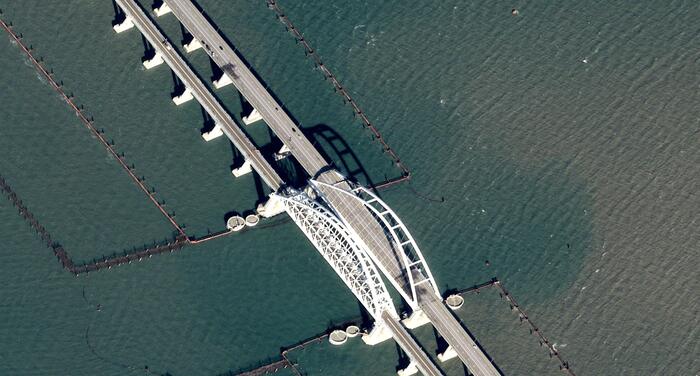
That is the first thing you notice when a nineteen-kilometer monument of concrete and steel stops breathing, because a bridge of that scale is never supposed to be quiet. For years, the Kerch Strait Bridge—the massive dual-span crossing stitching mainland Russia to the occupied Crimean peninsula—hummed with a constant, low-frequency vibration that you could feel in the soles of your boots before you ever heard the engines. Diesel locomotives hauled flatbeds groaning under the weight of T-72 tanks, artillery shells, and aviation fuel, while thousands of sedans crept bumper-to-bumper toward Black Sea resorts, their drivers pretending that the water beneath their tires was just another stretch of highway.
Then came the third strike in four days.
When Ukrainian forces hit the crossing again, halting rail traffic across the span, the headline read like another line item in a grinding war of attrition. Dry. Clinical. Easy to scroll past while waiting for your morning coffee to brew.
But numbers on a news ticker rarely capture the taste of diesel smoke hanging stagnant over salt water, or the sudden, suffocating panic of an entire military apparatus realizing its main windpipe has just been pinched shut. To understand what happens when rail traffic stops on the Kerch Bridge, you have to step away from the satellite maps and stand on the tarmac at Taman, on the Russian side of the strait, watching the brake lights flare red into the fog.
The Weight of Nineteen Kilometers
Consider a hypothetical Russian logistics officer—let us call him Major Aleksei—stationed near the Taman railhead. His job is not glamorous. He does not fire missiles or storm trenches; he stares at clipboards, manifests, and railway timetables. Before the strikes began, Aleksei’s world ran on predictable math. A single freight train rolling across the Kerch Bridge can carry roughly three thousand tons of cargo. To move that same amount of ammunition, diesel, and rations by road requires more than a hundred heavy trucks, each burning fuel, requiring a driver, and vulnerable to mechanical breakdown.
Over four days, three separate Ukrainian strikes hammered the crossing and its approaches, culminating in a blow that forced Russian authorities to suspend rail operations altogether.
For Aleksei, the world shrinks overnight. Imagine being told that the main highway feeding a city of two million people—and an army of hundreds of thousands fighting in southern Ukraine—has suddenly narrowed to a single, cracked country lane. Every shell meant for the front lines in Zaporizhzhia or Kherson, every pallet of medical supplies, every barrel of fuel needed to keep armored brigades moving now backs up at the station. The steel tracks gleaming in the coastal mist lead nowhere.
I have spent years covering infrastructure failures in conflict zones, and there is a specific, unmistakable smell when supply chains seize up. It is the odor of overheating idling engines, sour sweat, and wet cardboard boxes sitting too long on open loading docks. People outside military circles often fixate on dramatic explosions—the fireball, the collapsed span, the plumes of black smoke billowing against a blue sky. Those images make the evening news. Yet military historians will tell you that wars are rarely won by the explosion itself; they are won by the quiet, maddening paralysis that follows three days later when a battalion runs out of 152-millimeter shells because a rail switch thirty miles behind the lines is twisted beyond repair.
A Symbol Built to Deny Geography
To grasp why three strikes in four days carry such psychological voltage, you have to remember what this bridge meant when it opened in 2018. Built at a staggering cost of nearly four billion dollars after Russia’s 2014 annexation of Crimea, the Kerch Bridge was never merely an engineering project. It was an ideological declaration poured in reinforced concrete.
For centuries, geography separated Crimea from the Russian mainland. The peninsula hung from southern Ukraine like a pendant on a slender thread of land at Perekop, cut off from the east by the turbulent waters where the Sea of Azov meets the Black Sea. Building Europe’s longest bridge across that shifting, muddy seabed was Moscow’s way of physically rewriting the map—a permanent iron staple binding occupied territory to the Kremlin. When Vladimir Putin drove an orange Kamaz dump truck across the newly paved asphalt at the opening ceremony, the message to the world was unmistakable: This is irreversible.
For years, that illusion held. Tourists from Moscow and St. Petersburg packed their trunks with beach umbrellas and drove across the strait, snapping selfies against the white arches while warships patrolled the horizon below. Even after the war escalated in 2022, and even after the dramatic truck-bombing of October 2022 and the sea-drone attack of July 2023 scarred the structure, Moscow poured endless resources into repairing the spans, erecting anti-drone nets, submerging barges as barriers, and ring-fencing the strait with S-400 air defense batteries.
That is what makes this four-day sequence so unsettling for the Kremlin. One strike can be dismissed as a fluke, a lucky slip through an otherwise impenetrable shield. Two strikes suggest a vulnerability. Three strikes in ninety-six hours reveal a systematic dismantling.
Think of the bridge not as a road, but as the aorta of an entire military theater. You can patch a nick in an artery once. You can clamp it twice while the patient lies on the operating table. When the surgeon sees a third rupture appear before the stitches on the first have even set, the calculus changes from repair to survival.
The Invisible Ripple Across the Peninsula
What happens next on the ground in Crimea is where the human cost and strategic reality collide.
Take a hypothetical family living in Simferopol—let us call them Elena and her twelve-year-old son, Timur. For Elena, geopolitics is not an abstract chessboard; it is the price of milk at the corner shop and the anxious hum of her phone at two in the morning when air-raid sirens wail over Sevastopol. When rail traffic halts on the Kerch Bridge, the military gets absolute priority over whatever transport capacity remains.
Civilian freight moves to the back of the line. Ferry crossings across the strait—already choked by autumn storms and long queues—become bottlenecks where truckers sleep in their cabs for days waiting for a slot on a barge. Fuel stations across the peninsula begin quietly rationing high-octane petrol. Supermarket shelves do not empty all at once, because panic rarely looks like a Hollywood disaster movie; instead, deliveries arrive two days late, prices tick upward by fifteen percent, and residents begin hoarding bags of buckwheat, sugar, and bottled water in their hallways just in case the pause stretches from days into weeks.
Meanwhile, the Russian military faces an agonizing choice with no clean answer.
Without the Kerch rail line, Moscow must rely far more heavily on the so-called "land bridge"—the coastal highway and rail corridor running through occupied Mariupol, Berdiansk, and Melitopol along the northern shore of the Sea of Azov. On paper, that route connects Russia to Crimea. In reality, it runs directly within range of Ukrainian artillery, HIMARS rockets, and long-range strike drones.
Every ammunition train diverted from the Kerch Bridge onto the coastal railway becomes a moving target creeping through hostile territory. It is the logistical equivalent of forcing a convoy out of an armored tunnel and onto an open ridge during a thunderstorm. You can still move supplies, yes. You can still keep the front lines fed. But you pay a tax in time, fuel, equipment, and human lives for every single kilometer traveled.
Why Persistence Beats the Single Knock-Out Blow
Readers often ask me why Ukraine doesn't simply drop the entire bridge into the sea with one massive strike. It is a fair question, and the honest answer requires admitting the brutal limits of modern engineering and warfare.
Bridges are notoriously stubborn structures. Unlike an oil refinery, which is essentially a maze of pressurized pipes filled with flammable liquid waiting for a spark, a modern concrete-and-steel bridge is built to distribute immense downward weight across dozens of independent piers driven deep into the bedrock. Dropping a single span requires delivering thousands of kilograms of high explosives directly onto load-bearing pilings—pilings protected by layers of electronic warfare jammers, radar decoys, surface-to-air missiles, and physical sea barriers.
So if you cannot erase the bridge in a single night, you do something smarter. You attack its rhythm.
By striking three times in four days, Ukrainian planners turned Russia’s greatest defensive asset—its obsession with protecting the bridge—into an exhausting drain. Every time an alarm sounds over the Kerch Strait, traffic stops. Smoke generators belch thick white clouds to blind incoming sensors. Air defense crews fire interceptors costing millions of dollars apiece into the dark sky. Repair teams have to inspect every rail joint, every concrete girder, every electrical line before a three-thousand-ton locomotive can safely roll forward again, because sending a heavy freight train over a heat-warped rail is an invitation to a catastrophic derailment over open water.
Even when the steel does not collapse into the waves, the threat that it might collapse accomplishes half the mission. Reliability is the soul of rail transport. A railway that works fifty percent of the time is not half as useful as one that works all the time—it is a logistical nightmare that throws every schedule across a thousand-mile front into chaos.
The Slow Erosion of Certainty
There is a deeper truth hanging over the dark waters of the Kerch Strait, one that goes beyond tonnage tables and repair timelines.
For more than a decade, the Kremlin’s grip on Crimea relied on a carefully cultivated aura of permanence. Bridges, after all, are supposed to outlive the politicians who build them. They are meant to feel as natural and immovable as the cliffs they connect. When ordinary people drive across a bridge, they trust that the ground beneath their wheels will hold, that the state guarding the approaches is in total control, and that tomorrow will look much like yesterday.
Three strikes in four days shatter that spell.
Somewhere along the darkened embankment near Kerch tonight, welders are likely huddled behind blue canvas screens, their arc torches throwing sharp, violent sparks against the blackened steel tracks while cold sea spray stings their faces. Above them, searchlights sweep the low clouds, hunting for the faint buzz of an approaching drone or the streak of a incoming missile. They will patch the rails. They will test the ties. Eventually, a lone locomotive will creep cautiously out onto the span, its wheels clicking slowly over the fresh welds as engineers hold their breath on the shore.
And every person watching that train inch forward across the water will know the exact same thing: it is no longer a monument to permanence, just a fragile thread stretched tight over deep water, waiting for the next dark night.


