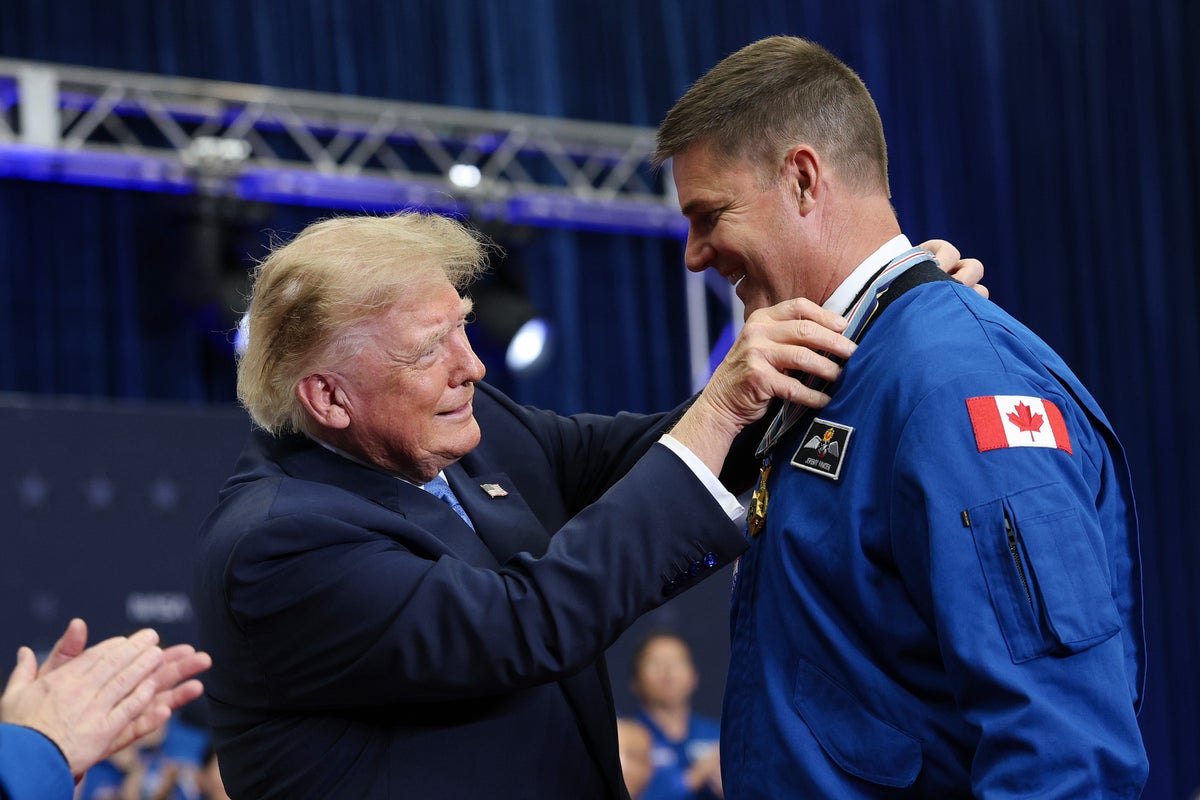
High-stakes public appearances operate on strict operational tolerances. When an executive or head of state introduces structural schedule variance into an event timeline, the downstream friction affects every stakeholder from operational security teams to specialized honorees. The mechanics of public scheduling require tight coordination between ceremonial objectives and logistical realities. Analyzing an event where a principal arrives nearly thirty minutes behind schedule and abruptly introduces an impromptu infrastructure initiative before honoring elite aerospace professionals reveals systemic vulnerabilities in public relations strategy.
Public visibility events function as optimized campaigns designed to project competence, strategic momentum, and institutional priorities. Introducing unscripted capital projects during a ceremony dedicated to human spaceflight alters the signaling hierarchy. The core subjects of the event, in this case astronauts preparing for deep space missions, are structurally displaced by ad-hoc policy declarations. This dynamic exposes a tension between disciplined statecraft and impulsive administrative signaling.
The Mechanics of Protocol Disruption
Protocol management relies on predictable inputs and invariant timing. When a principal disrupts the baseline schedule, the resulting compression forces downstream entities to truncate their operational windows. Ceremonial recognition requires deliberate pacing to validate achievement. Compressing these moments to compensate for an unannounced infrastructure diversion diminishes the symbolic value of the award.
Event logistics depend on three primary operational vectors.
- Temporal sequencing governs the precise allocation of minutes to arrival, remarks, recognition, and departure.
- Spatial staging dictates the physical placement of principals, media, and honorees to maximize visual and narrative impact.
- Narrative alignment ensures that secondary announcements do not cannibalize the primary thematic objective of the engagement.
When temporal sequencing fails due to late arrival, spatial staging adjustments become reactive rather than proactive. Media crews must reposition hastily, security perimeters face extended holding patterns, and the honorees experience extended exposure under high-visibility conditions. The introduction of a secondary capital construction project compounds this disruption by shifting the cognitive load of the audience away from aerospace achievement toward fiscal and logistical commitments.
Signaling Priorities in Public Infrastructure Policy
Announcing construction projects during ceremonial events serves a distinct rhetorical function, but it creates strategic dissonance. Aerospace milestones represent long-term technological horizons, international cooperation, and highly specialized engineering rigor. Conversely, ground-level infrastructure projects typically address localized economic activity, regional employment, or short-term tangible development.
Placing these two disparate priorities into a single operational window creates mixed messaging. Observers and market analysts parse such addresses for shifts in administrative focus. If space exploration policy is abruptly juxtaposed with domestic building initiatives, the underlying signal implies a dilution of focus rather than an amplification of capability.
- Strategic Coherence: The primary subject must retain dominant mindshare to validate the capital and political investment in the event.
- Audience Segmentation: Space professionals and construction stakeholders operate within different economic ecosystems; combining them dilutes targeted engagement.
- Resource Allocation Perception: Announcing unvetted capital projects casually from a podium signals an ad-hoc approach to public budgeting rather than systematic planning.
The Cost Function of Schedule Variance
In high-visibility engagements, time functions as a scarce, non-renewable resource. Every minute of administrative variance introduces compounding costs across multiple operational layers.
Security overhead scales non-linearly with duration. Protection details must maintain elevated threat postures for longer periods, increasing cognitive fatigue and logistical strain. For international or high-profile delegations, extended holding times disrupt complex motorcade and air-transit synchronization matrices.
Media transmission windows operate on strict syndication schedules. Broadcasters allocate specific broadcast blocks for live feeds. A thirty-minute delay risks missing primary news cycles, forcing the event out of prime-time slots and into secondary reporting loops. This reduces the return on investment for the organizing body, transforming a major communicative initiative into a logistical liability.
Honorees bear the highest human cost of schedule variance. Highly trained technical specialists, such as Artemis astronauts, operate under rigid physiological and psychological conditioning regimens. Subjecting them to unpredictable holding patterns and compressed recognition ceremonies undermines the dignity of their achievements. The operational framework must protect the principal focus from external administrative interference.
Systemic Remedies for Event Execution
To eliminate schedule slippage and messaging dilution, organizing bodies must enforce strict protocol governance.
- Implement mandatory freeze windows on speech content twenty-four hours prior to execution to prevent impromptu policy additions.
- Establish hard-stop protocols where late arrivals by principals result in the automatic truncation of secondary remarks rather than the compression of core ceremonial honors.
- Decouple unrelated announcements into separate press briefings to maintain narrative purity and audience retention.
Institutional credibility depends on execution precision. When ceremonial events devolve into unstructured platforms for ad-hoc initiatives, the long-term equity of the institution declines. Restoring rigorous protocol standards ensures that public appearances achieve their intended strategic objectives without inflicting operational friction on honorees or logistical teams.
Establish a zero-tolerance baseline for unvetted policy insertions during fixed-duration state ceremonies, requiring all secondary capital announcements to route through formal, dedicated economic briefings rather than live public engagements.