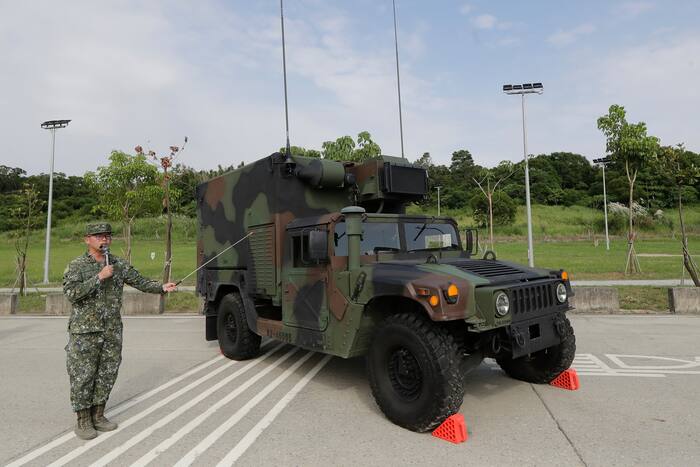
Foreign policy speeches in Washington love to emphasize that America's commitment to Taiwan remains rock-solid. Yet, behind closed doors, a massive fourteen-billion-dollar military package is caught in bureaucratic purgatory, waiting for a green light that keeps getting pushed back.
Official statements insist that policy hasn't budged an inch. Officials claim the alliance is as functional as ever. But if you look at the hardware—the Patriot missile interceptors, the advanced air defense batteries, and the integrated command networks that form the backbone of Taiwan's defensive "T-Dome"—they aren't on the island. They are sitting in limbo. Meanwhile, you can find related developments here: Why the Eiffel Tower Chief Had to Step Down After the Hindu Delegation Visit.
Understanding why this freeze is happening requires looking past sanitized diplomatic press releases and examining how high-stakes geopolitical bargaining actually works right now.
The Cost of Quiet Foot-Dragging
When major military packages stall without a formal rejection, it sends a dangerous signal to Beijing. China watches these delays closely and learns a predictable lesson: pressure works. To understand the complete picture, check out the excellent article by Associated Press.
Every time a summit happens between top global leaders and the weapons pipeline slows down, Beijing views the hesitation as a tactical victory. The delay functions as a gray-zone tactic. It requires no formal concession from China, yet it effectively pauses Taiwan's military modernization.
Military analysts in Taipei point out that defense procurement doesn't work like ordering items from an online retailer. Production lines take years to turn raw materials into operational interceptors. Training crews to run complex systems like National Advanced Surface-to-Air Missile Systems takes months of grueling preparation. Stalling the paperwork today means leaving a gaping hole in air defense years down the line.
Inside the Fourteen Billion Dollar Holdup
The massive package informal-cleared by Congress carries critical defensive capabilities. We are talking about hundreds of PAC-3 Missile Segment Enhancement interceptors, multiple battery units, and command architecture designed to link disparate radar systems together.
Taiwan needs these assets to shift toward asymmetric defense strategies. The island's legislature scraped together billions in defense spending, even amidst fierce domestic political fighting between opposing parties over budget allocations. When funding is approved locally but the hardware fails to clear Washington, domestic critics in Taiwan gain immediate ammunition. They argue that relying on the United States is a losing bet because shipments can be switched off or frozen at a moment's notice.
Washington defends the slowdown by pointing to constrained defense manufacturing capacity and competing global demands. Production lines for high-end interceptors are stretched thin, supplying both European partners and Middle Eastern operations. Lockheed Martin and other defense contractors are working to ramp up annual output, but factory floors can only move so fast.
Even so, weapon availability is only part of the puzzle. The political hesitation stems directly from high-level diplomatic balancing acts, where trade truces and presidential summits often take priority over long-term strategic consistency.
Why Splitting the Package Might Be the Only Way Out
Rumors are swirling among defense analysts that the massive fourteen-billion-dollar block might eventually get broken up into smaller, manageable chunks.
Splitting the sale allows the administration to approve items piecemeal, easing pressure from congressional hawks while avoiding a massive, headline-grabbing transfer that might trigger retaliation from Beijing. Taiwanese officials have made it clear they care less about the packaging method and more about the delivery timeline. Whether it arrives in one giant fleet or a slow drip of smaller shipments, the hardware is urgently needed.
Regional allies like Japan and South Korea are watching these developments with intense anxiety. Their own security calculations depend entirely on whether Washington honors its long-term defensive pledges in the Indo-Pacific. Beyond regional security, the global economy hangs in the balance. Taiwan produces the vast majority of the world's most advanced semiconductor chips. If global supply chains realize that security guarantees are negotiable assets, the economic shockwaves will dwarf any trade dispute.
The United States cannot afford to treat defensive deterrence as a flexible bargaining chip without inviting broader conflict. Approving the stalled packages and shortening review windows must become an urgent priority if Washington wants to prove its word still means something.