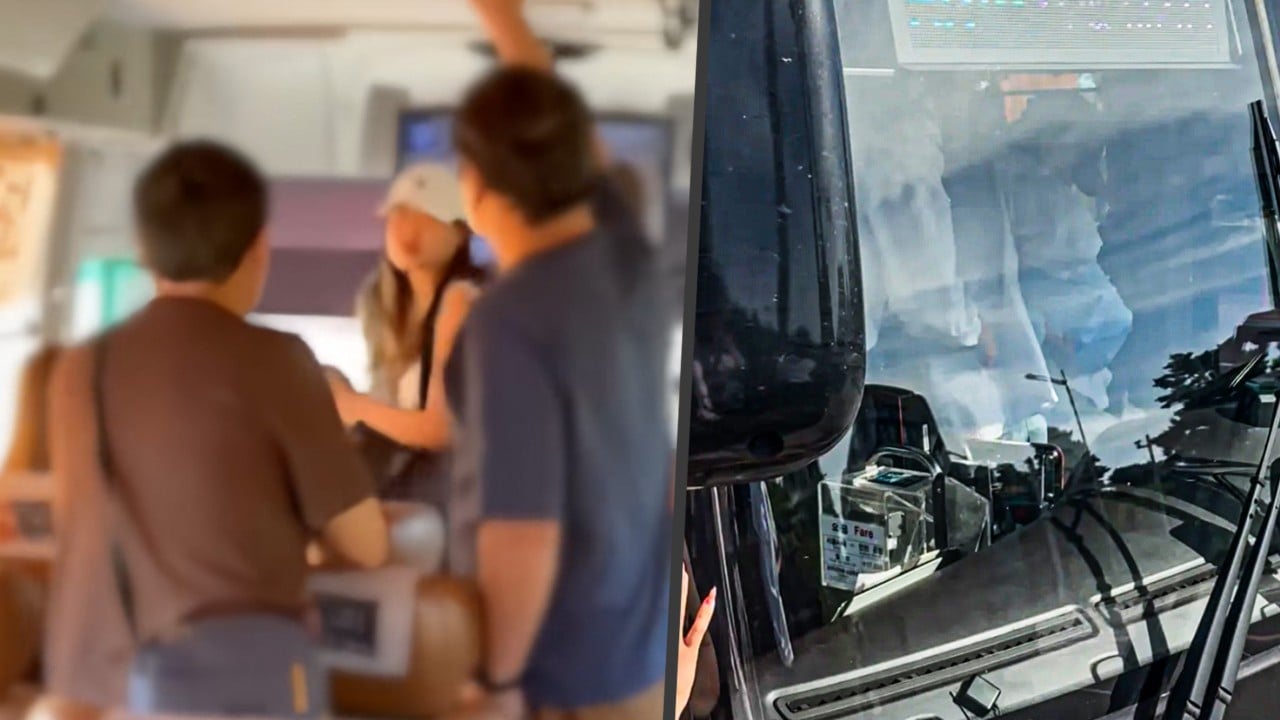
The air in Jeju Island has a specific weight to it. It carries the sharp, clean salt of the East China Sea, mingled with the earthy scent of volcanic stone. For tourists, this is a place designed for slowness. You walk. You look at the basalt cliffs. You take photos of the wind-bent trees. You exist, for a few days, outside the relentless machinery of your daily life.
Two women from China, visiting South Korea as tourists, were doing exactly that. They were navigating the quiet, unfamiliar geography of a foreign holiday. They expected the standard souvenirs: postcards, a few rolls of camera film, perhaps the pleasant fatigue of a long day spent on their feet. They did not expect to become the thin line between a normal afternoon and a catastrophic tragedy.
We rarely think about the physics of our daily environments. We walk past parked cars, heavy trucks, and massive tour buses without a second thought. We trust the parking brake. We trust gravity to stay conquered by small metallic notches. But gravity is a patient, silent hunter, waiting for the single moment a human hand forgets to pull a lever all the way up.
On that particular afternoon, a massive vehicle parked on a sloping road began to slide.
It did not start with a dramatic screech. It began with an almost imperceptible roll. A tire turning an inch. Then another. Within seconds, tons of metal and glass began to gather momentum down a steep incline, heading straight toward a busy intersection populated by unsuspecting pedestrians, shops, and oncoming traffic.
The Anatomy of the Freeze
When danger presents itself, the human brain undergoes a violent calculation. We like to believe we are all heroes in waiting. We watch movies and imagine ourselves running toward the fire, grabbing the falling child, or stopping the runaway train.
Psychology tells a colder story.
Most people freeze. This is not cowardice; it is a neurological traffic jam. The brain, confronted with an anomaly—a giant vehicle rolling silently backward without a driver—tries to reconcile what it sees with what it expects to see. Is there a driver slumped over? Is this a stunt? Am I misjudging the movement? By the time the brain processes the reality, the opportunity to act has often vanished.
The tourists from China did not have a map for this scenario. They did not speak the local language fluently. They were outsiders in a country where they were still finding their bearings. Yet, as the vehicle gathered speed, their reflexes bypassed the intellectual doubts that paralyze most onlookers.
They ran.
To understand the sheer terror of that run, you have to visualize the weight of a rolling vehicle. A standard passenger van or small bus weighs several tons. Once it starts rolling down a hill, it is no longer a car; it is a kinetic missile. Running toward it means placing yourself directly in its path of destruction. A single trip on the asphalt, a slight misstep, and you are under the wheels.
One of the women sprinted toward the driver’s side door. The door was unlocked, but swinging violently as the vehicle lurched. She reached out, her fingers catching the metal frame, dragging her own body along with the accelerating mass.
Imagine the sensation. The roar of the asphalt scraping against tires, the smell of friction, the terrifying realization that if she let go now, the momentum would throw her under the chassis.
She pulled herself up, reached into the cabin, and desperately searched for the handbrake.
The Metallic Click of Salvation
Inside the cabin of an unfamiliar vehicle, everything is foreign. The layout of the dashboard, the position of the emergency brake, the pedals—all of it can vary wildly from what you drive at home. In a state of high adrenaline, fine motor skills evaporate. Your fingers turn into clubs. Your vision narrows to a tiny pinprick.
Yet, she found it.
With a hard, desperate yank, she engaged the emergency brake. The tires locked. The vehicle shrieked, groaned, and shuddered to a violent halt, just yards away from plowing into a crowded area.
Silence returned to the street. It was the heavy, ringing silence that always follows a near-miss.
For a long moment, nobody moved. The pedestrians who had been walking oblivious to the danger turned around, suddenly realizing how close they had come to being crushed. The owner of the vehicle, returning to find their car stopped in the middle of the slope with two strangers standing beside it, gasped in shock.
In the hours that followed, the story leaked onto local South Korean forums, then onto social media, and eventually into mainstream news. The reaction was swift and overwhelming. The two tourists were hailed online and by local authorities as "great Chinese women" who had saved lives through sheer, unadulterated bravery.
Beyond the Geopolitics of the Moment
It is no secret that relations between neighboring countries in East Asia can sometimes be strained by history, politics, and media narratives. On any given day, the internet is filled with commentary highlighting divisions and cultural friction.
But a runaway vehicle does not care about borders. Gravity does not ask for a passport.
When those two women ran toward the rolling car, they did not stop to ask who might be standing at the bottom of the hill. They did not consider whether the people they were saving were South Korean, Chinese, or from any other corner of the globe. They saw human lives in danger, and they moved.
The overwhelming praise they received from South Korean citizens represents something far deeper than simple gratitude for a avoided accident. It was a moment of profound recognition. It reminded everyone watching that beneath the noise of geopolitics lies a fundamental human contract: when we see each other sliding toward disaster, we reach out to pull the brake.
The two travelers eventually went back to their quiet vacation, and then back to their lives in China. They did not ask for medals or monetary rewards. They packed their bags, boarded their flight, and returned home with a story that their families will likely tell for generations.
Consider the ordinary nature of heroism. It does not require a uniform, a title, or a lifetime of training. Sometimes, it only requires the willingness to run toward the heavy, rolling thing when everyone else is stepping back.