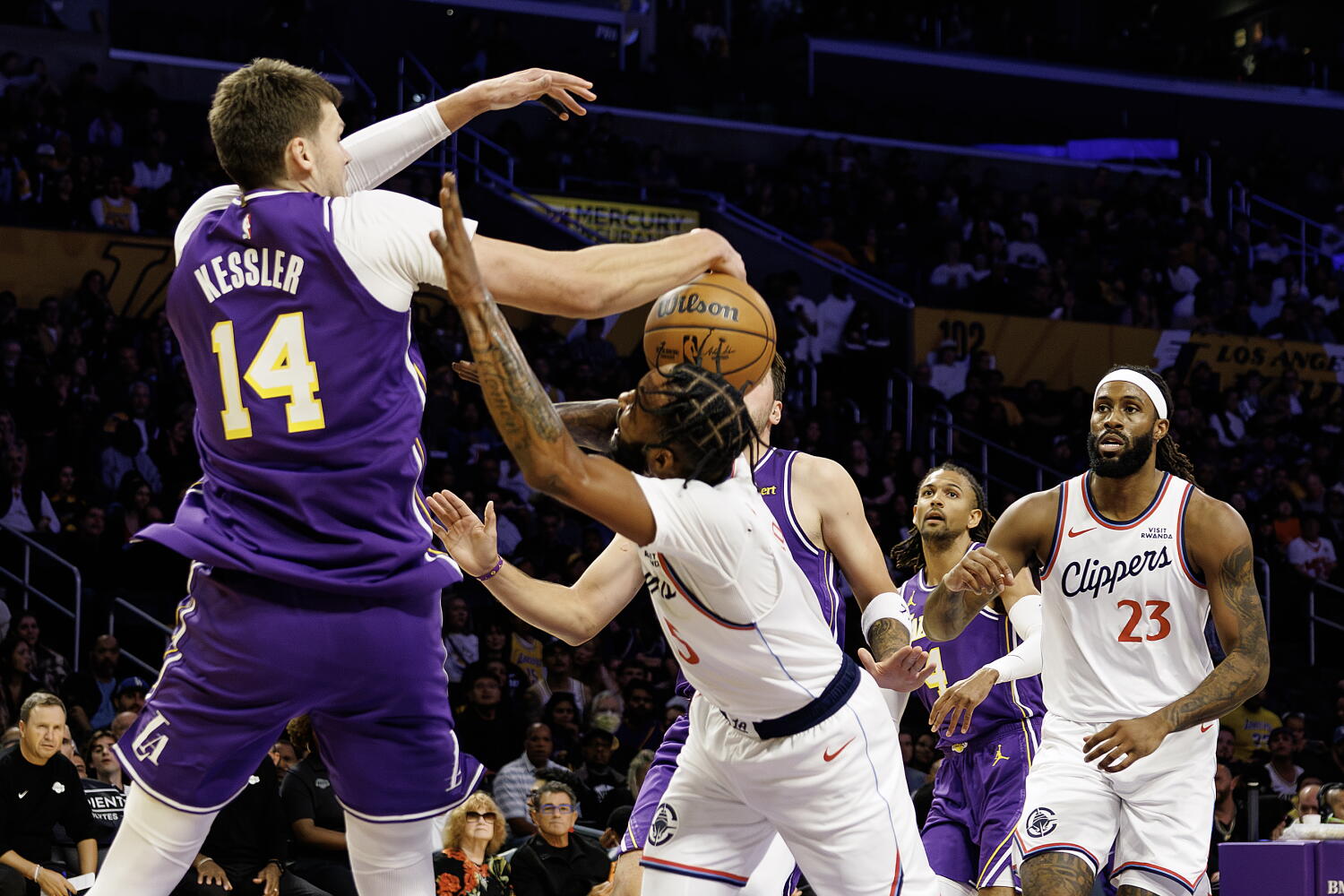
Modern NBA offense is an exercise in spatial distortion, and the tactical pairing of Austin Reaves and Walker Kessler dismantles conventional perimeter defense by forcing opposing coaches into an unsolvable geometric dilemma. When a Los Angeles Lakers roster deploys a high-IQ secondary playmaker alongside an elite vertical rim protector, the floor stretches vertically and horizontally at the exact same moment. Against a Los Angeles Clippers defensive scheme historically reliant on switch-heavy wing versatility and aggressive point-of-attack containment, this two-man architecture systematically breaks down rotational discipline.
Standard box-score recaps reduce a Lakers victory over the Clippers to surface-level point totals and rebound counts. That approach misses the underlying mechanical engine driving the outcome. The true advantage lies in how Reaves manipulates screen angles to exploit drop coverage, while Kessler alters the shot-distribution profile of the entire Clippers offense without needing a single post touch.
The Two-Man Pick-and-Roll Calculus
To understand why the Reaves-Kessler pairing disrupts the Clippers' defensive shell, you must examine the spatial constraints placed on the opposing big man. The Clippers frequently utilize switching schemes across positions one through four to neutralize perimeter isolation. However, introducing a high-gravity roll threat like Kessler forces the Clippers' center into a binary choice: hedge aggressively at the level of the screen or retreat into deep drop coverage.
Neither option yields a sustainable defensive expected value.
- The Deep Drop Exploitation: When the Clippers' center drops toward the restricted area to protect against Kessler’s vertical lob threat, Reaves gains an uncontested pocket of space between the three-point arc and the free-throw line. Unlike speed-dominant guards who rely on straight-line bursts to beat defenders, Reaves operates through deceleration and pace manipulation. He puts the trailing perimeter defender in "jail"—a biomechanical technique where the ball handler seals the pursuing defender on his back hip—effectively turning a five-on-five possession into a localized two-on-one advantage against the retreating center.
- The High Hedge Collapse: If the Clippers adjust by bringing their center up to the three-point line to trap or hard-hedge Reaves, the floor opens behind the play. Reaves possesses the passing angle dexterity to deliver pocket passes through tight windows or throw over-the-top lobs to Kessler rolling down the center lane. Once Kessler catches the ball on the move inside the paint, the Clippers' weak-side wing defenders must collapse inward to prevent a dunk, abandoning corner three-point shooters.
This dynamic illustrates a fundamental principle of basketball economics: advantage creation precedes shot creation. Reaves does not need to beat his primary defender off the dribble with elite athletic burst. He simply uses Kessler’s screen-setting mass to force a defensive rotation, then systematically punishes whichever rotation the Clippers choose to execute.
Rim Deterrence as an Offensive Catalyst
Defensive metrics often overvalue blocked shots while undervaluing shot deterrence. Walker Kessler’s primary structural impact against the Clippers is not merely the shots he swats into the stands, but the drives that never happen because of his presence in the paint.
The Clippers' offensive identity leans heavily on perimeter isolation and drive-and-kick sequences initiated by their primary wings. These actions rely on the threat of rim pressure to collapse the defense. When a ball handler beats his initial defender, the help-side defense must rotate, creating open perimeter looks.
Kessler’s verticality and positioning discipline neutralize this chain reaction. By holding his ground inside the restricted area with vertical arms, he allows the Lakers' perimeter defenders to stay attached to the Clippers' three-point shooters. The Lakers do not need to send early double-teams to the post or over-help on baseline drives.
This defensive stability directly fuels the Lakers' offensive efficiency through two distinct mechanisms:
- Transition Ignition: Missed contested two-point jumpers and altered layups generate long, predictable rebounds. When Kessler secures the defensive glass or taps the ball out to perimeter guards, the Lakers initiate their offense against an unset Clippers defense. Reaves thrives in these semi-transition environments, attacking cross-matched defenders before the Clippers can organize their switching assignments.
- Reduction of Foul Trouble: Teams that lack a true anchor at the five are forced to foul aggressively to prevent easy layups. Disciplined verticality keeps the Clippers off the free-throw line, denying them the highest-efficiency scoring opportunity in basketball and preventing the Clippers from setting their half-court press after made free throws.
The Structural Vulnerability of Switch-Heavy Defenses
The Clippers' roster construction traditionally prioritizes positional size on the wings, allowing them to switch screens effortlessly to eliminate open three-point attempts. While effective against isolation-heavy offenses, switch-heavy schemes carry an inherent structural flaw: rebounding displacement and mismatch hunting.
When the Clippers switch a smaller guard onto Kessler during a Reaves pick-and-roll, the Lakers do not need to dump the ball into the post and stagnate the offense. Instead, Kessler immediately leverages his positional size to seal the smaller defender under the basket. Even if Reaves misses a pull-up jumper or a floater, Kessler’s offensive rebounding probability spikes dramatically because the Clippers' primary rim protector has been pulled out to the perimeter to guard Reaves.
This creates a secondary possession engine. Every missed shot by the Lakers carries a high probability of turning into an offensive rebound and a high-percentage put-back. Over the course of forty-eight minutes, generating even four or five extra possessions through offensive rebounding completely swings the mathematical margin of victory in a tight rivalry matchup.
Furthermore, forcing the Clippers' primary wings to battle a seven-footer on the glass extracts a heavy physiological tax. The cumulative fatigue of boxing out a massive center in the paint degrades the Clippers' perimeter shooting legs in the fourth quarter. What appears to be a cold shooting streak late in the game is often the delayed biomechanical consequence of physical exhaustion accumulated during second-chance rebounding battles in the first three quarters.
Pacing Control and Decision Velocity
A critical differentiator in high-leverage matchups between Los Angeles franchises is control over tempo and decision velocity. The Clippers prefer a methodical, half-court grind where their veteran perimeter creators can hunt specific matchups late in the shot clock.
Austin Reaves disrupts this rhythm by accelerating decision velocity within the Lakers' half-court sets. Rather than dribbling out the shot clock to isolate, Reaves initiates actions early, forcing the Clippers to make multiple defensive reads within the first ten seconds of the possession.
Consider the cognitive load placed on the Clippers' weak-side defenders:
- They must track Reaves coming off a staggered screen.
- They must tag Kessler rolling hard to the rim to prevent a direct lob.
- They must recover back to their own man on the weak-side wing before Reaves whips a cross-court skip pass.
Human reaction time cannot sustainably execute three sequential rotations against a ball handler who reads the floor at an elite level. Eventually, a defender hesitates for a fraction of a second. Reaves identifies that hesitation—whether it is a dropped shoulder, a turned head, or a late closeout—and attacks the closeout immediately.
This brand of basketball exposes the limitation of pure athletic versatility. You can assemble a roster of long, agile defenders, but if their communication and rotational timing fracture under continuous screening actions, individual defensive talent becomes irrelevant.
Operational Limitations and Counter-Adjustments
No tactical alignment is immune to counter-strategies, and over-reliance on the Reaves-Kessler two-man game carries specific operational vulnerabilities that opposing coaching staffs will target in a seven-game series.
First, Kessler’s perimeter shooting limitations allow the Clippers to experiment with extreme sagging schemes. If the Clippers assign a nimble, physical wing to guard Kessler—accepting the rebounding disadvantage in exchange for switching speed—their center can rove freely as a free safety in the paint, clogging driving lanes for Reaves. If Kessler cannot punish this coverage by hitting short-roll push shots or making quick reads as a playmaking hub from the high post, the Lakers' spacing constricts rapidly.
Second, Reaves faces physical attrition when targeted relentlessly on the defensive end. The Clippers possess elite isolation scorers who will systematically hunt Reaves in pick-and-roll actions to force him to defend in space. If Reaves expends maximum energy fighting through screens and absorbing physical contact on defense, his late-game offensive efficiency and shooting accuracy will inevitably decline.
Third, turnover volatility increases when Reaves attempts high-degree-of-difficulty passes against long, athletic passing lanes. The Clippers' wings possess elite wingspans designed to deflect pocket passes and disrupt lob trajectories. If Reaves miscalculates the depth of the drop defender by even six inches, a potential alley-oop becomes a live-ball turnover that fuels a Clippers fast break.
Tactical Blueprint for Sustained Dominance
To prevent the Clippers from neutralizing this advantage through defensive adjustments, the Lakers must evolve the Reaves-Kessler dynamic from a static two-man pick-and-roll into a multi-layered offensive system.
- Deploy Inverted Pick-and-Rolls: Have Reaves set the screen for a larger forward while Kessler occupies the dunker spot. This forces the Clippers' perimeter defenders to navigate screens while keeping their big man pinned near the rim, preventing help defense from arriving early.
- Integrate Spain Pick-and-Roll Actions: Add a third shooter to back-screen Kessler’s defender immediately after Kessler sets the initial ball screen for Reaves. This eliminates the Clippers' ability to drop their center cleanly, creating simultaneous threats at the rim, in the mid-range, and behind the three-point arc.
- Weaponize Early-Clock Drag Screens: Execute the Reaves-Kessler pick-and-roll in transition before the Clippers can match up their defensive assignments. When the Clippers' center is still sprinting back to protect the paint, he cannot execute a disciplined drop coverage, granting Reaves an unobstructed runway to the rim.
The Lakers' path to controlling the Los Angeles basketball hierarchy depends entirely on maximizing this structural mismatch. By anchoring their defense with Kessler's vertical deterrence and dictating offensive geometry through Reaves's manipulative playmaking, the Lakers force the Clippers to abandon their preferred switch-heavy identity and play a style of basketball dictated entirely on the Lakers' terms.