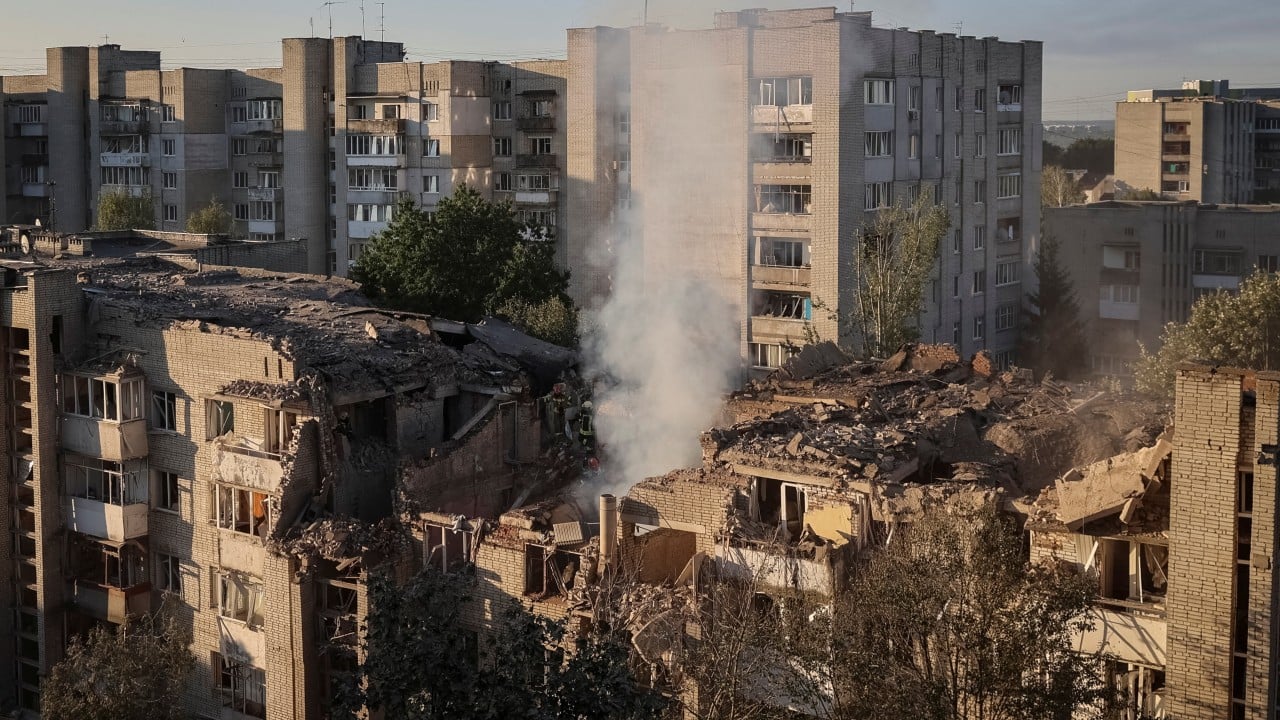
Sustained aerial bombardments across Ukrainian urban centers, resulting in multiple civilian casualties in locations ranging from Kyiv to the western hub of Lviv, expose the operational mechanics of asymmetric air attrition. When Russian ballistic and cruise munitions target infrastructure proximate to the European Union border, the spatial proximity dictates an immediate systemic reaction from neighboring alliance frameworks. The decision by Polish military authorities to launch fighter aircraft and deploy early-warning radar assets represents a predictable calibration of border security under conditions of high vector uncertainty.
The Vector Calculus of Proximity
The strategic geography of Eastern Europe imposes strict time-distance constraints on defensive architecture. Lviv, situated kilometers from the Polish border, functions as a transit and logistics node. When incoming ordnance vectors shift toward western administrative zones, the reaction window for sovereign airspace monitors collapses.
To evaluate this operational dynamic, consider three distinct variables:
- Detection Latency: The time elapsed between missile booster ignition and ground-radar identification.
- Decision Velocity: The procedural delay required for command authorities to authorize interceptor assets.
- Intercept Envelope: The spatial boundary within which defensive aircraft can engage supersonic or cruise threats without violating sovereign neighbor boundaries.
When missile trajectories pass through western Ukrainian airspace, the margin for error shrinks to minutes. The activation of Polish air defense and radar reconnaissance systems functions as a risk mitigation protocol designed to counter vector drift—the proven tendency of damaged or decoy-laden missiles to deviate from planned flight paths. Preventive scrambles are not tactical engagements; they are posture adjustments intended to establish a high-readiness buffer zone.
The Resource Allocation Bottleneck
Strategic vulnerability is fundamentally a function of inventory distribution. The disparity between incoming munition volume and interceptor availability creates a severe defensive deficit. Interceptor missiles operate on constrained supply chains, whereas massed ballistic and cruise strikes rely on industrial stockpiles that absorb attrition over extended operational horizons.
The systemic bottleneck involves three compounding factors:
- Depletion Rates: High-tier air defense interceptors are consumed at a rate outstripping replacement manufacturing output.
- Geographic Dispersion: Protecting urban centers simultaneously requires spreading finite batteries thin, creating coverage gaps in regional sectors.
- Terminal Ballistic Speed: Hypersonic and ballistic assets, such as Iskander variants utilized against central and southern nodes, demand specialized intercept systems that remain chronically scarce.
Diplomatic negotiations regarding licensing frameworks for advanced systems highlight the friction inherent in military procurement lead times. Acquiring production rights or physical inventory does not immediately translate to operational capability; maintenance pipelines, crew training, and telemetry integration dictate a prolonged transition curve before new batteries achieve operational status.
The Cost Function of Retaliation and Logistics
Asymmetric warfare extends beyond the immediate theater of kinetic strikes into industrial and logistics supply chains. Long-range drone and missile campaigns targeting regional distribution centers—such as major retail and warehousing infrastructure deep within Russian territory—impose systemic drag on domestic commerce. This creates a reciprocal friction model. While one side absorbs structural damage to power generation and municipal centers, the other faces localized supply chain fractures and inflationary pressures within commercial distribution networks.
Financial exposure manifests in the banking and insurance sectors through elevated loan-loss provisions and capital redirection. Insurers adjust risk premiums for commercial assets operating within range of drone corridors, forcing supply chains to reroute through redundant, higher-cost pathways. These commercial adaptations act as a hidden tax on economic output, compounding the direct fiscal costs of physical reconstruction.
Structural Deterioration and Strategic Posture
The operational rhythm of the conflict demonstrates that regional stability relies on the elasticity of air defense architectures. As long as the asymmetry between offensive strike volume and defensive intercept capacity persists, neighboring states will remain compelled to maintain high-tempo preventive postures. The economic and tactical burden will continue to skew toward maintaining perpetual readiness along the perimeter, transforming temporary defensive responses into permanent structural overhead for the alliance's eastern flank.
Strategic stability depends on narrowing the replenishment gap for high-altitude interceptors while simultaneously neutralizing launch platforms at their origin points. Absent a structural shift in manufacturing throughput or interceptor density, the calculus of border monitoring will remain bound to crisis-response loops dictated by the trajectory of incoming ordnance.
The Anatomy of the Russia-Ukraine War: Strategic Analysis
This video provides an in-depth breakdown of the ongoing tactical escalations, missile strikes, and NATO's airspace monitoring responses along the eastern flank.
http://googleusercontent.com/youtube_content/1