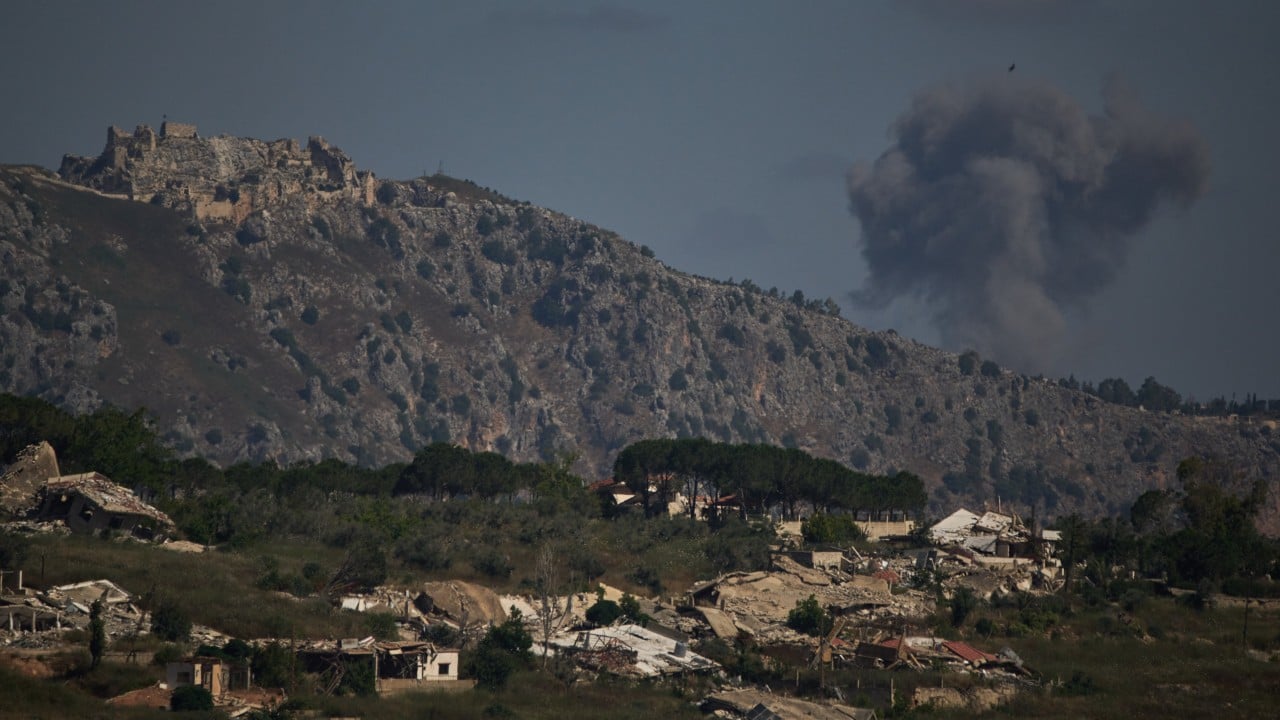
The afternoon heat in southern Lebanon does not lift; it thickens. In the hills above Tyre, the air smells of baked earth, wild thyme, and the faint, bitter tang of burning rubber that never quite leaves the back of your throat. For decades, the people who live along this fractured border have learned to read the sky the way a sailor reads the sea. They know the difference between the low, thunderous growl of a fighter jet breaking the sound barrier and the high, mechanical whine of a surveillance drone. The drone is worse. It stays. It lingers like a persistent migraine, a reminder that your life is being watched through a thermal lens miles away by someone who does not know your name.
When the strikes hit on a Tuesday, the sound did not come as a surprise. It came as an confirmation.
Eighteen people died across several villages in a matter of hours. Somewhere else, across the barbed-wire fence and the concrete walls of the Blue Line, families in uniform received the news that their sons would not be coming home from the northern front. The official military statements from Tel Aviv and Beirut arrived later, neatly typed, translating human annihilation into the sanitized vocabulary of geopolitical strategy. They spoke of "targeted infrastructure," "neutralized threats," and "operational losses."
But geography is not made of words. It is made of skin, stone, and the fragile things people build when they have nowhere else to go.
The Architecture of the Border
To understand why eighteen people die in an afternoon, you have to look at the dirt. Southern Lebanon is a beautiful, cruel place to live. The hills rise sharply from the Mediterranean, dotted with ancient olive trees whose roots run deeper than any modern state. For generations, these villages have been caught in a geographic trap. They are the buffer zone, the staging ground, and the target.
Consider a hypothetical family living in a village like Kafra or Khiam. Let us call the patriarch Farid. Farid is seventy-two. He remembers the 1978 invasion. He remembers 1982. He remembers the long occupation that ended in 2000, and the devastating war of 2006. His life is not measured by decades, but by the intervals between the ruins. When a new escalation begins, Farid does not look at the news on his phone. He looks at his pantry. He counts the bags of rice. He checks the oil in the generator.
This is the lived reality of a border flare-up. It is the sudden, frantic calculation of survival.
The latest exchange of fire follows a pattern that has become terrifyingly predictable, yet no less lethal. Rocket fire arches south over the hills, aimed at military outposts and towns in northern Israel. In response, artillery shells and precision-guided bombs rain north. The cycle is mechanical. It possesses its own terrible internal logic. When the Israeli military announces that its soldiers have been killed in action near the border, the response is swift and heavy. The sky fills with iron.
The eighteen who died in the recent strikes were not abstraction statistics. They were individuals caught in the physical footprint of retaliation. A grandfather who refused to leave his orchard because the olives were ready for harvest. A young mother who thought the concrete basement of her home would be enough to shield her children. A teenager who happened to be riding his motorbike down the wrong road at the wrong second.
The missiles do not see them. The missiles see coordinates.
The Weight of the Concrete
There is a particular vulnerability that comes with living under an iron sky. In western cities, we tend to think of war as an event with a clear beginning and an end. A declaration is made, a conflict is fought, a treaty is signed. But here, war is an environment. It is a chronic condition.
When a strike hits a concrete house, the sound is unlike anything else. It is not just an explosion; it is the instantaneous implosion of a family’s entire history. The concrete turns to a fine, gray dust that coats the lungs and settles on everything. It covers the broken plastic toys, the overturned kitchen tables, the framed photographs of weddings from a time when peace seemed possible.
Neighbors gather with their bare hands to dig through the rubble. They do not wait for heavy machinery because heavy machinery cannot navigate the narrow, cratered alleys, and besides, there is no time. The air is thick with the smell of explosives and crushed stone. Someone finds a shoe. Someone else finds a phone that is still ringing, displaying a name like "Mama" or "Brother" on the cracked screen.
Across the border, the grief is mirrored in a different language but with the identical sharp, choking pain. The Israeli soldiers killed in these clashes are often young, men in their late teens or early twenties, carrying the immense weight of national expectation on their shoulders. When they die, the loss ripples through small communities where everyone knows everyone, where every mother dreads the knock on the door from men in uniform.
The conflict is often presented as a grand chess match between regional powers, a proxy war fought with high-tech weaponry and strategic patience. That perspective is comfortable because it allows us to look at the map from a distance. It turns human suffering into a math problem. If eighteen die on one side and several soldiers die on the other, the commentators on television discuss the "proportionality" of the response. They debate whether the deterrent capacity has been restored.
But you cannot deter a mother's grief. You cannot restore a flattened home.
The False Promise of Distance
We live in an age where we can watch a war in real-time from our living rooms, scrolling through videos of airstrikes between checking the weather and reading restaurant reviews. This digital proximity creates an illusion of understanding. We see the flash of light, the plume of smoke rising over a hillside, and we think we have witnessed the event.
We have not. We have only seen the ghost of it.
The real event happens after the camera stops recording. It happens when the night falls and the electricity goes out, leaving the village in a darkness so absolute that the only lights are the fires burning in the distance and the stars overhead. It happens when a child wet the bed because the sound of the sonic boom was too loud, and her mother has no clean sheets to give her because the water pipes were severed by an artillery shell.
The real problem lies in our collective exhaustion. The international community looks at Lebanon and Israel and sees a script that has been performed a thousand times before. We become numb to the numbers. Eighteen dead feels like a minor update in a world filled with catastrophe.
Consider what happens next when the headlines fade: The bodies are buried. The funerals are held under the watchful eye of drones that still circle overhead, their engines buzzing like angry wasps. The politicians make speeches, promising that the blood of the martyrs will not be shed in vain. And the survivors are left to rebuild their lives with the same broken bricks that have been shattered three times before.
This is the true cost of the conflict. It is not just the loss of life, though that is paramount and irreplaceable. It is the systematic destruction of the future. It is the knowledge that whatever you build today can be turned into dust tomorrow by an order given in a room you will never see.
The border between Lebanon and Israel is a line drawn on a map, but for the people who live along it, it is a scar that never heals. It is a place where the past is always present, and the sky is always heavy with the threat of what comes next. As the smoke clears from the latest round of strikes, the people of the south look up at the clouds, listening closely, trying to figure out if the silence is a pause, or just the breath before the next scream.