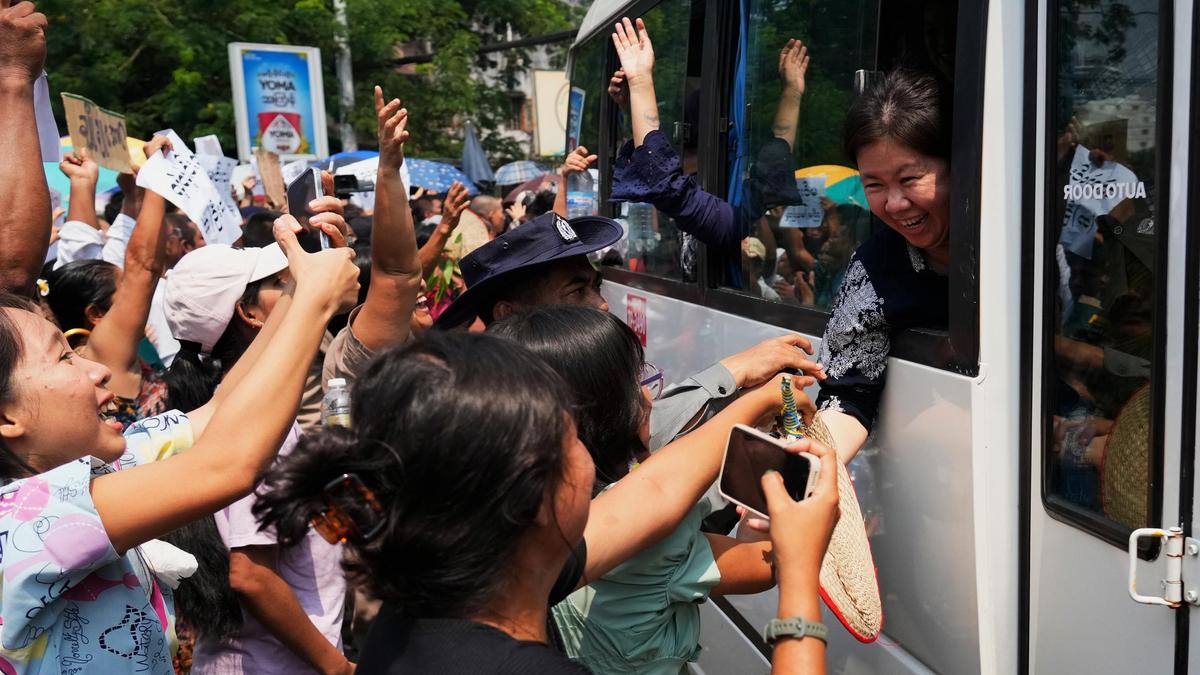
The metal gate doesn't just open. It shrieks. It is a sound that has stayed the same for decades, a grinding of iron against iron that signals either a beginning or an end. On this particular morning, as the humid heat of April began to settle over the streets of Yangon, that sound meant 3,300 souls were stepping back into a world they no longer recognized.
They call it Thingyan. It is the Burmese New Year, a time of water, washing away the sins of the past, and renewal. But for those waiting outside the high, bleached walls of Insein Prison, renewal isn't a metaphor. It is a physical ache. It is the sight of a brother’s face, thinner than it was two years ago, or a daughter’s hands, calloused from labor she never should have known.
Amnesty is a clinical word. It suggests a clean slate, a bureaucratic "pardon" delivered from the high offices of the ruling military council. Yet, as the buses rolled out of the prison gates, the reality was far more jagged. Among the thousands released, most were common criminals. The political prisoners—the students, the poets, the journalists who dared to hold a mirror to power—remained, for the most part, behind the glass.
The Geography of the Empty Chair
Think of a small kitchen in a village outside Mandalay. For three years, a chair has sat at the head of the table, vacant. The wood has gathered dust. The family has learned to speak around the absence, to avoid the name of the one who was taken during a midnight raid because they were seen at the wrong protest or held the wrong flyer.
When the news broke that the military would release 3,300 Burmese nationals and 36 foreigners to mark the holiday, that kitchen suddenly became a place of frantic, terrified hope. Families didn't wait for official lists. They grabbed their bags and headed for the gates. They stood in the sun for hours, clutching plastic bottles of water and faded photographs.
This is the hidden tax of a mass release. For every person who walks free, ten others watch the last bus pull away and realize their loved one isn't on it. The amnesty is a lottery where the rules are never explained. It is a calculated act of mercy designed to ease international pressure, a pressure valve turned just enough to prevent an explosion, but not enough to change the temperature of the room.
The military council, led by Senior General Min Aung Hlaing, framed the move as a gesture of "peace and stability." They spoke of the need for national reconciliation. But reconciliation requires two sides to meet on level ground. In Myanmar, the ground is tilted. The prisons are overflowing not because of a sudden spike in crime, but because the definition of a crime has expanded to include the act of disagreement.
The Foreigners and the Facade
Among those granted their freedom were 36 foreign nationals. For them, the journey home involves planes, passports, and the sudden, jarring transition from a concrete cell to an airport lounge. Their release is often the most publicized, a diplomatic bargaining chip used to signal to the West that the junta can be "reasonable."
But the numbers tell a different story. Since the coup in February 2021, the Assistance Association for Political Prisoners (AAPP) has tracked a grim tally. Thousands have been killed. Over 20,000 remain in detention. When you subtract 3,300 from a number that large, the remainder is still a tragedy.
The strategy is transparent. By releasing those convicted of minor thefts or drug offenses—the "traditional" recipients of New Year mercy—the state maintains a veneer of normalcy. They want the world to see the water festival, the smiling faces, and the crowded pagodas. They want the narrative of a country returning to its rhythm.
The rhythm, however, is broken.
A Long Walk to an Altered Home
Consider a man we will call Zaw. He is hypothetical, but his story is a composite of a dozen testimonies smuggled out through encrypted apps and hushed conversations. Zaw was 22 when he was arrested. He is 25 now.
When he steps off the bus, the air feels different. It is too wide. For years, his horizon was limited to twenty paces. Now, the sky is an overwhelming blue. He walks toward his neighborhood, but the landmarks have shifted. There are new checkpoints. The graffiti he remembers—the defiant red splashes of the resistance—has been painted over with a dull, institutional gray.
His friends are gone. Some are in the jungle, having traded their textbooks for rifles. Others have crossed the border into Thailand, working illegal jobs in factories just to send money back home. The "freedom" Zaw has been granted is a freedom of ghosts. He is out of a cell, but he is still in a country where looking a soldier in the eye is a gamble.
The psychological weight of amnesty is its own form of incarceration. The released are often required to sign pledges. They are told that if they are arrested again, they will serve the remainder of their old sentence plus the new one. It is a leash, invisible but tethered firmly to the iron ring in the wall.
The Math of Survival
The military’s grip on the country is not as firm as the state-run newspapers suggest. They are fighting a multi-front civil war against ethnic armed groups and the People’s Defence Forces (PDF). The economy is in a tailspin. The kyat, the local currency, has lost its value, making basic goods like rice and oil luxuries for many.
In this context, the amnesty is a logistical necessity. Prisons are expensive to run. They require guards who could otherwise be on the front lines. They require food that is increasingly scarce. By emptying the cells of those who pose no threat to the regime’s survival, the junta clears space—both physically and financially.
It is a cold calculation disguised as a warm heart.
The water of Thingyan is supposed to be pure. Children run through the streets with plastic buckets and hoses, drenching passersby in a chaotic, joyful ritual. But this year, the water felt heavy. In the shadow of the prisons, the celebration was a performance.
The Silence After the Gates Close
As the sun sets on the first day of the New Year, the crowds at the prison gates begin to thin. The last bus has long since departed. The guards return to their posts. The heavy iron bolts are slid back into place.
For the thousands who remain inside, the silence is deafening. They are the teachers who refused to work under the regime, the doctors who treated wounded protesters in secret clinics, and the elected officials whose terms were cut short by the barrel of a gun. For them, there was no amnesty. There was no water to wash away the years.
The world moves on. The news cycle finds a new crisis, a different war, a fresher outrage. The headline about 4,500 prisoners (the initial estimate before the final tally of 3,300 was clarified) becomes a footnote in a long, bloody history.
But for the mother still sitting in that Mandalay kitchen, the story isn't over. She looks at the empty chair. She listens to the sound of the wind rattling the door, hoping it might be the sound of a key turning, knowing it is probably just the ghost of a promise.
The gate is closed. The country is waiting. And in the dark of the cells, the only thing that grows is the memory of what was lost.