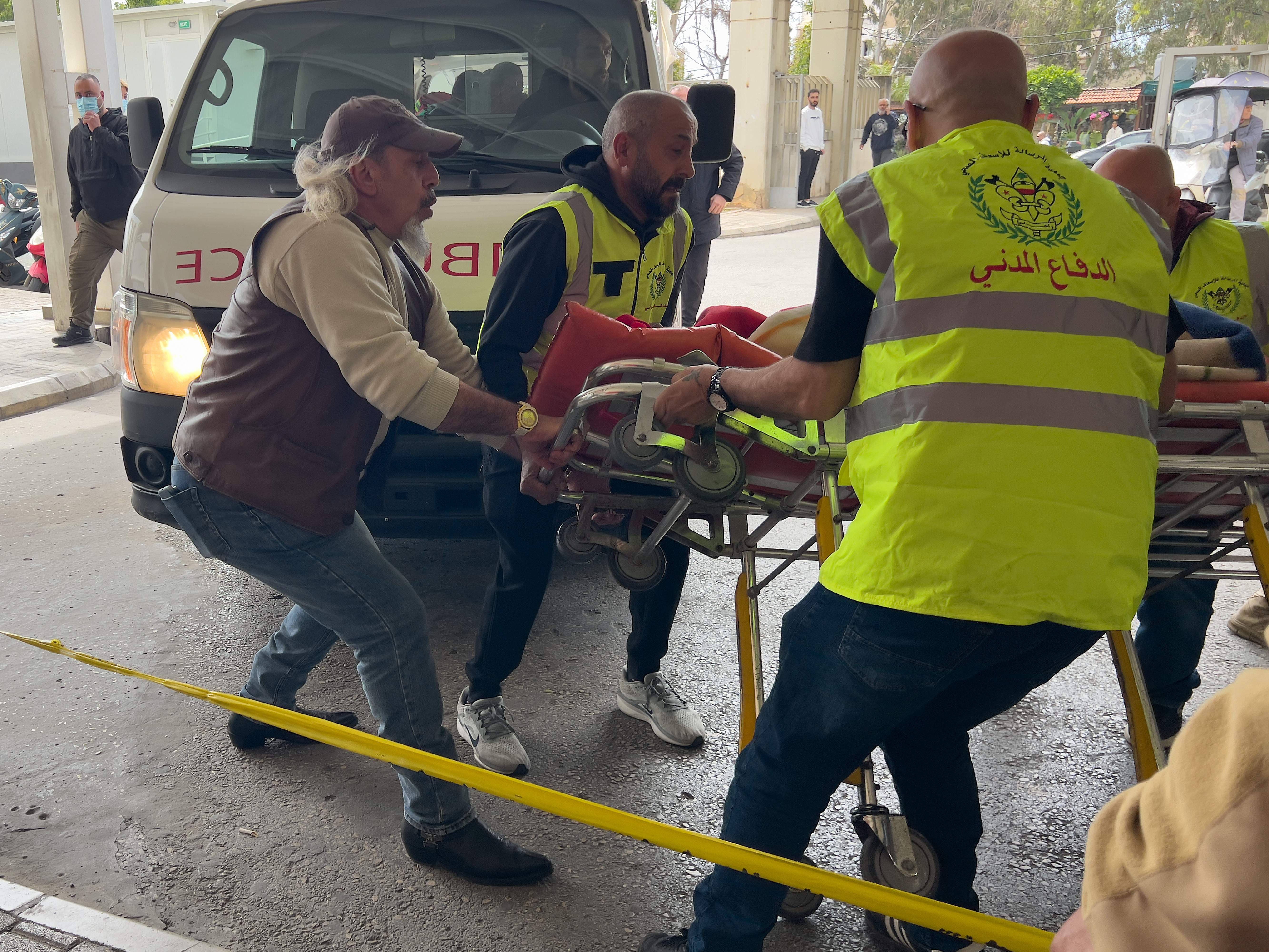
In the basement of a Beirut hospital, there is a specific frequency to the hum of a ventilator. It is a steady, rhythmic click-whir that serves as the only metronome for a life suspended. To a doctor, it sounds like safety. To a mother sitting by a plastic crib, it sounds like hope. But lately, that sound has begun to feel fragile, as if the very air being pushed into the lungs of the vulnerable is being borrowed on a high-interest loan that is about to come due.
The World Health Organization (WHO) recently issued a warning that reads like a ledger of impending catastrophe. It isn't just about the bombs or the political stalemates anymore. It is about the arithmetic of survival. Lebanon’s healthcare system, once the "Hospital of the East," is staring at a calendar where the numbers are bleeding out. Vital medical supplies—trauma kits, blood bags, chronic disease medications, and the fuel required to keep the lights on—are projected to run out within days.
Not weeks. Days.
Consider a surgeon named Elias. He is a hypothetical composite of the men and women currently scrubbing into darkened operating theaters across the capital. Elias does not worry about his skill; he has spent twenty years perfecting the art of reassembling shattered limbs. He worries about the gauze. He worries about the fact that the hospital’s sterile supply of basic bandages is dwindling. When a country’s supply chain snaps, a genius surgeon becomes a man with a useless knife.
The Mathematics of the Brink
The crisis is a cascading failure. It begins with the borders and ends at the bedside. Because Lebanon imports nearly all of its medical goods, any disruption to the ports or the airports acts as a tourniquet on the nation’s throat. When the WHO reports that supplies are "critically low," they are referring to a logistical nightmare where 80% of the population's health needs are suddenly untethered from the resources required to meet them.
The statistics are cold, but the reality is searing. Over 1,000 health facilities are currently operating in a state of high alert, but alert does not mean prepared. Since the escalation of regional hostilities, the demand for trauma care has spiked by several hundred percent. Imagine a bucket with a hole in the bottom being filled by a wide-open tap. Now, imagine someone turns off the tap while the hole remains. That is the Lebanese medical inventory.
It is easy to look at a headline and see a generic "shortage." It is harder to visualize the specific cruelty of a shortage. It means a diabetic patient searching four pharmacies for a single vial of insulin and finding only empty shelves and apologetic shrugs. It means a cancer patient missing a chemotherapy session because the hospital is prioritizing the influx of "war-related" injuries. This is the invisible triage. We often think of triage as a choice made on a battlefield, but the cruelest triage happens in the quiet of a bureaucratic office where a director decides which floor gets the remaining liters of fuel for the backup generators.
The Ghost of the Generator
Electricity in Lebanon has long been a ghost. It haunts the walls, appearing for an hour or two before vanishing again. Hospitals have stayed afloat by relying on massive, diesel-chugging generators. These machines are the true lungs of the city. Without them, the neonatal units go dark. Without them, the cold chain—the precise temperature control required to keep vaccines and blood viable—is broken.
The fuel is running out.
When the WHO warns of "days," they are calculating the burn rate of diesel. If the tankers cannot reach the pumps, the humming in the basement stops. And when the basement goes silent, the ventilators upstairs stop too.
This is not a metaphor. This is a mechanical certainty.
We have seen this pattern before, but never with this level of intensity. During the 2020 port explosion, the world rushed in. Today, the world is distracted, weary, and stretched thin across multiple global theaters of suffering. The "E-E-A-T"—the experience, expertise, authoritativeness, and trustworthiness—of the organizations on the ground is being tested by a reality that defies traditional humanitarian logic. How do you maintain trust with a patient when you have to tell them that the basic antibiotic they need for a routine infection is being saved for a "catastrophic" case?
The Human Cost of Logistical Silence
To understand the stakes, you have to look past the white coats and the sterile hallways. You have to look at the people like "Sara," a hypothetical young woman in the southern suburbs. She isn't a casualty of a blast. She is a casualty of a broken system. Sara has a heart condition that requires daily medication to keep her pulse from racing into a lethal rhythm.
For Sara, the "supply chain" isn't a concept in a business textbook. It is the rattling sound of a half-empty pill bottle. She knows that when that bottle is empty, her heart becomes a ticking clock. The WHO's warning is her death warrant, written in the dry language of international diplomacy.
The irony is that the knowledge exists. The doctors are there. The nurses are there. Lebanon’s medical professionals are among the most resilient and highly trained in the world, having spent decades practicing "crisis medicine." They can perform miracles with a flashlight and a prayer. But even a miracle requires a clean needle. Even a hero needs a pair of gloves.
The Invisible Stakes
Why does this matter to someone sitting thousands of miles away? Because the collapse of a healthcare system is never contained within a single border. It creates a vacuum. When hospitals fail, infectious diseases that were once controlled begin to seep back into the population. Vaccination programs halt. Maternal mortality rates, a key indicator of a civilization's health, begin to climb.
The crisis in Lebanon is a warning to the world about the fragility of our interconnected dependencies. We live in an age of "just-in-time" delivery, where stocks are kept low to maximize efficiency. But efficiency is the enemy of emergency. In Lebanon, we are seeing the final, logical conclusion of what happens when a society is forced to live "just-in-time" for years on end, only for the "time" to finally run out.
The sound of the city has changed. The traffic is different, the conversations in the cafes are hushed, but the most haunting sound is the one you can’t hear: the absence of a future being planned. No one in the medical community is looking at six months from now. They are looking at the next six hours. They are checking the gauges on the oxygen tanks. They are counting the bags of saline.
There is a specific kind of exhaustion that settles into the bones of a nurse who knows that the person she is saving today might die tomorrow from a lack of a simple infusion. It is a moral injury that leaves no physical scar but hollows out the spirit.
The WHO is not prone to hyperbole. When they use the word "days," they have done the math. They have looked at the shipping manifests and the warehouse inventories. They have seen the empty docks. They are telling us that the metronome is slowing down.
In a small room in the heart of Beirut, a nurse adjusts a blanket. She moves with a practiced, elegant efficiency, trying not to notice that the lights flickered twice in the last ten minutes. She knows that every breath her patient takes is a victory against the odds. But she also knows that the odds are currently being written by people in offices far away, who are deciding if a ship will turn toward the port or away from it.
The click-whir of the ventilator continues. For now.
It is a thin, mechanical heartbeat for a nation that is tired of being resilient. It is a sound that demands to be heard before it is replaced by the loudest noise of all: the silence of a hospital that has finally run out of everything.


