The coffee in the ceramic mug did not spill. It vibrated. First came a ripple, tight concentric circles shivering against the dark surface of the liquid, and then a low, bass note that seemed to originate from the center of the skull rather than the ears.
Seconds later, the floorboards began to sway.
When a magnitude 7.3 earthquake strikes, the world loses its solid state. We spend our lives treating the ground beneath our feet as an absolute constant, an unyielding foundation upon which we build our homes, our families, and our futures. But along the Pacific coast of Mexico, where the massive tectonic plates grind against one another in a slow-motion battle for dominance, that certainty can evaporate in an instant.
To understand a major seismic event, you have to look past the numbers on a seismograph. A statistic like 7.3 is abstract. It is a sterile digit on a news ticker. To truly understand it, you have to look at the swinging ceiling lamps, the frantic barking of street dogs minutes before the first shockwave hits, and the sudden, breathless silence of a coastal town realizing that everything is about to change.
The Anatomy of the Shaking
Imagine the earth’s crust not as a solid shell, but as a fractured puzzle. Off the southwestern coast of Mexico, two major pieces of this puzzle—the Cocos Plate and the North American Plate—are locked in a permanent, agonizing embrace. The Cocos Plate is dense and oceanic, sliding beneath the lighter continental crust of North America at a rate of a few inches per year.
Usually, this movement is sticky. The rocks catch. They bind. They hold fast while the immense pressure from the earth’s mantle pushes from behind. For decades, the tension builds. The rock deforms, stretching and compressing like a colossal rubber band drawn back to its absolute limit.
Then, a fracture occurs.
When the friction finally gives way, the release of energy is instantaneous and catastrophic. The point where the break happens, miles beneath the ocean floor, sends shockwaves tearing through the water and the stone. These are the primary and secondary waves—the physical manifestation of planetary strain snapping back into place.
For those living along the coastlines of Oaxaca or Chiapas, the initial sensation is a strange, vertical jolt. It feels as though a heavy vehicle has slammed into the side of the building. This is the P-wave, the fast-moving compressional wave that arrives first, acting as a terrifying herald for what is to follow. It gives a few precious seconds of warning. Smart phone alerts chime with a distinctive, mechanical wail. Then the S-waves arrive, side-to-side shears that roll through the earth like ocean swells, turning brick and mortar into flexible, fragile ribbons.
Voices in the Dark
Consider Mateo, a hypothetical fisherman who has spent forty years working the waters near Puerto Escondido. On the afternoon of the quake, he is repairing nets on the beach. He knows the ocean better than he knows his own children, but he does not notice the warning signs until the pelicans suddenly take flight en masse, screaming as they head inland.
The sand beneath his boots begins to behave like liquid. This is a phenomenon known as liquefaction, where loose, water-saturated sediment temporarily loses its strength and acts more like quicksand than solid ground. Mateo watches the tide line. When an earthquake of this magnitude occurs offshore, the immediate instinct of every coastal resident is not to look at the falling tiles, but to watch the horizon.
The water is the real wild card.
When a massive fault line shifts vertically under the ocean, it acts like a giant paddle, displacing cubic miles of seawater in a single second. This displacement creates a series of long, low waves that travel across the deep ocean at the speed of a jet airliner. In the deep sea, you wouldn't even notice them. But as they approach the shallow waters of the coastline, they slow down, bunch up, and grow into walls of water.
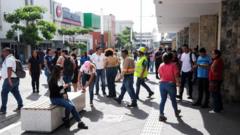
The tension of waiting for a tsunami advisory is a psychological weight that statistics cannot capture. For hours after the shaking stops, the air remains thick with dust and anxiety. Sirens echo from emergency vehicles navigating streets littered with fallen concrete and tangled power lines. Neighbors gather in the middle of wide avenues, away from facades that might still drop loose masonry during the inevitable aftershocks. They stare at their phones, waiting for official word from the oceanographic monitors. Is the water receding? Is the ocean pulling back to reveal the sea floor, the classic, terrifying prelude to a surge?
The Invisible Balance Sheet
The dry reports published by international news agencies focus on infrastructure. They list damaged highways, disrupted power grids, and broken water mains. These are important metrics, to be sure, but they miss the true human cost of a 7.3 event.
The real damage is measured in the fragile economy of survival. When a small hotel loses its roof, it isn't just a construction problem; it is the cancellation of a season’s worth of bookings that would have paid the wages of twenty local families. When a mountain road collapses, cutting off a remote village, it means the local clinic will run out of insulin within forty-eight hours.
Mexico is a country forged in seismic fire. Its people possess a deep, cultural memory of disaster, stretching back to the devastating 1985 earthquake and the twin shocks of 2017. This history has birthed an extraordinary capacity for self-organization. Long before the heavy machinery of the military arrives under the DN-III-E disaster relief plan, ordinary citizens are already forming human chains to clear rubble. They bring out buckets, shovels, and bottles of water. They share whatever food hasn't been spoiled by the power outage.
This resilience is beautiful, but we must be careful not to romanticize it to the point of ignoring the systemic vulnerabilities that make these events so destructive in the first place. Building codes exist, but enforcing them in rapidly growing coastal towns is an uphill battle against poverty and informal construction. A concrete home built without proper steel reinforcement rebar is a trap waiting to sprung by the next shift of the Cocos plate.
The Ground Settles
As night falls over the impacted region, the immediate chaos begins to subside into a grueling marathon of recovery. The tsunami warnings are eventually downgraded, bringing a collective sigh of relief that can almost be felt across the entire coastline. The ocean, this time, chose to be merciful.
But the earth does not stop moving immediately.
Aftershocks rumble through the dark every few hours, a series of smaller snaps as the fault line adjusts to its new position. Each one sends a fresh jolt of adrenaline through the bodies of people trying to sleep on mattresses dragged out into the open air of soccer fields and parking lots. The nervous system does not reset as quickly as a seismograph. Every passing truck, every sudden vibration of a refrigerator motor, triggers the flight response.
We live on a restless planet. Events like a magnitude 7.3 earthquake are reminders that our cities, our borders, and our daily routines are merely temporary arrangements permitted by geological grace. When the earth breaks open, it strips away the trivialities of modern life, leaving behind only the stark realities of human connection, the immediate necessity of looking out for the person standing next to you, and the profound, humbling awareness of the power that sleeps beneath the soil.