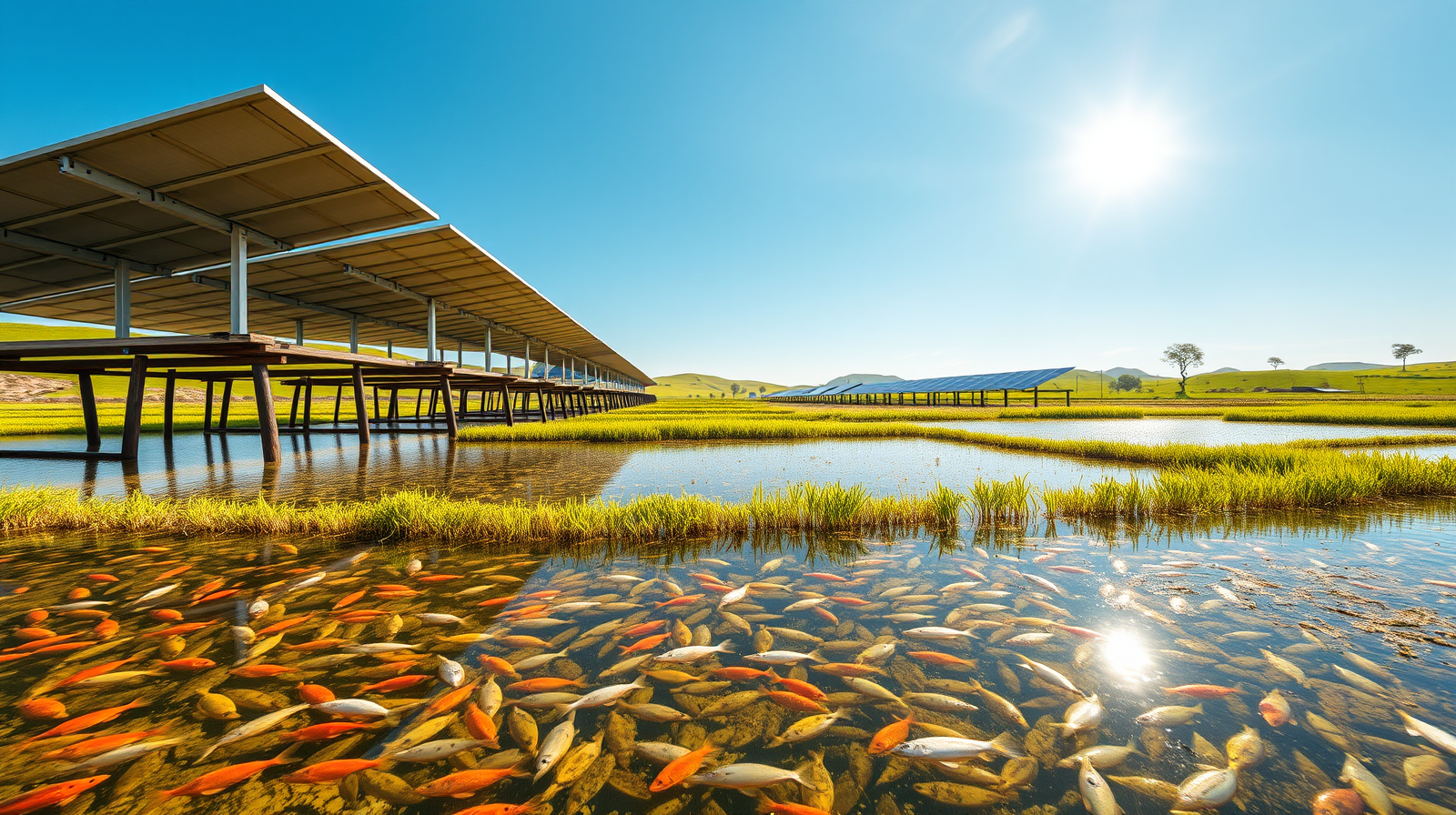
The 422 Megawatt Water Myth
The PR machine is humming over the Philippines’ plan to mount 422 megawatts of solar panels above commercial fish ponds. Media outlets are rushing to parrot the official line: it saves precious agricultural land, boosts energy output through water cooling, and creates dual-income streams for aquaculture operators.
It sounds like clean energy magic. It is actually an operational nightmare waiting to hemorrhage capital.
I have spent years looking at balance sheets for utility-scale solar buildouts across Southeast Asia. Every time a developer pitching floating solar or agro-photovoltaics starts raving about "spatial efficiency," I check for the exit. Land scarcity in island nations is real, but slapping massive silicon arrays over brackish water ponds isn't an ingenious land-use hack. It's an over-engineered asset class that prioritizes press release metrics over long-term levelized cost of energy (LCOE).
Building solar on stilts over working fish ponds trades simple, predictable civil engineering for a brutal mix of corrosion, structural fatigue, and logistical chaos.
Salt, Hydrogen Sulfide, and the Fallacy of Free Cooling
The core narrative pushed by floating solar and agrivoltaic cheerleaders boils down to one thermodynamic benefit: the cooling effect of water improves module efficiency.
Standard silicon panels lose about 0.35% to 0.5% efficiency for every degree Celsius above 25°C. In humid tropical environments, temperature coefficients matter. Ground-mounted systems heat up fast. Placing modules over water does indeed keep the ambient microclimate lower. You might gain a 3% to 5% boost in peak power yield on a hot afternoon.
Here is what the press release conveniently forgets to balance against that 5%: microclimates over fish ponds are chemically hostile.
Commercial aquaculture ponds are not pristine mountain lakes. They are hyper-eutrophic, biological pressure cookers loaded with organic waste, fertilizers, and dissolved gases like hydrogen sulfide ($H_2S$). Combined with high relative humidity and coastal salt spray, you are exposing electrical connections, racking systems, and power electronics to continuous chemical attack.
The Real Cost of "Free" Cooling
- Gasket and Seal Degradation: Polymer seals on solar glass and junction boxes degrade rapidly under constant moisture and high UV exposure, inviting moisture ingress and Potential Induced Degradation (PID).
- Corrosion Rates: Galvanized steel or aluminum racking placed directly in brackish water or soil saturated with fish waste requires specialized anti-corrosion coatings (like high-grade marine anodization or heavy epoxy resins) that decimate initial capital expenditure efficiency.
- Inverter Stress: Strings and central inverters need to be placed either far onshore—requiring massive, expensive high-voltage copper cabling to combat voltage drops—or mounted on elevated platforms directly in the humid zone, driving up thermal cycling strain and failure rates.
That 3% temperature yield gain? It gets eaten alive in year three when corrosion-induced line losses and inverter failures kick in.
Operations and Maintenance Over Aquaculture: A Logistical Farce
Ask any solar Operations & Maintenance (O&M) director what they fear most, and they will tell you: anything that slows down human access.
On standard ground-mounted utility arrays, a crew with a utility vehicle can swap out a blown inverter, replace a cracked module, or run automated thermal drone sweeps across tens of megawatts a day. The workflows are standardized, repeatable, and cheap.
Now, try doing that over a commercial fish pond on stilts.
Ground Solar O&M Workflow:
[Truck Access] -> [Standard Scaffolding/Ladders] -> [5-Minute Swap] -> [Low Insurance Risk]

Solar-on-Stilts O&M Workflow:
[Boat/Catwalk Access] -> [Rigging over Water] -> [Safety Protocols] -> [Delayed Component Swaps] -> [Skyrocketing Insurance Premiums]
Imagine a scenario where a string of modules goes down in the middle of a 50-hectare pond network. Your O&M team cannot drive a truck up to the array. They are either crawling along elevated, slick catwalks with heavy replacement modules or navigating narrow boats through shallow ponds without damaging the underlying aerators or disrupting the fish stock.
The Human and Fish Conflicts
- Boating vs. Biology: Ponds are filled with submerged aerators, feeding lines, and netting. Navigating motorboats or work barges through these systems without entangling equipment or scaring fish populations to death is virtually impossible.
- Cleaning Logistics: Dust and soiling still accumulate in humid environments, turning into a sticky film of organic grime and bird droppings. Cleaning ground arrays uses tractor-mounted brushes. Cleaning arrays over water requires custom, light-footprint equipment or manual labor walking on elevated beams, ballooning labor costs by 200% to 300%.
- Aquaculture Interference: Harvesting fish requires nets, heavy drawstrings, and frequent draining. How do you drain a pond to harvest tons of milkfish or tilapia when you have tons of concrete pilings driven deep into the mud floor, surrounding electrical conduits, and casting permanent shadows over the water?
The fish farmers do not want the solar guys in their way. The solar O&M guys do not want to wade through waist-deep fish sludge to fix a junction box. The assumption that these two industries will live in harmony is an executive fantasy cooked up in a air-conditioned boardrooms.
The Structural Nightmare of Dynamic Mud
Ground-mounted solar relies on driving steel piles directly into compacted soil. If the soil is bad, you ballast with concrete blocks. It is simple, cheap, and easily tested using standard geotechnical surveys.
Driving stilts into the bottom of actively managed aquaculture ponds is a completely different engineering challenge.
Pond bottoms are soft, saturated, organic silt. They undergo constant erosion, swelling, and chemical alteration from fish waste and mechanical aeration.
To hold elevated solar arrays—which act as giant, rigid sails during tropical typhoons—your stilts must be anchored deeply into stable bedrock beneath the mud.
| Variable | Ground-Mounted Solar | Elevated Pond Solar (Stilts) |
|---|---|---|
| Foundation Type | Direct-driven steel piles | Heavy reinforced concrete/piles |
| Wind Load Resistance | Distributed directly to ground | Amplified via high-lever-arm stilts |
| Civil CapEx share | ~10-15% of total budget | ~30-40% of total budget |
| Failure Mode | Minor soil settling | Pile tilt leading to catastrophic array glass cracking |
During a Category 4 typhoon—an annual reality in the Philippines—wind speeds easily exceed 200 km/h. When wind hits a high-clearance, elevated solar array, the lateral force places massive leverage on those stilts. If even one pile shifts or settles unequally in the soft pond bed by a few centimeters, the rigidity of the aluminum mounting frames will twist the glass panels, shattering hundreds of modules in a cascade failure.
To build stilts strong enough to survive that uplift and lateral torque, you have to pour thousands of tons of high-grade, marine-rated concrete. By the time you finish over-engineering the sub-structure, your CapEx per watt has soared far beyond the cost of simply buying dry, non-arable land elsewhere.
The Real Winner? Land Owners Cashing In
If the physics are difficult and the economics are stretched, why is this project happening?
Follow the money.
It is not about engineering efficiency; it is about regulatory arbitrage and real estate speculation. In many developing nations, acquiring hundreds of contiguous hectares of flat, non-agricultural land for utility-scale solar is a legal nightmare. Land titling is fragmented, zoning laws are rigid, and converting agricultural land to industrial energy use requires years of bureaucratic approvals.
Aquaculture ponds offer massive, contiguous footprints under single-owner titles or straightforward government concessions.
Developers are paying a premium for solar-on-stilts not because it is technologically superior, but because it bypasses the nightmarish process of land acquisition. They are taking on massive, long-term O&M liabilities simply to get projects permitted and funded today.
It is a short-term trade-off. They solve today’s permitting bottleneck by guaranteeing tomorrow's maintenance crisis.
Stop Romanticizing Dual-Use Clean Energy
Agrivoltaics and floating solar have valid, niche applications. Small-scale arrays over water-reservoir channels to prevent evaporation make sense. Solar canopies over high-value, shade-loving crops can work.
But scaling 422 megawatts over active, highly corrosive, soft-bottomed commercial fish ponds is a high-risk gamble masquerading as a green breakthrough.
When you strip away the polished media narratives, the reality is clear:
- The cooling performance gains are offset by harsh microclimate corrosion.
- The civil engineering costs of driving deep stilts into soft pond beds inflate CapEx to absurd levels.
- The operational friction between fish harvesting and solar maintenance guarantees inflated long-term OpEx.
Stop treating every spatial combination of green tech and food production as an unmitigated win. Real infrastructure engineering requires cold, hard trade-offs. If a solar project requires extra concrete, elevated risks, and complex logistics just to avoid buying dry land, it isn't the future of clean energy. It’s an expensive workaround that will be paid for in broken modules, rusted steel, and depressed equity returns.