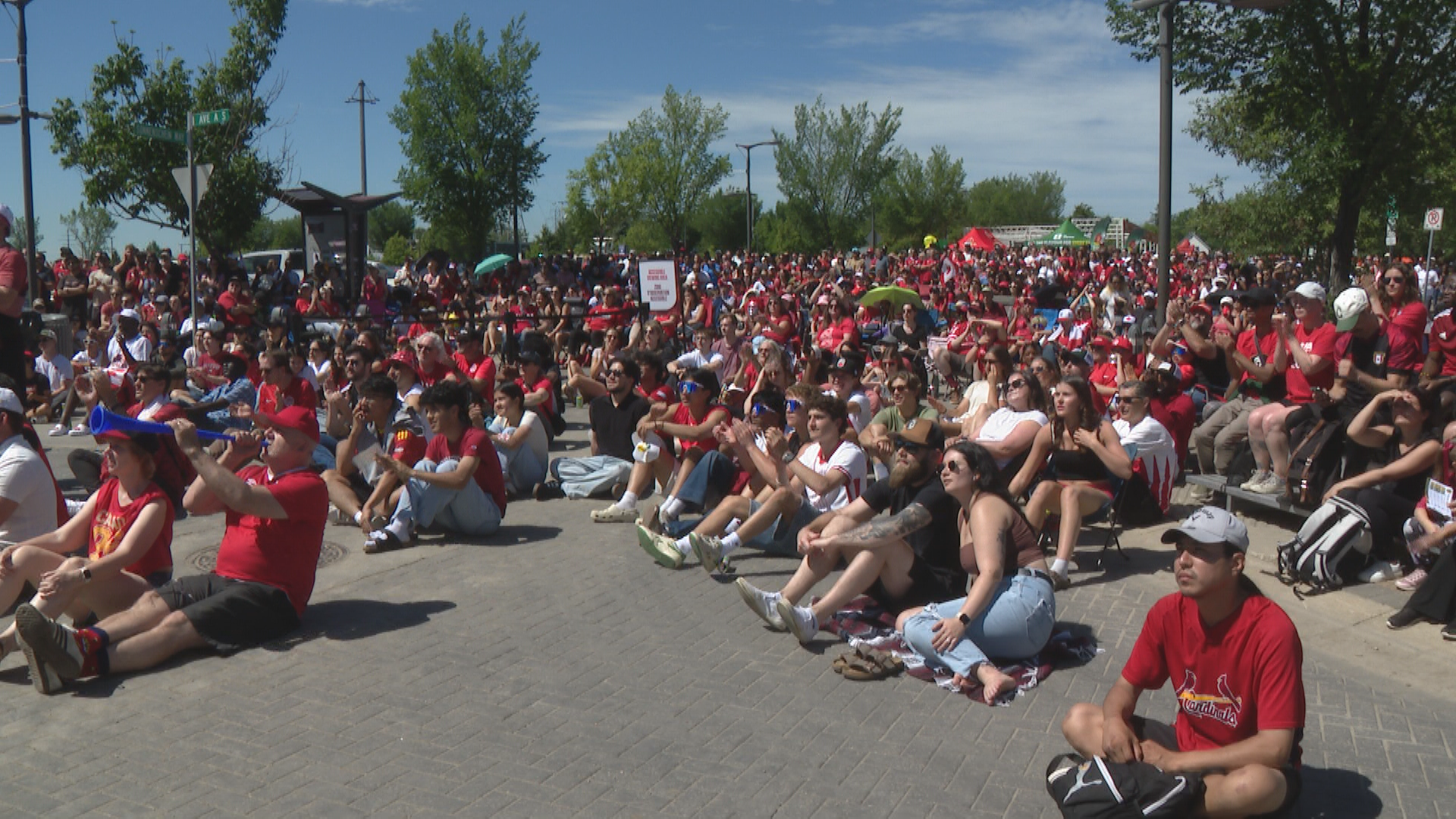
Saskatoon’s Gather Local Market saw thousands of soccer fans pack River Landing on July 4, 2026, to witness Canada’s historic Round of 16 World Cup match against Morocco. While the 3-0 defeat ended the national team's deepest run in tournament history, the massive public turnout in a traditional hockey stronghold exposed a profound municipal gap. Saskatchewan's cultural foundation is shifting rapidly, driven by an immigration boom that treats soccer as a baseline necessity rather than a secondary pastime. Local infrastructure is completely unequipped to handle this new reality, forcing cities to confront decades of lopsided recreational funding.
The ice is melting. For generations, Saskatchewan defined its civic identity through frozen sheets of water, heavy hockey bags, and small-town arenas that consumed the vast majority of municipal capital expenditure budgets.
On Saturday, that old priority list collided with a new demographic truth. Well over a thousand people stood beneath a punishing prairie sun, dressed in a sea of red and white, packed into a market square to watch a sport that many local decision-makers still treat as an afterthought. They watched coach Jesse Marsch’s squad hold the line through an intense first half, matching one of the top teams in the world before ultimately conceding to Morocco’s superior clinical execution. The crowd did not disperse when the goals started mounting. They stayed because the gathering itself felt like an undeniable statement of presence.
The Prairie Hockey Stronghold Confronts a New Reality
Municipalities across Western Canada have long operated under the assumption that winter sports hold an unbreakable monopoly on public interest. That assumption is obsolete. The data coming out of local registration offices tells a story that city halls are struggling to read. Soccer registration numbers across Saskatchewan have climbed steadily over the past decade, yet the physical spaces allocated for the sport remain stubbornly stagnant.
Consider the baseline financial commitment required to maintain a single indoor hockey arena versus an indoor multi-sport turf facility. Ice plants require massive electrical draws, specialized refrigeration technicians, and constant mechanical upkeep throughout months of swinging prairie temperatures. A turf field requires real estate, proper ventilation, and lighting. Despite this disparity in operational efficiency, municipal capital allocation remains heavily weighted toward the arena model.
This is not a failure of public interest. It is a structural failure of municipal imagination. When thousands of people pack a temporary downtown fan zone, they are showing a demand that local sports leagues have been screaming about in budget consultations for years. The kids playing on makeshift patches of grass in city parks today are the ones driving this statistical surge, but they are playing on uneven turf, without proper lighting, and with season schedules compressed by a lack of year-round indoor facilities.
New Demographics and the Field Deficit
The catalyst for this shift is no secret. Saskatchewan’s population growth is heavily driven by international immigration, bringing families from West Africa, the Middle East, South America, and Europe straight to the prairies. These new residents do not arrive with an inherent desire to spend thousands of dollars on hockey equipment and sub-zero rink rentals. They arrive looking for a pitch.
Saskatoon Mayor Cynthia Block acknowledged the changing environment during the event, noting her own history as a long-time soccer mom and stating plainly that the city must build more space for newcomers who bring the sport with them. Acknowledgment is cheap. Concrete is expensive. The current deficit in indoor turf space means that during Saskatchewan’s brutal six-month winters, youth clubs are forced to ration hours, split fields into tiny quarters, or turn away prospective players entirely.
Saskatchewan Recreational Facilities Breakdown (Estimated Allocation)
+-------------------------+------------------------+------------------------+
| Facility Type           | Current Active Count   | Average Public Subsidy |
+-------------------------+------------------------+------------------------+
| Indoor Ice Sheets       | High Density           | Significant / Annual   |
| Indoor Turf Fields      | Critical Deficit       | Minimal / Occasional   |
+-------------------------+------------------------+------------------------+
When a city cannot provide basic athletic spaces for its changing population, it creates an invisible barrier to civic integration. Families who cannot get their children into winter soccer programs are left isolated from the traditional community networks that youth sports provide. The public watch party at River Landing was a visible manifestation of a community trying to build those networks in spite of the infrastructure deficit, using temporary big screens and beer gardens to create a space that should exist permanently.
The High Cost of Cold Weather Inaction
Grassroots soccer cannot survive on summer months alone in a province where snow can fall from October to May. The indoor crunch is where the system breaks down completely. Private facilities charge premium rates that push the sport out of reach for working-class immigrant families, completely undermining the low-barrier appeal that makes soccer a global equalizer.
Public school gymnasiums are frequently used as a fallback option. These spaces are inherently flawed for high-level youth development. Hardwood floors, low ceilings, and basketball hoops do not replicate the dynamics of a true soccer pitch. Players trained in these environments face an immediate competitive disadvantage when traveling to provinces like British Columbia or Ontario, where indoor turf complexes are treated as standard community infrastructure.
The lack of facilities also stymies economic opportunity. Major youth tournaments bring millions of dollars in tourism, hotel stays, and restaurant revenue to host cities. Saskatoon routinely misses out on these economic windfalls because it lacks the centralized, multi-field indoor hubs required to host regional or national competitions. The province is effectively outsourcing its athletic talent and its sports tourism revenue to neighboring jurisdictions that had the foresight to build for a changing world.
Beyond the Beer Gardens and Temporary Screens
The euphoria of Canada’s 2026 World Cup run will eventually fade into statistical history books. The fans who wore bright red wigs, waved flags, and stood shoulder-to-shoulder with Moroccan supporters waving their own banners will return to their daily routines. What remains is a stark public policy choice for Saskatchewan's urban centers.
Cities can continue to treat events like the Gather Local Market watch party as isolated anomalies, convenient photo opportunities for politicians looking to project a modern, multicultural image. Or they can look at the raw numbers and realize that the province's sporting identity has changed permanently. The demand for soccer infrastructure is not a temporary trend tied to a single tournament run. It is a permanent fixture of a modern prairie population that expects its municipal tax dollars to reflect the sports they actually play.
Building a sports culture requires more than just celebrating when a national team makes television history. It requires funding the boring variables. It requires land allocation, winterized utility planning, and a deliberate dismantling of the old spending monopolies that have dictated prairie recreation budgets since the mid-twentieth century. If the cities of Saskatchewan do not begin pouring concrete for indoor pitches soon, the historic momentum generated on the world stage will simply evaporate into the prairie wind.