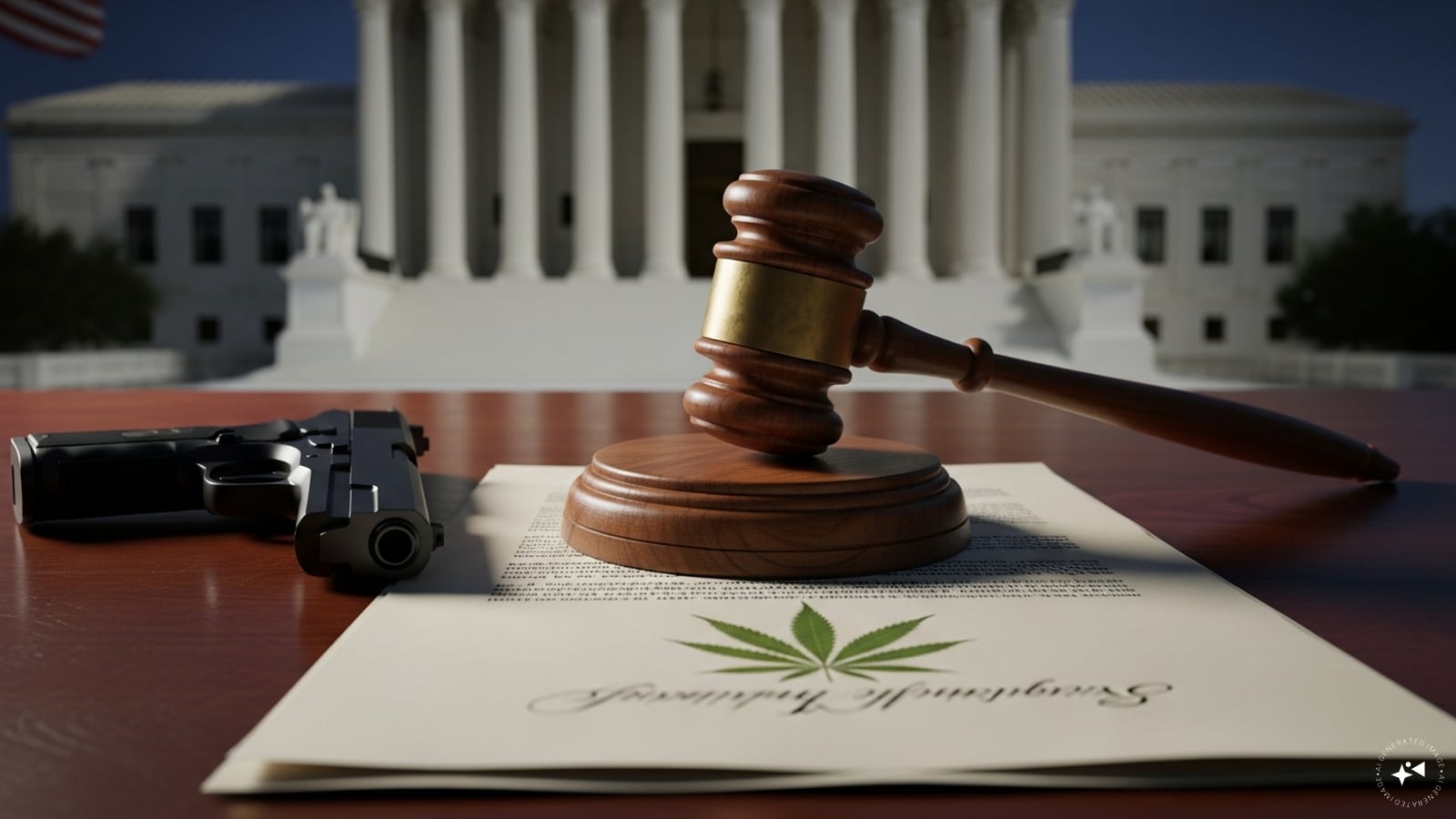
The federal government cannot automatically strip your Second Amendment rights just because you smoke marijuana a few times a week. That is the definitive message from a unanimous U.S. Supreme Court decision. The justices completely rejected a long-standing federal restriction, fundamentally altering how the intersection of gun rights and cannabis use works across the United States.
If you are one of the millions of Americans living in a state where cannabis is legal, you have likely faced a frustrating catch-22. Federal law made it a serious crime for any "unlawful user" of a controlled substance to purchase or possess a firearm. Because cannabis remains illegal under federal law, taking a puff of a joint technically turned you into an unlawful user, meaning you had to choose between your state-sanctioned edible and your constitutional right to self-defense.
The Supreme Court just dismantled that automatic disqualification. In the case United States v. Hemani, the court ruled 9-0 that the federal government cannot use a blanket ban to disarm casual or regular marijuana users without specific proof that they are actually dangerous.
How a Texas Raid Rewrote Federal Gun Laws
The battle started in August 2022 when federal agents raided the Texas home of a man named Ali Danial Hemani. During the search, officers found a 9mm Glock handgun and 60 grams of marijuana. Hemani did not have a violent criminal record. He was not accused of using the gun while high, nor was he accused of committing any other crimes. He simply admitted to investigators that he smoked marijuana about every other day.
That admission was enough for federal prosecutors to charge him under a provision of the Gun Control Act of 1968. That law carries a penalty of up to 15 years in prison for possessing a firearm while being an unlawful drug user.
Hemani challenged the charge. His legal team argued that the law violated his Second Amendment rights and was unconstitutionally vague. Lower courts agreed and dismissed the case, forcing the Justice Department to appeal to the highest court in the land. The resulting unanimous decision is a massive blow to the federal government's broad enforcement strategies.
The Founders Heavy Drinking Habit Broke the Government Case
To understand why the government lost so badly, you have to look at the legal standard established by the Supreme Court in its landmark 2022 ruling, New York State Rifle & Pistol Association v. Bruen. Under the Bruen standard, if the government wants to restrict gun ownership, it must prove that the restriction is deeply rooted in the nation's historical tradition of firearm regulation.
The Justice Department tried to meet this standard by pointing to founding-era laws that stripped gun rights from "habitual drunkards." They argued that modern regular marijuana users are the exact equivalent of historic habitual drunkards.
Writing for the court, Justice Neil Gorsuch completely tore that analogy apart. He pointed out that founding-era drunkard laws did not apply to people who simply drank regularly. If they did, many of America's notable founders would have been legally disarmed.
Instead, those historical laws were designed to protect people from financial ruin or complete physical incapacitation. They were not broad public safety measures meant to label an entire group of people as inherently violent. Gorsuch noted that the government's argument failed under every measure because it assumed anyone who uses marijuana is automatically violent and dangerous.
The Hypocrisy of Federal Cannabis Policy
The Supreme Court did not ignore the massive shift in how the country treats cannabis. Justice Gorsuch explicitly pointed out the awkward position the federal government found itself in during oral arguments.
While federal law technically outlaws marijuana, more than 40 states have legalized it for either medical or recreational use. Even the executive branch under President Donald Trump reclassified medical marijuana as a less-dangerous drug.
The federal government has not just tolerated the booming cannabis market; its shifting policies helped fuel it. Because of this, the court ruled that the government cannot turn around and claim that the millions of ordinary citizens who use marijuana are suddenly too dangerous to own a gun.
The ruling brought together an unusual alliance of political groups. The National Rifle Association and cannabis legalization groups like NORML found themselves fighting on the exact same side as the American Civil Liberties Union. They all argued that categorical assumptions cannot be used to strip a person of a fundamental constitutional right.
Knowing the Boundaries of the New Rule
Do not mistake this ruling for a total legal free-for-all. The Supreme Court was careful to note that its decision is narrow. It changes the landscape for casual and regular users, but it leaves several lines in the sand that you need to know.
- Active Intoxication: The government can still penalize you if you are caught carrying or using a firearm while actively under the influence of cannabis.
- Severe Addiction: The court explicitly stated it was not addressing bans aimed at individuals with severe drug addictions that render them an active danger.
- Individualized Proof: Prosecutors can still try to disarm a marijuana user if they can present specific, individualized evidence proving that the specific person's drug use makes them an actual danger to themselves or others.
- Felony Records: This ruling does not change the federal restrictions that prevent individuals with felony convictions from owning firearms.
The core shift is about the burden of proof. The government can no longer point to a positive drug test or an admission of casual use and automatically take your guns away. They have to prove you are dangerous on an individual level.
If you are a gun owner who uses cannabis in a legal state, your immediate next step is to ensure you remain fully compliant with your specific state's local carry laws. Never mix active consumption with firearm handling, as local public intoxication and reckless endangerment laws remain fully active and strictly enforced.