The air tasted like copper and old paper.
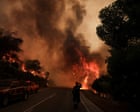
Standing on a dry limestone ridge in the Gironde, you could hear it long before you saw the crimson line chewing through the pine canopy. It sounded like a freight train dragging its brakes across gravel. Constant. Heavy. Unforgiving.
For weeks, the headlines had been sanitized into bureaucratic shorthand. Containment percentages. Hectares burned. Wind vectors. But numbers do not choke your throat at three in the morning, and statistics do not leave behind the ghostly, pale silhouette of a centuries-old farmhouse reduced to a heap of chalky grey ash.
Consider what happens when a forest stops being a living ecosystem and becomes tinder.
Across Southern Europe, the summer of firefighting was not a sequence of isolated incidents. It was a slow-motion collision between modern climate reality and ancient geography. In France, the colossal Gironde megafire had finally met its match in trenches, water-dropping aircraft, and exhausted crews who measured sleep in stolen minutes. Yet, barely a breath away across the Mediterranean, the hills of Greece and the scorched earth of Spain were still crying out under relentless heat domes.
Smoke does not respect national borders. It drifts across the Pyrenees. It stains the Attic sky.
Let us drop the satellite view and step down to the ground. Imagine a hypothetical vintner standing outside Bordeaux, his calloused hands clutching a handful of soil that feels as dry as bone china. This earth has fed his family’s vines for four generations. He knows the exact depth of the water table in June; he knows how the Atlantic breeze usually cools the August nights. But this year, the breeze brought no relief. It brought a furnace wind, blowing straight from the Sahara, turning the humidity to zero and the pine needles into matchsticks.
When the evacuation order finally arrived via a shrill, blinking cell phone alert, he had twenty minutes to decide what history could fit into the bed of a pickup truck.
That is the hidden cost of a megafire. We talk endlessly about carbon metrics and firebreaks, but we rarely speak of the eviction.
The science of these blazes is deceptively simple and terrifyingly effective. Drought dries the vegetation; extreme heat cooks the moisture out of the soil; a stray spark—whether from a discarded cigarette, a downed power line, or spontaneous combustion in organic mulch—strikes the match. Once a fire reaches a certain scale, it creates its own weather. It generates towering pyrocumulonimbus clouds, sucking in oxygen with such violence that it spawns fire tornadoes. Trees explode internally as their sap instantly turns to superheated steam.
In Gironde, the sheer scale of the pine plantations—planted centuries ago to drain the marshes—created a vast, continuous corridor of fuel.
"Contained" is a comforting word. It sounds like an ending.
It is not.
Containment simply means the beast has been thrown into a cage of dirt lines and foam, pacing angrily behind iron bars. But the bars are hot to the touch. In Greece, stubborn pockets continued to flare up through ancient olive groves, threatening archaeological sites and rural hamlets alike. In Spain, firefighters fought exhausting rear-guard actions in rugged terrain where trucks could not follow, relying on hand tools and shovels to scrape the earth down to bare rock before the flames could jump.
The fire leaves behind a silence that is louder than the roar.
Birds are gone. Insects are gone. Even the wind sounds different whistling through skeletal, black poles that used to be green forests. The topsoil, stripped of its biological glue, waits for the autumn rains to wash it down into the choked rivers.
We built our modern European infrastructure assuming a stable climate corridor that no longer exists. Roads, power grids, rural zoning laws—they were all drawn on maps from an era that has effectively vanished. Every summer now tests the limits of that architecture.
The vintner in Gironde will replant. He has to. It is the only future he knows. But he will not plant the same way, and he will not look at the horizon with the same naive trust.
The sky over the Mediterranean clears slowly, bruised purple and orange as the sun sinks low, casting a long, amber shadow over the blackened hills where the embers still glow beneath the ash, waiting for the dark.