There is a specific smell to living in a tin can falling through the dark. It is not the smell of ozone or the clean metallic tang of a machine shop. It is old skin. It is metabolic dust. It is the accumulated ghost of every meal eaten, every mile run on a tethered treadmill, and every drop of sweat that has nowhere to go.
Ask any veteran spacefarer about the odor of a long-duration station rotation, and they will tell you about the laundry problem.
On Earth, we take water for granted. We treat it like an infinite resource, dumping gallons into washing machines to violently agitate our clothes until the grease and bacteria surrender. But in low Earth orbit, or during a hypothetical transit to the red dirt of Mars, water is currency. Every single drop is sweated out of the air, filtered through chemical beds, purified, and turned back into yesterday's coffee. Spending precious hydration on a pair of shorts is a luxury that physics simply refuses to subsidize.
So, what happens instead? You wear your clothes until they cry for mercy. Then you wear them some more.
When cotton and synthetic blends absorb months of human perspiration in zero gravity, they become tiny, pressurized ecosystems. Microbes thrive in the damp, warm microclimate between fabric and skin. Without the scouring power of traditional laundering, textiles transform into biological archives.
Picture Commander Elena Vance, stepping out of the airlock after a six-hour spacewalk. Her heart is hammering. Her skin is slick with exhaustion. She peels off her undersuit—a garment that has absorbed a week of high-stress exertion. It doesn't just smell; it is stiff. Salt crystals have formed a rigid cartography across the shoulders. That fabric is saturated with millions of microscopic squatters, bacteria that view her body not as a partner, but as an infinite buffet.
For decades, the space program dealt with this through the most heartbreakingly mundane solution imaginable. They threw the clothes away.
Cargo ships packed with fresh uniforms, food, and propellant launch toward orbit with regular cadence. When the cargo holds empty, astronauts pack them with refuse. When the supply ships uncouple and drop out of orbit, they burn in the upper atmosphere. Millions of dollars of textiles, cotton shorts, and wool socks incinerated in a brilliant streak of plasma because washing them was too heavy a thermodynamic burden.
It is an absurd logistical tax on exploration. We are trying to reach other worlds while weighed down by the dirty laundry of our own making.
The Physics of the Invisible Clean
To understand why a group of scientists decided to build a gun that shoots clothes clean, you have to understand what water actually does in a washing machine.
Water is a solvent. It is a transport medium. It carries detergent molecules to grease and carries detached filth down the drain. But in a zero-gravity environment, water behaves like a stubborn gelatinous blob. It clings to surfaces, forms floating spheres, and refuses to flow through fabric pores the way it does on Earth. Introduce a stream of water inside a capsule, and you risk shorting out avionics or creating floating droplets that astronauts could accidentally inhale.
Liquid water is an enemy of spacecraft efficiency.
So the engineers looked past the liquid state entirely. They looked toward the edge of matter. They looked at carbon dioxide.
Imagine taking ordinary gas and squeezing it until it forgets what state it belongs to. Under extreme pressure and precise temperature control, carbon dioxide enters what chemists call a supercritical state. It is neither purely a gas nor strictly a liquid. It possesses the density of a liquid, allowing it to dissolve oils and organic compounds, but it maintains the viscosity of a gas, slipping effortlessly through the tightest weave of a synthetic athletic shirt.
This is the secret behind modern dry cleaning on Earth, but miniaturizing it and adapting it for a metal tube hurtling through the vacuum of space required a radical pivot in industrial design.
Enter the prototype device that aerospace reporters have casually dubbed the laundry gun.
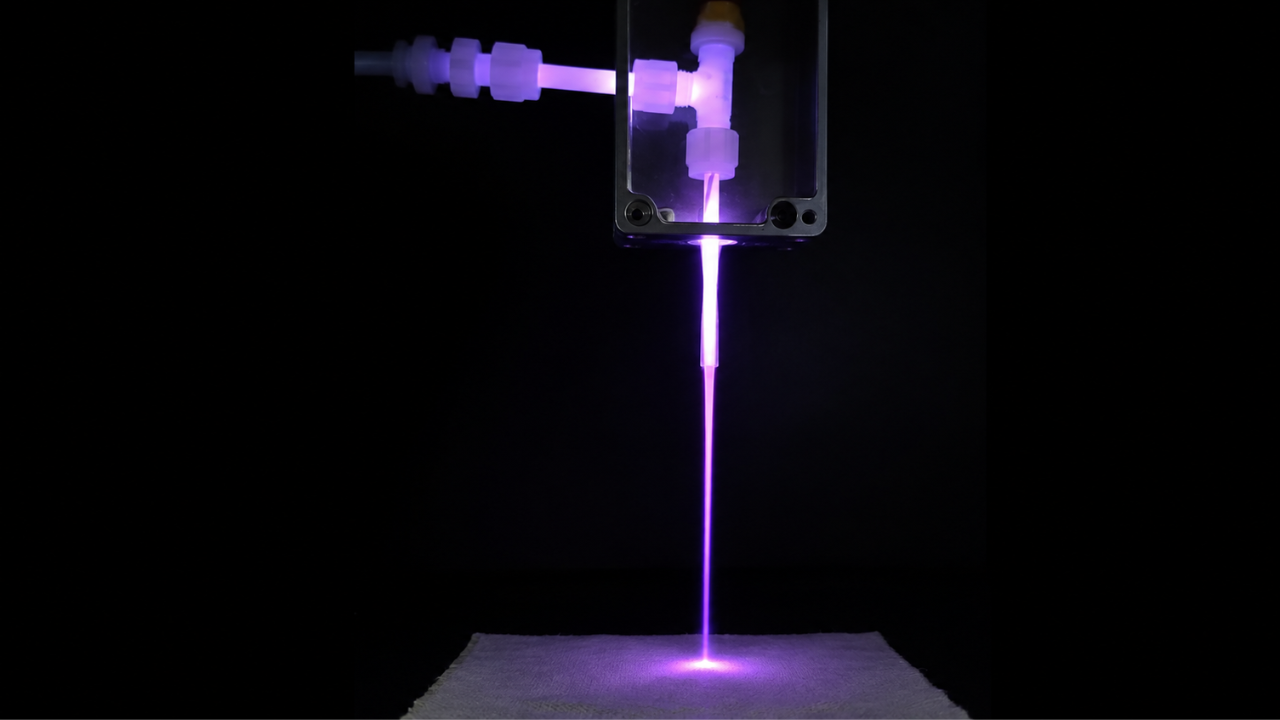
It is not a firearm in the cinematic sense. It does not discharge lead or plasma. Instead, it is a handheld applicator connected to a closed-loop recycling chamber. You place a heavily worn garment inside a compact containment sleeve, point the nozzle, and pull a trigger.
High-pressure supercritical carbon dioxide rushes into the fabric matrix. It blasts through the microscopic canyons between cotton threads, dissolving body oils, dead skin cells, and microbial cell walls on contact. The pressurized gas strips the filth away, dragging the microscopic invaders into a recovery filter.
Then comes the magic trick of the physics involved. The pressure drops. The carbon dioxide instantly flashes back into a harmless gas, leaving the garment bone-dry, sterile, and entirely free of moisture. The extracted oils and biological waste are trapped in a solid residue collector, while the gas is re-compressed and used again.
No water wasted. No clothes thrown into the incinerator.
The Weight of Going Farther
Consider what this means for a mission to Mars.
A round trip to the Martian surface will take roughly three years. There are no space Amazon deliveries halfway there. Every single pound of mass launched from the surface of Earth requires an exponential amount of fuel. Every kilogram of spare clothing you pack is a kilogram of food, scientific equipment, or structural shielding you had to leave behind.
If you can recycle a single set of clothes fifty times instead of throwing it away after five, the mass equation changes entirely.
We often talk about space exploration through the lens of grand achievements. We talk about rocket telemetry, thermal shields, ion propulsion, and orbital mechanics. We celebrate the hardware that conquers distance. But survival in the void is won in the margins. It is won in the quiet, unglamorous struggle against entropy, body odor, and microbial colonization.
When Elena Vance eventually points that handheld applicator at her uniform, pulling the trigger with a soft hiss of compressed gas, she is not just cleaning a shirt. She is cutting the umbilical cord that ties humanity to Earth's supply lines. She is gaining a little more autonomy. A little more endurance.
The air clears in the small utility bay. The fabric feels cool, soft, and neutral against her fingers. For a brief moment, standing thousands of miles away from the nearest ocean, she is wrapped in something that feels like home, cleaned by a technology that respects the harsh arithmetic of the stars.
The machine clicks off. The green light glows steady.
Outside the hull, the infinite black waits. But inside, the air smells like nothing at all.