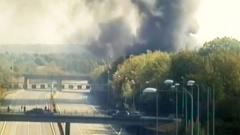
The amber glow did not look like fire at first. From a mile away, across the flat, concrete sprawl of the industrial estate, it looked like a welding torch left burning in the night.
Then came the sound. It was not a crackle. It was a rhythmic, heavy thumping, like a giant’s fist beating against the underside of the earth, punctuated by the sharp, metallic shrieks of corrugated iron tearing apart under intense thermal stress.
By the time the horizon turned the color of bruised plums, the asphalt of the M25—Europe’s busiest orbital artery—was already cooling into an eerie, unnatural silence. Tens of thousands of commuters, haulers, and travelers found themselves frozen in place, staring at a billowing plume of black smoke that climbed miles into the atmosphere, carrying with it the volatile secrets of a burning warehouse.
The Anatomy of an Invisible Threat
We tend to view our infrastructure as permanent. We look at six lanes of smooth concrete, overhead gantries flashing electronic limits, and miles of safety barriers as monuments to human permanence. We forget how fragile the ribbon really is.
When a massive industrial fire breaks out, the immediate danger is visible: the flames, the smoke, the blinding light. But the true danger is what remains unseen. In this particular warehouse fire, the looming specter was not just structural collapse, but the terrifying risk of explosion. Commercial storage facilities are often modern-day Pandora's boxes. They hold pressurized cylinders, industrial solvents, household chemicals, and lithium-ion batteries stacked by the pallet.
Imagine standing fifty yards away when a sealed canister of acetylene or propane hits its critical temperature threshold. The metal does not merely melt; it yields catastrophically. The shockwave travels faster than sound, shattering windows blocks away and turning ordinary debris into shrapnel.
Emergency services knew this. That is why the perimeter was pushed back not by yards, but by miles. That is why the motorway was brought to an absolute, grinding halt.
The Ripple Effect Across the Asphalt
Traffic is a living organism. Disturb one vein, and the entire body spasms.
When the decision was made to close sections of the M25, the impact did not stay confined to the tarmac. It cascaded outward into sleepy commuter towns, narrow village lanes, and residential side streets that were never engineered to carry forty-ton articulated lorries.
Consider Sarah, a logistics driver who had been behind the wheel since four that morning, hauling fresh produce destined for supermarket shelves across the capital. She watched the electronic matrix signs switch from speed limits to stark, unyielding red crosses.
Minutes later, her GPS began recalculating frantically, offering routes through suburban neighborhoods choked with diverted traffic. She did not move an inch for three hours. Outside her cab, the air smelled faintly of burning plastic and acrid rubber—a smell that clung to the back of the throat long after the engine was switched off.
This is the hidden cost of modern efficiency. We build our lives around speed, seamless connectivity, and just-in-time delivery schedules. When a single node in that vast network fails catastrophically, the illusion of control shatters instantly. We are reminded that our high-speed civilization is built on top of very old, very vulnerable ground.
Firefighting in the Dark
Inside the exclusion zone, the reality of the response was a symphony of coordinated chaos. Fire crews from multiple counties converged on the scene, their hoses drawing millions of gallons of water from local mains and nearby rivers, turning the streets into shallow, rushing streams.
Fighting a fire where explosion risks are high requires a terrifying calculus. You cannot simply rush in with water hoses. Certain chemicals react violently with water; others require specialized foam or dry powder. Commanders must weigh the value of the physical structure against the safety of the personnel on the ground.
Firefighters wore heavy breathing apparatus, their faces illuminated by strobing red and blue lights, listening intently for the distinct, high-pitched whistling sound that metal makes right before it ruptures. They worked in rotation, drenched in sweat despite the freezing night air, driven by a singular imperative: keep the blast contained. Keep it from reaching the fuel tanks parked outside. Keep it from jumping to the adjacent properties.
The hours bled together. The smoke column shifted from pitch black to a dirty, churning grey as dawn began to bleed over the horizon, revealing the charred skeletal remains of the warehouse roof sagging inward like a broken ribcage.
The Long Road to Reopening
Long after the flames were beaten back into smoldering embers, the work of recovery had only just begun.
You cannot simply reopen a major highway after an intense thermal event. Engineers had to move in with laser scanners and thermal cameras to inspect the surface of the M25 itself. Intense heat can weaken the steel reinforcement within concrete bridges, warp overhead sign gantries, and cause micro-fractures in the asphalt that could cause a high-speed blowout weeks later.
Every inch of the affected corridor had to be certified safe. Every scorched barrier had to be replaced.
When the road finally reopened, the traffic flowed again, hesitant at first, then returning to its relentless, mechanical rhythm. Commuters sped past the charred perimeter, glancing momentarily at the blackened ruins before returning their eyes to the road ahead.
Life resumes quickly. But for one night, the great mechanical pulse of the region stopped, forced to look up at the dark smoke and remember how close we always are to the edge.


