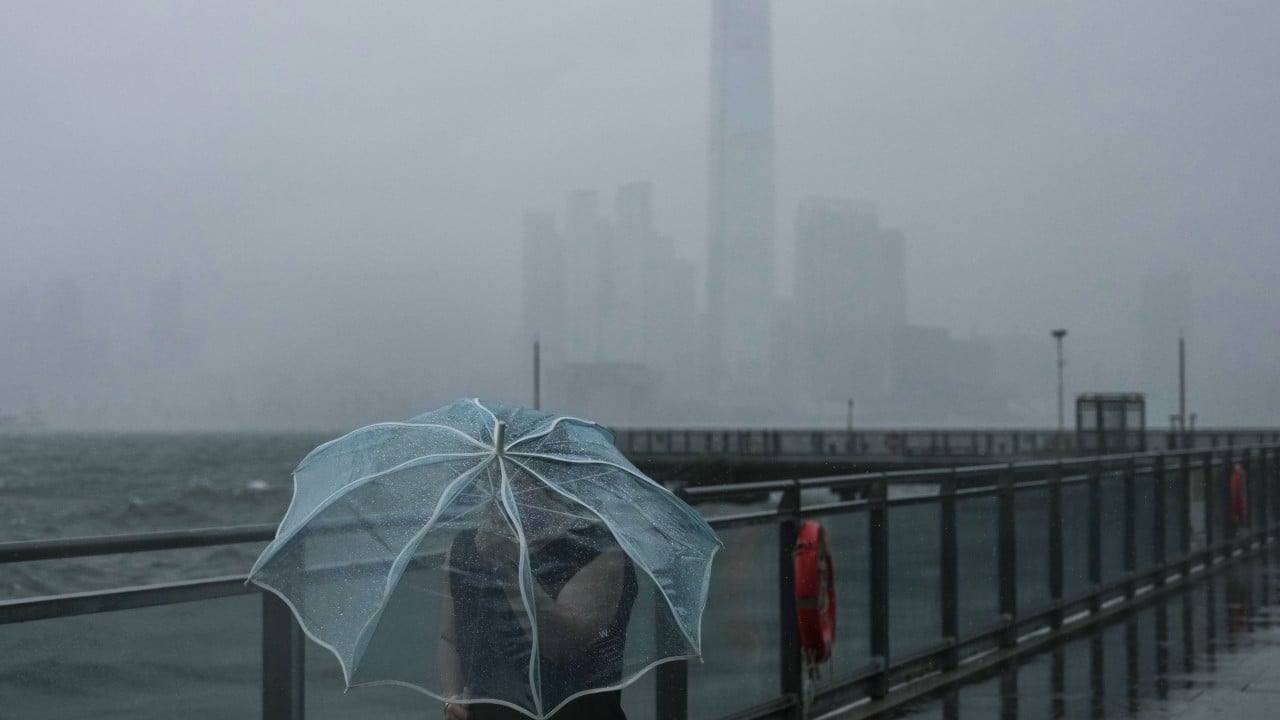
Rain in Hong Kong does not fall; it arrives. It strikes the concrete with the weight of lead, drumming a frantic rhythm against office towers that pierce the gray fleece of the stratosphere. Down in the narrow corridors of Causeway Bay, the neon signs blur into bleeding smears of crimson and electric blue. For generations, the rhythm of this city has been dictated by the typhoons that roar in from the South China Sea, twisting wind vanes and forcing millions indoors behind shuttered windows.
When Signal Number 8 is hoisted, the city holds its breath. You might also find this connected article useful: Universal Basic Income Will Not Save Us From Automation.
I remember standing near Victoria Harbour during a late summer squall years ago, watching the harbor water swell until it began to lap over the granite promenade. The fear wasn't just the wind. It was the waiting. It was the frantic scramble of hundreds of thousands of people trying to outrun a storm while drainage systems gasped and traffic lights flickered out in chaotic clusters. You felt entirely small, an ant caught in the machinery of an indifferent ocean.
That vulnerability has always been the baseline of coastal life. But next typhoon season, something unprecedented will share the rain with us. As highlighted in detailed articles by MIT Technology Review, the results are widespread.
The Mind Behind the Spires
Behind glass doors in government offices, officials like Eric Chan have been watching a different kind of storm gather. Not one of wind and water, but one of data. They call it an AI city brain.
To picture it, strip away the cold jargon of neural networks and algorithms. Imagine instead a vast, invisible nervous system woven through the veins of the metropolis. Beneath the asphalt of Nathan Road, inside the traffic gantries overhead, and behind the lenses of thousands of closed-circuit cameras, millions of data points are whispering to each other in milliseconds.
When a pressure drop is registered out at sea, the brain does not wait for a human supervisor to connect the dots. It is already calculating the trajectory, factoring in tidal surges, historical flood maps, and the exact volume of water currently draining through subterranean conduits.
It is a shift from reaction to anticipation. For decades, urban disaster management has been a game of catching up. A street floods, someone calls emergency services, a crew is dispatched, a warning is broadcast. By the time the bottleneck clears, the damage is done. The city brain aims to invert that timeline. It sees the bottleneck forming in code before the first drop of water pools on the sidewalk.
The Human Cost of Hesitation
Consider what happens in a typical crisis. A bus driver navigates a flooded underpass because the detour sign hasn't been updated yet. A hospital loses backup power for precious minutes because maintenance logs were buried in a paper folder. A landslide cuts off a residential slope in Mid-Levels, and rescue teams waste critical time figuring out which access roads are still passable.
These are not failures of competence. They are failures of human bandwidth. Our brains are simply not built to synthesize real-time data from eight
The Concrete Shoreline Remembers Every Storm
technology, news
The wind does not knock before it enters Hong Kong. It arrives first as a low, sullen growl off the South China Sea, rattling the glass facades of Admiralty and whipping the laundry on the bamboo poles of public housing estates in Chai Wan. By the time the warning signals climb to a screaming T8 or T10, the sea has already decided to reclaim the asphalt.
We have lived with this rhythm for generations. You tape the windows. You stock the pantry with instant noodles and bottled water. You watch the harbor gray out, turning the color of wet slate, and you wait.
For decades, waiting was all we could do.
Then came the numbers. Thousands of sensors, miles of fiber optic cables, and a silent, sleepless intelligence designed to watch the water before the water even knows it is rising. This is what officials call the artificial intelligence city brain. But behind the cold terminology of administrative updates—such as Eric Chan’s recent announcement that the system could face its baptism by wind as early as the next typhoon season—lies a quieter, more urgent human reality.
We are trying to outsmart the sky.
Consider a hypothetical night in Heng Fa Chuen. Water surges over the promenade, turning the underground parking garages into dark, rising lakes. In the past, the alarm was raised by a security guard making a wet, dangerous round with a flashlight, or by a resident shouting up a stairwell. Information crawled at human speed, while the storm ran at sixty knots.
Now, imagine that same night filtered through a network of predictive eyes.
Cameras on the sea walls do not just record the waves; they measure the kinetic fury of the tide against the concrete. Underground drainage monitors listen to the gurgle of storm drains, calculating flow rates before a single puddle spills onto a main road. Traffic lights, pedestrian tunnels, and emergency dispatch centers talk to one another in milliseconds.
This is not magic. It is pattern recognition on a scale no human brain can manage while standing in horizontal rain.
The system—often described clinically as an urban operating system—takes the chaotic variables of weather, geography, and human density and translates them into a single, blinking red line on a screen in a control room. It asks a simple, terrifying question: Where will the water be thirty minutes from now?
And more importantly: Who is in its path?
Yet, technology does not erase fear; it merely changes its shape. When you introduce an algorithmic layer between a city and its disaster response, a new kind of anxiety takes root. Will the sensors fail in a salt-spray blackout? Will the algorithm panic, or worse, become complacent? We have spent centuries learning to trust the barometer and the weather anchor on the evening news. Trusting a server rack buried deep beneath a commercial tower requires a different kind of faith.
It is a faith built on invisible labor.
Months before the first typhoon banner goes up, engineers walk the damp maintenance tunnels, checking connections. Data scientists clean corrupted feeds, teaching the software to ignore the stray reflection of a neon sign on a wet street so it does not mistake light for a rising hazard. This is the unglamorous underbelly of the smart city. It is not sleek. It smells of ozone, damp concrete, and coffee grounds gone cold at four in the morning.
When Eric Chan speaks of testing this infrastructure against the raw fury of the upcoming typhoon season, he is not just talking about software performance metrics. He is talking about a city holding its breath.
Hong Kong is a vertical labyrinth built on reclaimed land and stubborn ambition. Every square foot is contested, every street canyon a potential wind tunnel. When a super typhoon hits, the margin between minor inconvenience and catastrophic paralysis is measured in centimeters of water and seconds of warning.
If the city brain works as intended, the rescue trucks roll out before the highway floods. The power grid cuts off a vulnerable substation before a short circuit can cascade through a neighborhood of fifty thousand souls. The chaos is contained, smoothed over by millions of calculations running silently in the dark.
And if it fails? We fall back on the old ways. The brooms, the sandbags, the neighbors pulling each other through waist-high water while the rain screams overhead.
The wind is howling outside your window right now. The glass flexes, just a fraction, under the pressure of the gale. Somewhere in the heart of the city, millions of lines of code are quietly trying to predict what happens next, desperate to keep the dark water at bay.