The coffee was still steaming on the laminate table when the windows ceased to be glass and became shrapnel. In the southern suburbs of Beirut, and in the terraced hills of the south, mornings are usually defined by the scent of roasting beans and the rhythmic sweep of shopkeepers clearing the overnight dust. That rhythm is gone now. It has been replaced by a sound so profound it is felt in the marrow before it is heard by the ear. It is the sound of a geography being rewritten by fire.
When we talk about "deadly strikes," we are using clinical language to describe the erasure of a kitchen. We are talking about the way a child’s backpack, once filled with geography homework and a squashed sandwich, becomes part of a grey mound of pulverized concrete. International rights bodies have begun to issue their condemnations, their voices rising in a chorus of legalistic outrage, but the law feels very far away when the horizon is a jagged line of rising smoke.
The numbers are staggering, but numbers are a sedative. They allow us to look at a tragedy without seeing the faces. When a report says hundreds have been killed in a single day, the brain struggles to process the weight. To understand Lebanon right now, you have to look smaller. You have to look at the single shoe left on a balcony. You have to look at the silence of a village that was, twenty-four hours ago, loud with the gossip of elders.
The Anatomy of an Afternoon
Consider a hypothetical woman named Farah. She is not a fighter. She is a teacher who worries about her mother’s blood pressure and the rising price of bread. When the warnings flashed on her phone—messages from an invading military telling her to flee her home—she had exactly ten minutes to decide what a lifetime was worth. Do you take the photo albums? The deed to the house? The medicine?
Farah represents the millions currently caught in a vise. The strikes are described by military spokespeople as "surgical" and "targeted," aimed at the infrastructure of a militant group. But surgery, when performed with two-thousand-pound bombs in a crowded neighborhood, has a way of becoming a massacre. Human Rights Watch and Amnesty International are pointing to the scale of the destruction as evidence of a disregard for civilian life that crosses the line into war crimes. They argue that even if a target is legitimate, the "collateral damage"—that bloodless, horrific phrase—is so disproportionate that the entire operation loses its legal footing.
But Farah isn't thinking about the Geneva Convention. She is sitting in a car that hasn't moved in six hours, trapped in a river of steel and desperation flowing toward Beirut. She is watching the sky. In Lebanon, the sky has become a predator.
The Architecture of Ruin
The strikes have not been confined to the border. They have reached deep into the heart of the country, striking residential blocks, medical centers, and the very roads people use to escape. This is the strategy of total pressure. By turning the civilian environment into a battlefield, the intent is to break the will of a population. Yet, history suggests that will does not break; it only hardens into a bitter, jagged resentment that will fuel the next fifty years of conflict.
Legal experts point to the principle of distinction. It is the simple, foundational idea that you must tell the difference between a soldier and a baker. When bombs level entire apartment complexes because a "launcher" might be hidden in the basement, the distinction vanishes. The baker dies with the soldier. The children in the apartment above die with the soldier. The city itself becomes a target.
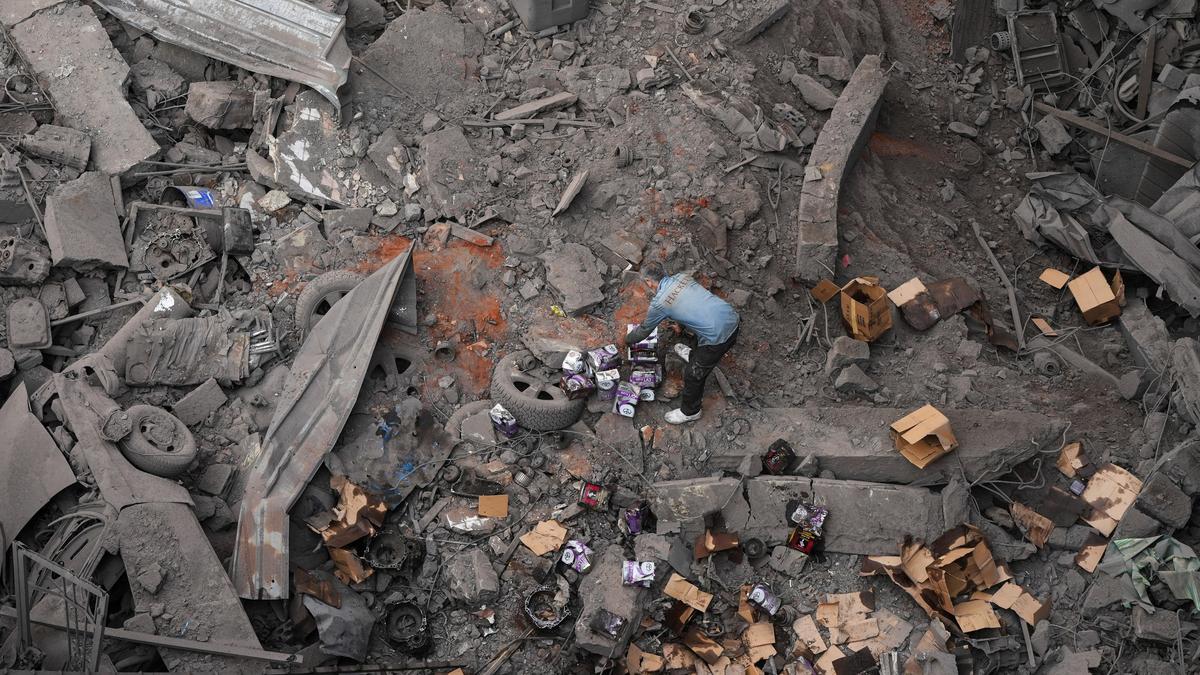
The international community watches through the lens of a smartphone. We see the plumes of smoke, the orange flashes of secondary explosions, and the frantic digging of rescue workers with bare hands. There is a specific kind of dust that comes from a collapsed building—a fine, white powder that coats the lungs and turns every survivor into a ghost before they are even dead. It is the dust of crushed dreams, of pulverized memories, of a middle class that has already spent the last five years drowning in economic collapse, only to be finished off by high-explosives.
The Invisible Stakes
What is being lost isn't just infrastructure. It isn't just the power lines or the bridges. It is the invisible fabric of a society. When you displace a million people in a week, you aren't just moving bodies. You are severing the ties that keep a nation sane. You are creating a generation of children who will jump at the sound of a slamming door, who will never look at a clear blue sky without a flicker of terror.
The rights bodies are right to be outraged. They highlight that the sheer volume of explosives dropped on Lebanon in these recent days rivals some of the most intense bombing campaigns of the twenty-first century. But their condemnation lacks teeth. It is a paper shield against a rain of steel. The world has become accustomed to the "unprecedented." We have developed a callus over our empathy. We see the headlines about "Israel’s deadly strikes" and we scroll past, perhaps pausing for a second of pity before checking the weather or our stocks.
But for the people on the ground, there is no scrolling past. There is only the wait. The wait for the next drone hum, which sounds like a giant, angry insect circling the rooftops. The wait for news of a relative in the south who didn't answer their phone. The wait for a ceasefire that feels like a fairy tale told to keep children quiet in the dark.
The Logic of the Grave
There is a cold logic used to justify this. It is the logic of security, the idea that one side’s safety justifies another side’s annihilation. It is a zero-sum game played with human lives. The military objective is to push back an enemy, to clear a zone, to ensure that rockets stop falling on their own northern towns. It is a goal any state would pursue. But the cost—the sheer, bloody cost—is being paid by people who never held a gun.
The strikes have hit ambulances. They have hit civil defense workers who were trying to pull the living from the dead. These are not accidents of war; they are the inevitable outcomes of a campaign that prioritizes "maximum impact" over human life. When the rules of engagement become this loose, the world becomes a much more dangerous place for everyone, not just those in the crosshairs. It sets a precedent that says if you are strong enough, the laws of humanity are merely suggestions.
We are witnessing the death of the "proportionality" argument. In legal terms, proportionality means that the harm caused to civilians should not be excessive in relation to the concrete and direct military advantage anticipated. How do you measure a military advantage against the life of a ten-year-old girl? How many launchers is a primary school worth? The math of war is always ghoulish, but in Lebanon, the equations have completely broken down.
The Weight of the Silence
In the evenings, when the bombing pauses for a few minutes, a terrifying silence settles over the country. It is not the silence of peace. It is the silence of bated breath. In the shelters—schools, parking garages, half-finished malls—thousands of people huddle together. They share blankets and what little food they managed to grab. They are the "displaced." Another clinical term.
To be displaced is to be stripped of your identity. You are no longer an engineer, a mother, a student, or a grandfather. You are a number in a UN report. You are a mouth to feed. You are a problem to be solved. The indignity of it is almost as sharp as the fear. To have worked for forty years to buy a home, to plant a garden, to build a life, and to see it erased in a three-second burst of kinetic energy is a trauma that no "outrage" from a rights body can ever heal.
The world talks about "escalation" as if it were a weather pattern, something that just happens. But escalation is a series of choices. It is the choice to pull the trigger. It is the choice to ignore the pleas for a diplomatic exit. It is the choice to believe that peace can be built on a foundation of rubble.
Beyond the Condemnation
The outrage from international organizations is necessary, but it is also a confession of helplessness. They document the craters. They count the dead. They verify that the weapons used were American-made or locally modified. They issue press releases that use words like "catastrophic" and "unacceptable." And then, the next morning, the strikes begin again.
The real story of Lebanon right now isn't in the halls of the UN or the briefing rooms in Tel Aviv. It is in the hospitals where doctors are working thirty-six-hour shifts, performing amputations on children by the light of their phones because the fuel for the generators is running low. It is in the eyes of the young men who are looking at the ruins of their streets and feeling the first cold embers of a lifelong rage take hold.
We are told this is a war for security. But as the smoke clears over Tyre and Sidon, as the rubble piles up in the streets of Dahiyeh, you have to wonder what kind of security is being bought. If you kill a man’s family and destroy his world, you haven't made yourself safer. You have simply ensured that he has nothing left to lose.
The sun sets over the Mediterranean, casting a long, beautiful orange light over a coastline that is broken and burning. It is a stunning view, if you can ignore the smell of cordite and the sound of sirens. It is a reminder that the world is indifferent to our violence. The sea will still lap at the shore, and the mountains will still stand, long after the "deadly strikes" are finished and the "outrage" has faded into the next news cycle.
But for the people of Lebanon, the morning is not coming. They are trapped in a long, loud night, waiting for a world that claims to care about human rights to prove that those rights belong to them, too. Until then, they will continue to dig through the dust of their lives, looking for anything that survived the fire. Often, they find nothing but the heat.