The rain in the city doesn’t just fall. It attacks from the side, whipped by the wind tunnels between glass towers, turning an ordinary commute into a minor battle for survival.
Picture a typical Tuesday rush hour. You are juggling a wet, heavy canvas dome in your right hand. Your left hand tries to navigate a smartphone screen slicked with raindrops, attempting to call a ride or check a transit map. A sudden gust catches the fabric. The metal ribs groan. In that split second, you are not a highly evolved citizen of the modern world. You are an exhausted primate wrestling with a piece of technology that hasn't fundamentally changed since the ancient Egyptians stretched palm leaves over wooden sticks.
We have automated our homes, outsourced our memories to servers in the desert, and put rovers on Mars. Yet, when the clouds open up, we still walk around holding sticks over our heads like medieval guardsmen.
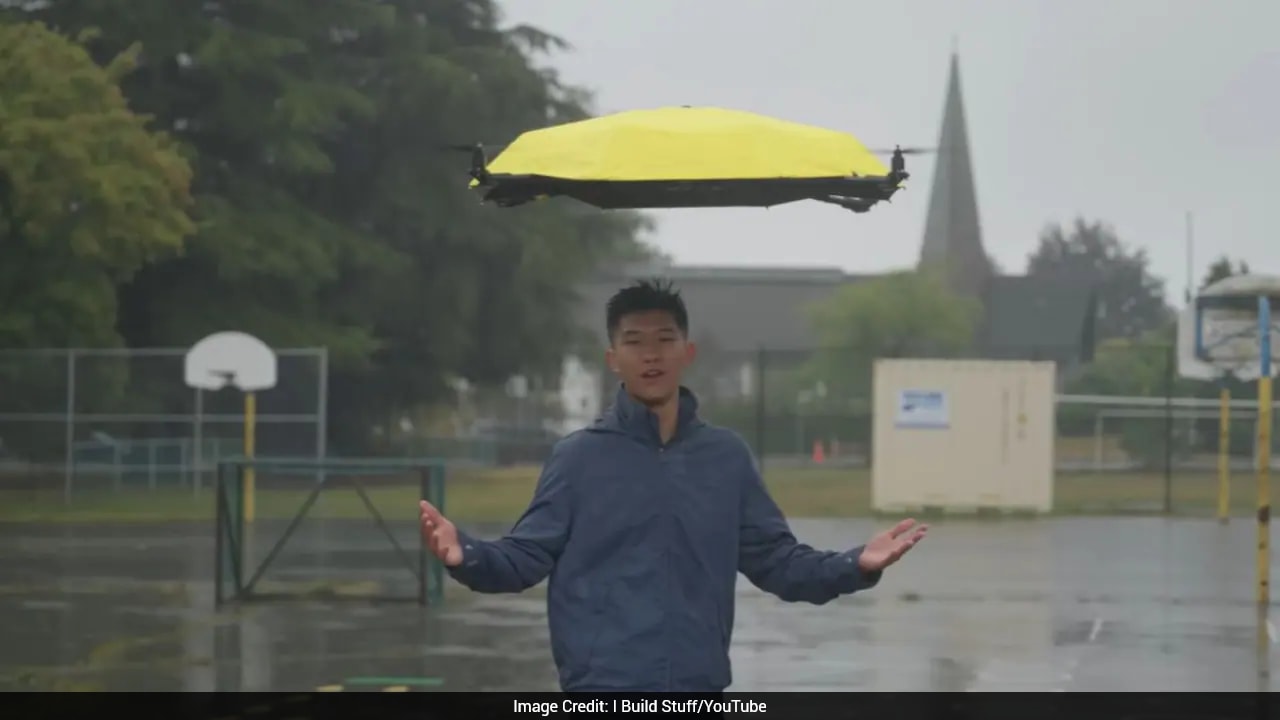
That is why a recent video tore through the internet over the last few weeks, racking up millions of views and leaving a trail of disbelief in its wake. It wasn’t a sleek smartphone launch or a flashy electric vehicle reveal. It was a video of a man walking down a rain-slicked sidewalk, his hands buried deep in his pockets, while a matte-black umbrella floated precisely three feet above his head, tracking his every move like an attentive robotic pet.
The internet reacted with its usual mix of viral euphoria and deep skepticism. Was it a CGI hoax? A clever magic trick involving invisible wires?
It wasn't. The flying umbrella is entirely real, a marriage of drone technology and advanced computer vision. But the frenzy it sparked reveals something much deeper than a collective fondness for quirky gadgets. It exposes a profound, unspoken frustration with the friction of everyday life.
The Weight of the Invisible Anchor
To understand why a floating canopy feels so revolutionary, we have to look at what the traditional umbrella actually costs us. Not in dollars, but in human bandwidth.
Psychologists often talk about cognitive load—the amount of mental effort being used in the working memory. When you carry a traditional umbrella, you aren't just holding a handle. You are constantly calculating wind resistance. You are adjusting your grip to avoid poking a passing stranger in the eye. You are sacrificing one of your two primary tools for interacting with the physical world.
Consider a hypothetical commuter named Sarah. She is a graphic designer, a mother, and a daily train rider. On a rainy morning, Sarah’s hands are her most precious commodity. She needs one hand to hold her toddler’s fingers as they cross the slick asphalt. She needs the other to carry her briefcase containing a company laptop. When it rains, she runs out of limbs. She must choose between getting soaked, dropping her work, or letting go of her child’s hand.
This is the invisible anchor of bad design. It forces a compromise where there shouldn't be one.
When the autonomous umbrella enters the frame, it isn't just keeping off the rain. It is restoring autonomy. By lifting the physical burden off our shoulders and out of our hands, it returns that lost bandwidth. Sarah can hold her child with one hand and her briefcase with the other, while the storm rages harmlessly above them. The technology shifts from an active chore to a passive shield.
Breaking Down the Magic
The mechanics behind this viral sensation are deceptively complex, stripping away the old-world mechanics of fabric and wire and replacing them with a delicate dance of algorithms and aerodynamics.
At its core, the device is a highly specialized drone, but it functions completely differently than the quadcopters used for aerial photography. A standard drone requires a pilot with a remote control, focused entirely on keeping the craft airborne and on course. The flying umbrella removes the pilot from the equation.
Instead, it relies on a sophisticated suite of sensors and a localized tracking system. Here is how the magic actually happens:
- The Digital Tether: The umbrella pairs with a small beacon carried by the user, usually embedded in a smartphone app or a lightweight clip attached to a belt or backpack.
- Computer Vision: Tiny, high-speed cameras built into the underbelly of the drone constantly scan the environment, recognizing the user's silhouette and calculating distance, speed, and trajectory in real time.
- Aerodynamic Compensation: Standard drones push air downward to stay aloft. If you put a solid fabric canopy directly above the propellers, you block the airflow and the drone crashes. Engineers solved this by redesigning the propulsion system, placing the rotors around the periphery of the canopy or using proprietary ducting to channel air efficiently while still providing shelter.
The result is a machine that doesn't just fly; it anticipates. If you speed up to catch a bus, the canopy tilts slightly forward, accelerating to stay ahead of your stride. If you stop at a crosswalk, it hovers in place, maintaining its protective dome over your head.
It feels like magic because the technology works hard to make itself invisible.
The Turbulence of Reality
As mesmerizing as the viral footage is, anyone who has ever stood on a street corner during a November gale knows that reality is rarely as smooth as a compressed internet video. The transition from a viral prototype to a practical consumer product is fraught with physics-based hurdles that cannot be solved by software alone.
The first and most glaring obstacle is battery life. Propelling a device through the air requires immense energy. Lifting a payload that includes a battery, motors, sensors, and a canopy heavy enough to deflect water is an inefficient use of electricity. Currently, most prototypes can only stay aloft for fifteen to twenty-five minutes before needing a charge. That might get you from the subway station to your office door, but it won’t sustain you through an afternoon of running errands.
Then there is the noise. Drones are notoriously loud, producing a high-pitched, buzzing whine that sounds like a swarm of angry hornets. Imagine a crowded Manhattan sidewalk at 5:00 PM on a rainy Friday, with hundreds of commuters walking home, each accompanied by a buzzing, whirring robotic companion. The auditory pollution would be deafening.
Perhaps the most terrifying variable is the wind itself. A traditional umbrella acts like a sail; when a heavy gust hits it, your wrist absorbs the shock. When a gust hits a flying umbrella, the onboard computer must instantaneously recalculate its motor speeds to fight the wind and maintain its position. If the wind wins, the umbrella becomes a kinetic projectile, blown down the street or forced into a collision with a storefront, a power line, or another pedestrian.
Admitting these flaws doesn’t mean the technology is a failure. It simply means we are witnessing the messy, awkward infancy of an entirely new category of human tools. Every great leap forward looked ridiculous, impractical, and slightly dangerous when it first arrived on the scene.
A History of Ridicule
We tend to look at the past through a lens of inevitability, assuming that the tools we use today were always embraced by our ancestors. They weren't. Innovation is almost always met with mockery before it is met with acceptance.
In the 1750s, an Englishman named Jonas Hanway returned from a trip to France carrying a strange device made of oiled silk and whalebone. At the time, umbrellas were viewed in England as a ridiculous, effeminate French fashion accessory, or a sign that the user could not afford their own carriage.
When Hanway walked down the streets of London in the rain with his umbrella raised, he was jeered by passersby. Coach drivers, who viewed the umbrella as a direct threat to their business, intentionally targeted him, splashing mud from the gutters onto his clothes. Hanway persisted for thirty years, enduring public ridicule every time the clouds darkened. By the time he died, the British public had abandoned their prejudices, realizing that staying dry was far more sensible than worrying about looking foolish.
The flying umbrella faces a similar cultural hurdle today. When people see the viral videos, the initial reaction is often laughter or a cynical roll of the eyes. It looks lazy. It looks like the ultimate symptom of a society too pampered to hold a stick.
But this perspective misses the historical pattern entirely. The desire to free our hands is not about laziness; it is about progress. The moment we stop using our hands to manage our survival is the moment we start using them to build, to create, and to connect.
The Emotional Core of Innovation
We live in a world that often feels overwhelmingly heavy. The macro-problems of our era—economic instability, shifting climates, fractured communities—can leave us feeling small and powerless. In the face of those massive shifts, our daily lives become a series of micro-battles against inconvenience.
Technology is at its best not when it solves the grand, abstract equations of existence, but when it removes a tiny splinter of friction from the human experience.
The profound fascination with the flying umbrella isn’t really about the drone, the sensors, or the battery packs. It is about the deeply human desire for a moment of grace in an uncomfortable environment. It is the dream of walking through a downpour with your head held high, looking at the world around you rather than staring at the wet pavement beneath your feet, feeling entirely protected by an invisible, intelligent shield.
The technology will evolve. The batteries will become lighter and denser. The motors will grow quiet. The tracking will become flawless. One day, the sight of a canopy floating serenely above a traveler’s head will be no more remarkable than a pair of wireless earbuds or a self-driving car.
Until then, those viral videos serve as a compelling reminder of what happens when we refuse to accept the status quo. They remind us that even the most ancient, stubborn problems can be turned upside down if we are willing to look up at the sky and imagine a better way to walk through the storm.