The fluorescent lights of a pediatric exam room have a specific, unforgiving hum. If you have ever sat on the crinkly white paper of an examination table holding a seven-month-old infant, you know that sound. You know the smell of rubbing alcohol, the weight of a diaper bag slung over one shoulder, and the sudden, sharp intake of breath when a nurse walks in carrying a stainless-steel tray.
Wait.
Look closely at the syringe in that tray. Under normal circumstances, a child born in the United States does not receive the measles, mumps, and rubella vaccine—the MMR shot—until their first birthday. That twelve-month milestone has been etched into American parenting culture for decades, right alongside smashing a first birthday cake and taking wobbly, unsupported steps across the living room rug. Yet across pediatric clinics from Chicago to Austin, and from Seattle to Miami, that calendar is being torn up and rewritten in real time. Parents of six-month-olds, eight-month-olds, and ten-month-olds are leaning across exam tables and asking a question that rarely crossed their minds a few years ago.
Can we do it now?
Behind that quiet question lies a seismic shift in how American families calculate risk. A virus that public health officials declared eliminated from the United States in the year 2000 has clawed its way back into airport terminals, daycare centers, and grocery store aisles. When measles flares up in local communities, the twelve-month waiting period stops feeling like a routine medical guideline and starts feeling like an agonizingly long exposure window. Parents are no longer waiting for the first birthday candles. They are opting for early measles vaccinations, trading long-term scheduling convenience for immediate biological armor.
The Invisible Window of Vulnerability
To understand why a mother or father would voluntarily move up a needle prick by half a year, you have to understand the biology of a newborn's borrowed shield. Let us look at a hypothetical family—call them Elena and Marcus—living in a suburban neighborhood just outside a major international transit hub. Their son, Leo, is eight months old. He puts everything in his mouth, smiles at strangers in the checkout line, and spends four days a week in a bustling daycare room.
When Leo was born, he did not enter the world entirely defenseless. During the final trimester of pregnancy, Elena passed her own antibodies across the placenta into his bloodstream. Think of those maternal antibodies as a rented bulletproof vest. For the first few months of life, that vest absorbs incoming threats, neutralizing viruses before they can take hold.
Here is the catch. That vest dissolves.
By the time a baby reaches six months of age, those borrowed maternal antibodies have largely faded away, leaving the infant's own immune system to fend for itself. Yet standard pediatric guidelines hold off on the first routine MMR dose until twelve to fifteen months. Why the gap? Because if you give the vaccine too early, any lingering maternal antibodies still floating in the baby's bloodstream might attack and neutralize the weakened virus in the vaccine itself, preventing the infant's immune system from building its own lasting memory.
In a world where ninety-five percent of the surrounding population is vaccinated, that six-month gap is safe. Herd immunity acts like a firebreak in a dry forest; even if a spark lands, there is no dry brush for it to catch.
We no longer live in that forest.
Over the past several years, pockets of declining immunization rates have dried out the brush. In communities where vaccination coverage dips below that critical ninety-five percent threshold, measles does not merely trickle in—it explodes. Measles is not a mild childhood rash. It is an evolutionary masterpiece of contagion, arguably the most infectious human virus ever documented. If a person with measles walks into a room, coughs, and leaves, the virus remains suspended in the air like invisible smoke for up to two hours. Nine out of ten unvaccinated people who breathe that air will contract the disease.
For Elena and Marcus, reading news reports of an outbreak three counties away turns a routine trip to the pediatrician into an urgent strategic briefing. Suddenly, the theoretical risk of lingering maternal antibodies interfering with a vaccine feels trivial compared to the very real risk of an eight-month-old catching a virus that causes pneumonia in one out of every twenty infected children, brain swelling in one out of every thousand, and death in up to three out of every thousand.
What Happens When You Pull the Trigger Early
When parents ask their pediatricians for an early MMR shot, they are stepping into a well-established, clinically sanctioned gray zone. The Centers for Disease Control and Prevention has long maintained specific guidance for accelerated schedules, originally designed for families traveling internationally to regions where measles remains endemic. Under these guidelines, infants as young as six months old can safely receive an early dose of the MMR vaccine.
Notice the exact phrasing doctors use when they administer it. They do not call it the first dose. They call it "Dose Zero."
This distinction matters immensely, and it is the source of considerable confusion among parents navigating outbreak anxiety. If Leo receives an MMR shot at eight months old, his body will mount a defensive response, producing antibodies that offer immediate, crucial protection during a local surge or an upcoming flight. However, because an eight-month-old's immune system is still maturing—and because trace amounts of maternal antibodies might still blunt the full effect—public health authorities do not count that early shot toward the official two-dose series required for lifelong immunity and school entry.
Consider what happens next.
If you vaccinate early at six to eleven months, your child still needs to return at twelve months for their official first dose, and again between ages four and six for their official second dose. In total, the child receives three shots instead of two.
Is that safe? Decades of clinical data confirm that receiving an extra dose of the MMR vaccine poses no added safety risk to the child. The immune system simply treats the subsequent shot as a booster, reinforcing the cellular memory banks. The trade-off is entirely logistical and emotional: one more trip to the clinic, one more afternoon of soothing a cranky toddler with a sore thigh, and one more line item on an immunization record. For parents staring down an active outbreak in their zip code, a third shot is a bargain they will take every single time.
The Anatomy of a Shifting Mindset
Spend enough time listening to pediatricians describe their daily appointments, and a clear behavioral pattern emerges. Historically, parents who deviated from the CDC immunization schedule did so out of hesitation, seeking to delay shots or space them out over years. Today, the clinics seeing the sharpest deviations are witnessing the exact opposite phenomenon: vaccine acceleration.
Dr. Aris Thorne, a composite of dozens of frontline pediatricians practicing in high-traffic metropolitan areas, describes the shift in stark, sensory terms. Five years ago, he spent twenty minutes per appointment reassuring nervous parents that the twelve-month MMR shot was safe. Today, he spends those twenty minutes fielding calls from mothers checking their flight itineraries or tracking local health department exposure alerts, asking if six months and one day is old enough to get on the schedule.
This psychological pivot is driven by a profound loss of control. Parenting an infant already feels like standing on the edge of a cliff in the dark; you sanitize pacifiers, obsess over crib mattress firmness, and monitor breathing rhythms on a video monitor. You do these things because they give you agency. You can control what your baby eats and where they sleep. You cannot control who sat in Seat 14B on the flight before yours, or whether the toddler coughing in the library story-hour circle has been immunized.
When community immunity fractures, the burden of protection shifts violently from the collective back onto the individual household. Parents realize that the invisible wall they assumed was protecting their baby has holes in it. Requesting an early MMR shot is an act of reclaiming agency. It is a parent's way of building their own wall when the neighborhood fence falls down.
Separating Panic from Prudence
Still, medical experts urge parents not to treat an early MMR shot as an automatic reflex without weighing local context. Medicine is always an exercise in probability, and geography dictates the odds.
If you live in a rural county with high vaccination rates, zero reported measles cases within five hundred miles, and no plans to board an airplane or visit crowded tourist hubs before your baby's first birthday, waiting until twelve months remains the gold standard. Waiting ensures that the very first dose hits an immune system fully primed to generate maximum, durable protection—roughly ninety-three percent effective after one dose, and ninety-seven percent effective after two.
The calculus flips the moment exposure risk enters the picture. Pediatricians generally point to three specific triggers that justify pulling the trigger on Dose Zero between six and eleven months of age:
- Active Local Outbreaks: When county or state health departments confirm community transmission of measles—meaning cases are spreading locally rather than remaining isolated to a single returning traveler—the threat is no longer theoretical.
- International Travel: Airports are biological crossroads. Even if you are flying to a country with low measles rates, international terminals funnel travelers from every corner of the globe through shared ventilation systems and security lines.
- High-Risk Domestic Travel: Flying through major domestic hubs or visiting regions experiencing documented outbreaks puts an unimmunized infant directly in the path of airborne transmission.
Even in these scenarios, timing requires precision. A vaccine is not an instant force field; it takes roughly two weeks after the injection for an infant's immune system to manufacture enough antibodies to fend off an exposure. Getting the shot in the airport parking lot on the way to your terminal offers zero protection for the flight. Parents planning summer travel or holiday trips have to count backward on the calendar, booking that pediatric visit at least fourteen days before wheels-up.
The Echoes of a Forgotten Fear
To appreciate how strange this moment truly is, you have to step back and look at the arc of medical memory. For generations prior to the licensing of the first measles vaccine in 1963, the disease was treated as an unavoidable rite of passage, much like losing baby teeth. Virtually every child caught it before turning fifteen. Yet beneath that casual familiarity lay a grim ledger: every year in the United States, measles hospitalized forty-eight thousand people, left four thousand with encephalitis—a devastating inflammation of the brain—and killed four hundred to five hundred children.
When the vaccine arrived, those numbers plummeted so dramatically that within two generations, measles vanished from the American consciousness. Most parents raising babies today have never seen a child with Koplik spots—the tiny white grains of sand that appear inside the cheeks before the telltale blotchy red rash sweeps down from the hairline. They have never watched a toddler burn with a 105-degree fever while coughing until their ribs ache, praying the infection stays out of their lungs and brain.
We forgot what the monster looked like because the cage held for so long.
Now, as the bars of that cage bend under the weight of misinformation and declining routine checkups, parents are rediscovering a primal vigilance their great-grandparents knew intimately. The decision to vaccinate a seven-month-old early is not born out of panic. It is born out of clarity. It is the realization that public health is a fragile social contract, and when enough people stop signing their names to it, the rest have to adapt to survive.
The Quiet Victory in the Exam Room
Let us return to that exam room, where the fluorescent light hums overhead and the crinkly paper rustles beneath an eight-month-old's kicking heels.
The pediatrician steps back, having explained the mechanics of Dose Zero, the necessity of returning at twelve months, and the likelihood of a mild fever or fussiness over the next few days. The mother nods. She understands that this shot will not count toward kindergarten enrollment. She knows she will have to go through this exact routine again in four months. None of that deters her.
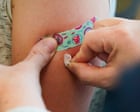
The nurse preps the outer thigh with a cold swipe of alcohol. The baby blinks, startled by the chill. A quick pinch, a brief wail that peaks and subsides before the adhesive bandage is even smoothed over the skin, and it is over. Within moments, the baby is chewing on the strap of the diaper bag again, tears already drying on plump cheeks.
Nothing visible has changed in the room. Yet inside that tiny body, millions of specialized white blood cells are already swarming to inspect the harmless fragments introduced by the needle, sketching out the blueprints for an immune defense that will stand guard in crowded airport terminals, daycare playrooms, and supermarket aisles. As the parent buckles the infant into the stroller and pushes open the heavy clinic door into the afternoon sun, they walk out into an uncertain world carrying something priceless—not the promise that danger no longer exists, but the quiet, unshakable certainty that their child is ready to meet it.