Silence.
That is the sound of a boardroom holding its breath right before an automated voice announces the results of a corporate proxy vote, the kind of sterile, bureaucratic ritual that usually puts institutional investors to sleep while lawyers bill by the hour. Yet when the tally finally dropped for Nvidia’s annual shareholder meeting, the numbers didn't just whisper approval; they roared across the Pacific and rattled the glass towers of Sand Hill Road. More than 158,000 individual and institutional votes—roughly 1.58 lakh backers in the parlance of global markets—had lined up behind one man, Jensen Huang, alongside some of the loudest, most combative founders in modern tech history, including Elon Musk and Uber co-founder Travis Kalanick.
Think about how strange that is.
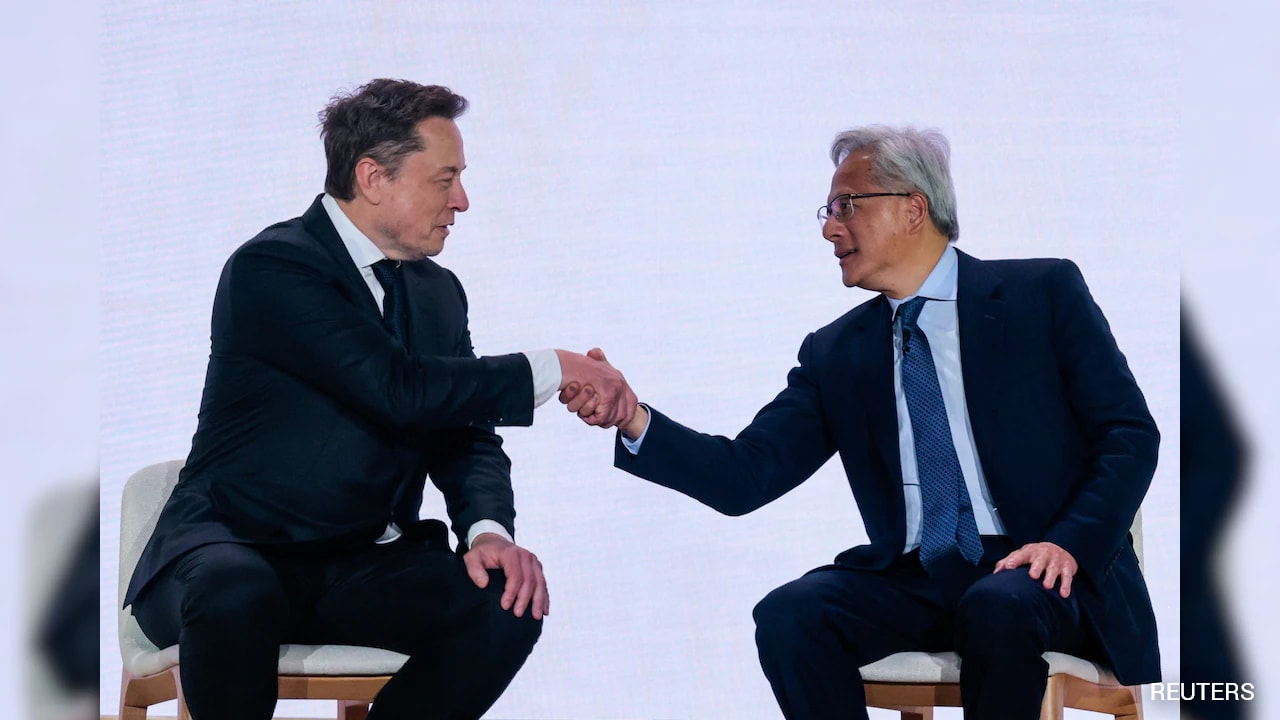
Silicon Valley is a bloodsport. Founders do not hold hands and sing campfire songs around a rival’s quarterly earnings report, especially not when that rival controls the single most precious bottleneck in the global economy. Musk has spent years publicly sparring with boardrooms, firing off midnight posts that sink stock prices, and building his own massive supercomputer clusters in Memphis because he hates depending on anyone else’s timeline. Kalanick, a man whose entire career was built on smashing incumbents and rewriting rules through sheer, unapologetic aggression, rarely lends his public weight to corporate governance votes unless the stakes cut straight to the bone. Yet there they were, standing shoulder-to-shoulder with 158,000 everyday retail shareholders, pension fund managers, and engineers, casting a resounding vote of confidence in the 61-year-old engineer who still wears the same black biker jacket to every keynote.
To understand why a routine shareholder ballot turned into a referendum on the future of human intelligence, you have to step away from the ticker symbols and feel the heat radiating off a modern server rack.
The Architecture of a Necessary Monopoly
Picture a hypothetical engineer named Maya. Let us place her in a cramped, fluorescent-lit apartment in Bengaluru or Austin at two in the morning, nursing lukewarm coffee while staring at a terminal window that refuses to compile. Maya isn't building a billion-dollar social network; she is training a specialized diagnostic model meant to spot early-stage pancreatic cancer from blurry ultrasound scans. Her entire life’s work—the grants she begged for, the nights she missed her daughter’s bedtime, the quiet terror that she might run out of runway before the math works—comes down to one brutal physical reality. She needs compute. Not just any silicon, not the standard central processors that have run laptops since the nineties, but the dense, parallel-processing muscle of Nvidia’s graphics processing units, stitched together by a software ecosystem called CUDA that makes those chips actually listen to her code.
Now scale Maya’s apartment up by ten million.
That is the invisible weight sitting on Jensen Huang’s shoulders every single morning when he wakes up at four, checks his emails, and prepares to steer a company that crossed the three-trillion-dollar valuation threshold faster than any enterprise in recorded human history. When shareholders vote to retain a CEO, they are usually grading past performance—did revenue go up, did margins hold, did the dividend clear? With Nvidia, the vote wasn't about last quarter’s balance sheet. It was a panicked, collective recognition that if you pull the architect out of the cockpit mid-flight, the entire artificial intelligence boom could stall in thin air.
I remember watching the early days of GPU computing back when everyone thought Nvidia was just a toy company making graphics cards for teenagers playing Quake in dark basements. Back then, the conventional wisdom among Wall Street analysts was almost comical in its certainty: dedicated graphics chips were a dying niche, destined to be swallowed whole by Intel’s integrated processors. Wall Street loved neat spreadsheets and predictable five-year projections. Huang ignored them. He poured billions of dollars into an esoteric software layer that nobody wanted yet, betting the entire farm on a mathematical hunch that parallel processing would eventually crack problems sequential chips couldn't touch. He survived near-bankruptcy in the late nineties, endured brutal crypto-mining crashes that left warehouses full of unsold cards, and stared down skeptics who called his vision an expensive hallucination.
You cannot teach that kind of scar tissue in an MBA program. And you certainly cannot replace it with a hired-gun executive brought in to "optimize operational efficiencies."
Why Sharks Defend the Whale
Consider what happens next when a company becomes the sole tollbooth on the highway to the future. Normally, customers hate a monopoly. They lobby regulators, fund open-source alternatives, and pray for the king to stumble so prices can finally drop. Look at how fiercely Musk has pushed xAI to move fast, or how tech giants from Redmond to Mountain View are quietly burning billions trying to design their own custom AI silicon just to escape the "Nvidia tax."
So why on earth would Elon Musk and Travis Kalanick—men who have built empires by refusing to bow to anyone—join a chorus of 158,000 voices backing Huang’s leadership?
Because in the brutal calculus of high-stakes technology, chaos is far more expensive than a high price tag.
Let us use an analogy that anyone who has ever survived a kitchen renovation will immediately understand. Imagine you are building a house during a hurricane, and only one supplier on earth knows how to forge the steel beams that keep the roof from caving in. You might grumble about what he charges per beam. You might even try to build your own forge in the backyard to lower your costs next year. But if someone walks up to that supplier’s factory and suggests replacing the master blacksmith with a committee of cautious accountants, you don't cheer—you grab a megaphone and defend the blacksmith with everything you have.
Musk knows this intimately. When Tesla needed tens of thousands of H100 chips to train its Full Self-Driving neural networks, or when xAI needed to stand up the Colossus cluster in record time, it wasn't a standard procurement contract that made it happen. It was direct, founder-to-founder velocity. Huang treats his biggest customers like co-conspirators in an industrial revolution, personally reviewing delivery schedules, tweaking networking architectures like InfiniBand and NVLink on the fly, and compressing product cycles from two years down to a relentless, bone-crushing twelve-month cadence.
Kalanick, who now spends his days building CloudKitchens and navigating the messy physical logistics of modern commerce, understands the exact same truth from a different angle. He lived through what happens when a founder’s raw, uncompromising drive gets replaced by consensus-driven corporate governance. Whether you admire Kalanick’s methods or despise them, nobody in Silicon Valley doubts that founder-led companies move with a different metabolic rate than manager-led conglomerates. When 1.58 lakh shareholders cast their ballots, they weren't just endorsing a CEO; they were voting against the slow, creeping suffocation of bureaucracy.
The Invisible Stakes Behind the Numbers
Strip away the celebrity endorsements and look closely at that figure: 158,000 backers.
Behind that statistic sits a massive, quiet shift in who actually owns the future. Ten years ago, a shareholder vote at a semiconductor firm was dominated by faceless pension funds and quantitative hedge funds rebalancing portfolios in milliseconds. Today, a staggering chunk of those votes belongs to ordinary people—teachers in Ohio, retired engineers in Pune, nurses in London, young software developers putting half their paycheck into index funds and fractional shares. For them, Nvidia isn't an abstract ticker symbol flashing green on a Bloomberg terminal. It is the down payment on a house, the college fund that suddenly looks possible, the tangible proof that betting on human ingenuity still pays off in an economy that often feels rigged against the little guy.
Yet there is a terrifying fragility baked into that success, and pretending otherwise would be dishonest.
Even seasoned market watchers feel a cold knot in their stomachs when a single company carries so much weight. Look at the numbers: when Nvidia sneezes, the entire S&P 500 catches pneumonia. A single delayed shipment of Blackwell chips, a sudden geopolitical tremor in the Taiwan Strait where TSMC fabricates those microscopic silicon wafers, or a sudden realization among hyperscalers like Microsoft, Meta, and Google that their massive capital expenditures aren't generating enough immediate software revenue—any one of these shocks could wipe hundreds of billions of dollars off the board before the opening bell even rings.
I’ve spoken with institutional portfolio managers who admit, off the record and usually after a second drink, that holding Nvidia right now feels like riding a bullet train with no brakes. You cannot get off because the train is the only thing moving forward, yet every curve in the track makes your knuckles turn white. In that kind of environment, leadership isn't about smooth sailing; it is about having someone at the controls who knows every inch of the machinery because he built it with his own bare hands.
The Cult of the Founder Versus the Machine
History is littered with empires that collapsed the moment the founder stepped back and handed the keys to a caretaker.
Think back to Apple in 1985, when the board ousted Steve Jobs in favor of John Sculley, a brilliant marketing executive who knew how to sell sugar water but couldn't feel the soul of a personal computer in his fingertips. Within a decade, the company that invented the Macintosh was ninety days away from bankruptcy, saved only when Jobs returned with a sharper, harder vision. Or look at Intel, once the undisputed titan of Silicon Valley, which slowly lost its manufacturing crown after generations of financial engineers prioritized stock buybacks and quarterly margin protection over the messy, terrifying gamble of next-generation lithography.
Nvidia’s shareholders didn't need a history lecture to see the parallel. They looked at the competitive landscape—AMD nipping at their heels with the MI300 series, custom ASICs rolling off assembly lines at Amazon and Google, startups promising radical new chip architectures that bypass traditional GPUs altogether—and realized that Nvidia’s real moat isn't just hardware. It is cultural paranoia.
Huang famously tells his employees that the company is always thirty days away from going out of business. Imagine working inside a three-trillion-dollar juggernaut where the boss still acts like a starving startup founder hiding from creditors. That paranoia radiates outward. It keeps sixty direct reports reporting directly to Huang without layers of middle management buffering bad news. It forces engineers to tear up working blueprints before competitors even finish copying last year’s model. And it reassures the 158,000 people who backed him that complacency—the silent killer of every tech giant—hasn't crept through the front doors in Santa Clara.
What Happens When the Jacket Comes Off?
Still, a nagging question lingers beneath the applause, the kind that keeps thoughtful investors awake long after the celebratory headlines fade.
What happens when a company becomes so tightly fused to one human being that the market treats his leadership as irreplaceable?
Governance experts have spent decades warning against "key-man risk"—the danger that an organization’s brilliance lives inside one person’s skull rather than inside durable institutional systems. When Elon Musk’s attention splits across electric vehicles, orbital rockets, brain implants, and social media platforms, shareholders feel every tremor of his distraction. Huang has avoided that trap by staying monomaniacally focused on one domain for over thirty years, refusing side quests, refusing celebrity distractions, and treating every waking hour as an extension of Nvidia’s mission.
Yet no human being outruns time forever. By rallying behind Huang with overwhelming force, Musk, Kalanick, and 158,000 shareholders bought themselves certainty for today, while quietly raising the stakes for tomorrow. They affirmed a truth that modern corporate governance often tries to sanitize away: great leaps forward rarely come from committees. They come from obsessive individuals willing to look foolish for ten years straight until the rest of the world finally catches up to what they saw in the dark.
Think back to our hypothetical engineer, Maya, sitting at her desk at two in the morning, waiting for her diagnostic model to finish training so she can catch a few hours of sleep before her daughter wakes up. She doesn't care about boardroom politics, proxy ballots, or billionaire rivalries. She just needs the cursor on her screen to keep blinking, the racks humming in some distant data center to keep crunching numbers without failing, and the tools in her hands to get faster next year than they were tonight.
Far away in a brightly lit auditorium in California, a man in a black leather jacket steps up to a microphone, rolls up his sleeves, and starts drawing architectures on an invisible chalkboard, while 158,000 believers hold their breath and watch him build the floor beneath their feet.