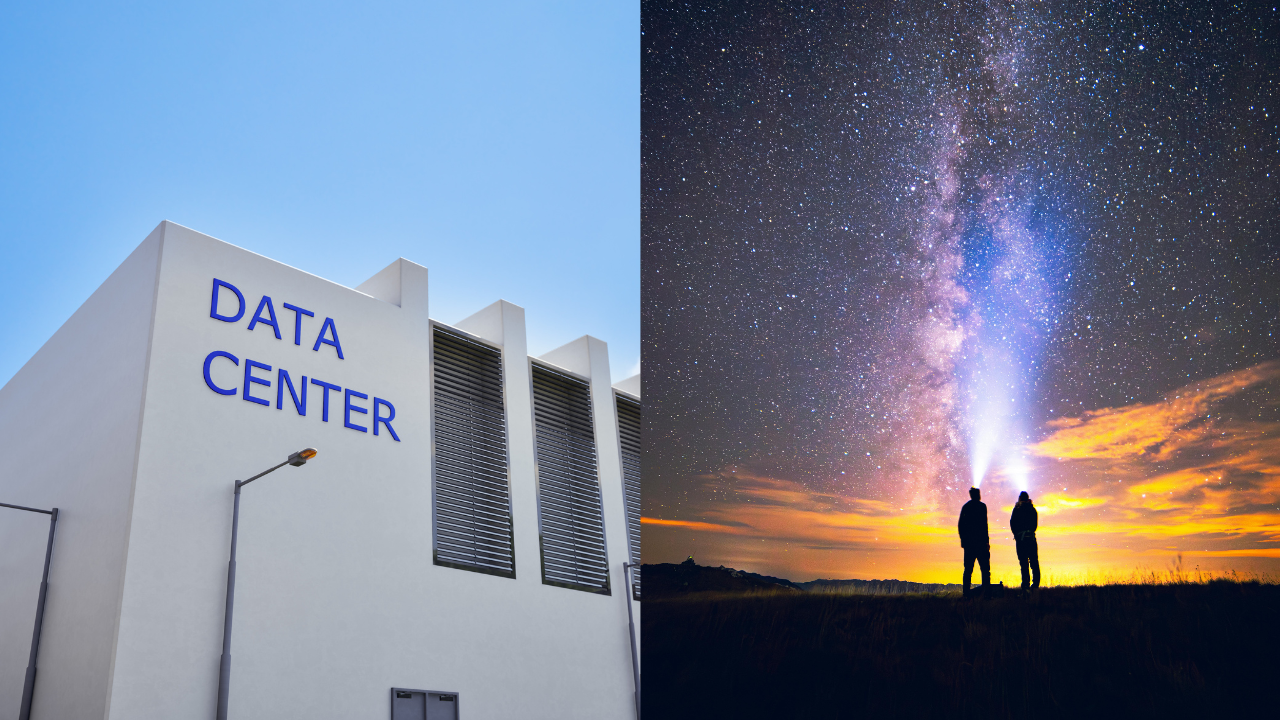
In the River Murray International Dark Sky Reserve, a proposed hyperscale data centre is pitting the astronomical clarity of South Australia's night sky against the relentless global appetite for artificial intelligence compute. Local residents and astrotourism operators are pushing back against the facility, warning that industrial security lighting, massive cooling towers, and sprawling warehouse footprints will permanently degrade the pristine darkness that anchors their regional economy.
This is no longer a localized zoning dispute over rural farmland. It is the latest flashpoint in a widening infrastructure war where cloud providers, desperate for cheap land and renewable power grids, are colliding with communities whose entire identity depends on keeping the industrial world at bay. For a different perspective, consider: this related article.
The Collision of Two Incompatible Economies
To understand why a server farm poses an existential threat to a dark-sky reserve, you have to look at the mechanics of both industries. Neither is willing to compromise on its core operational requirements, and those requirements are fundamentally opposed.
The Physics of Dark Sky Preservation
Established in 2019, the River Murray International Dark Sky Reserve spans roughly 3,200 square kilometers northeast of Adelaide. It was the first of its kind in Australia and remains one of the darkest accessible spots on the planet. Achieving and maintaining accreditation from DarkSky International requires strict adherence to lighting ordinances. Every fixture within the core and buffer zones must be fully shielded, directed downward, and calibrated to warm color temperatures below 3,000 Kelvin to prevent blue-rich light from scattering in the upper atmosphere. Related analysis on the subject has been published by Engadget.
Light pollution is insidious. A single unshielded floodlight or a cluster of high-intensity perimeter lamps does not just illuminate a parking lot; it creates a localized dome of skyglow that washes out faint nebulae, globular clusters, and the Milky Way core for miles around. For astrophotographers, amateur astronomers, and rural tourism operators who have spent years building businesses around nocturnal serenity, even a fractional increase in ambient brightness degrades the product they sell.
The Reality of Hyperscale Infrastructure
Now consider what a hyperscale data centre actually looks like in operation. These are not quiet office buildings filled with humming desktop computers. They are fortified industrial fortresses spanning tens of thousands of square meters, engineered to house tens of thousands of high-density server racks running continuously at peak load.
Because these facilities store sensitive corporate, financial, and government data, physical security is non-negotiable. Insurance underwriters and enterprise clients demand rigorous perimeter illumination to ensure high-definition surveillance cameras capture clear footage around the clock. Even with modern motion-activated LED arrays and downward shielding, the sheer scale of the building footprint, loading docks, substations, and access roads introduces an unprecedented artificial light signature into an otherwise pitch-black valley.
Beyond the light, there is the physical presence. A hyperscale campus requires high-voltage transmission lines, massive backup diesel generators that must be tested regularly, and vast mechanical cooling yards. You cannot hide a facility the size of several football fields behind a row of eucalyptus trees.
Why Tech Giants Are Hunting in Rural Australia
If you have followed the infrastructure buildout over the past five years, the arrival of hyperscale developers in regional South Australia is entirely predictable. The major metropolitan hubs—Sydney and Melbourne—are hitting hard physical limits. Land in Western Sydney is astronomically expensive, grid connection queues stretch out for years, and local water authorities are growing increasingly anxious about evaporative cooling demands during drought cycles.
Regional South Australia offers an irresistible alternative on paper.
First, there is the energy profile. South Australia has become a global testbed for grid-scale renewable energy, routinely generating more than enough wind and solar power to meet state demand. For technology companies under intense shareholder pressure to hit net-zero carbon targets, plugging a massive compute facility directly into a renewable-heavy grid is a major strategic win. It allows them to claim green credentials without having to build the generation capacity from scratch.
Second, land is cheap and flat. Hyperscale campuses require large, contiguous parcels of flat terrain to pour massive concrete slabs quickly. A hypothetical developer looking at the River Murray region sees wide-open agricultural plots, proximity to high-voltage transmission corridors, and a relatively sparse population that theoretically translates to fewer residential objections than an inner-ring suburb.
What the spreadsheets fail to capture is that the emptiness of the River Murray region is not an oversight. It is a carefully protected asset.
The Hidden Footprints Beyond Light Pollution
Opponents of the River Murray proposal have focused heavily on the threat to the night sky, and rightfully so. Yet decades of covering industrial infrastructure projects reveal that light is rarely the only friction point once the bulldozers arrive. When a hyperscale facility lands in a quiet rural community, the secondary impacts often prove just as disruptive.
Acoustic Hum and Low-Frequency Drone
Data centres are loud. While the servers themselves are sealed inside concrete walls, the heat they generate must be vented outside. This requires banks of industrial chillers, cooling fans, and air-handling units operating 24 hours a day, 365 days a year.
In a bustling industrial park near an airport, a constant 65-decibel mechanical hum blends into the background noise of highways and freight trains. In a rural reserve where the baseline nighttime noise floor drops to the sound of wind in the scrub, that continuous low-frequency drone travels for kilometers. Low-frequency noise is notoriously difficult to mitigate with standard sound walls, often vibrating through walls and disrupting sleep patterns for nearby residents and wildlife alike.
Water Consumption in a Dry State
South Australia is the driest state in the driest inhabited continent on Earth. The Murray River itself is already over-allocated, subject to fierce political battles over agricultural irrigation, environmental flows, and municipal drinking water.
While newer data centres increasingly utilize closed-loop liquid cooling or air-side economizers to reduce water usage, traditional evaporative cooling remains common in hot climates because it is the most energy-efficient way to shed heat during summer spikes. During a 40-degree Celsius heatwave—a regular occurrence in the South Australian summer—a single hyperscale facility can evaporate millions of liters of water per day just to keep its processors from throttling. Residents watching their own water allocations tighten naturally question why an offshore tech conglomerate should be granted industrial water rights to cool servers processing distant internet traffic.
The Illusion of Local Job Creation
Developers almost always pitch these projects to regional councils with promises of massive capital investment and economic revitalization. The numbers sound impressive at town hall meetings: hundreds of millions of dollars in construction spend, upgrades to local roads, and a surge in business for local cafes and motels.
The reality is front-loaded. A hyperscale build employs hundreds of electricians, concrete finishers, and heavy equipment operators for 18 to 24 months. Once the facility is commissioned and the servers go live, the construction crews pack up and leave. Because modern data centres are heavily automated, a massive facility might employ only 30 to 50 full-time staff—mostly specialized security guards, HVAC technicians, and network engineers brought in from metropolitan centers. The local tax base gets a bump, certainly, but the promised long-term employment boom rarely materializes.
The Developer Playbook and Regulatory Gray Areas
When communities push back against these projects, developers typically deploy a well-worn set of mitigation promises. They offer to install specialized dark-sky-compliant lighting, plant vegetative screening buffers, and contribute to local community funds.
The problem lies in enforcement and regulatory drift. Planning approvals in rural districts are often written by local councils accustomed to evaluating sheds, wineries, or agricultural processing plants—not multi-hundred-megawatt digital infrastructure. Councils frequently lack the technical expertise to audit complex photometric lighting plans or verify acoustic modeling before granting permits.
Furthermore, a data centre is never truly finished. A campus approved for a single hall today inevitably files for expansion permits three years later as compute demand grows. Lighting curfews agreed upon during the initial approval phase can be quietly overridden when a global client demands stricter security protocols, or when emergency maintenance requires floodlights to run through the night. Once a massive concrete facility is anchored to the grid, no regulator is going to shut it down because its perimeter lights are slightly too bright.
Navigating the Trade-Off Without Blind Spots
To dismiss the data centre industry entirely is to ignore the reality of modern life. Every cloud backup, telehealth consultation, banking transaction, and streaming video relies on physical infrastructure somewhere. We cannot demand instant digital connectivity while simultaneously insisting that servers exist in a vacuum.
South Australia needs economic diversification, and hosting high-value digital infrastructure is a legitimate avenue for growth. If the state wants to attract technology investment, those facilities have to go somewhere with robust power connections and manageable land costs.
Yet strategic infrastructure planning requires drawing hard lines. The entire purpose of designating an International Dark Sky Reserve is to establish a sanctuary where natural darkness is prioritized above standard industrial development. Allowing a hyperscale data centre inside or immediately adjacent to that reserve undermines the very regulatory framework that made the designation possible in the first place.
If South Australia wants both a thriving tech sector and an internationally recognized astrotourism industry, the state government cannot leave these decisions to ad-hoc developer proposals and under-resourced local councils. It requires proactive zoning that steers energy-intensive industrial compute toward existing brownfield sites, industrial corridors, and degraded agricultural land far removed from sensitive ecological and astronomical zones.
A dark sky cannot be rebuilt once it is lost to the glow of industrial sprawl, and no amount of corporate community grants will bring the stars back once the floodlights turn on.