A few nautical miles off the coast of Sumatra, the water changes color. It shifts from a brilliant, sun-bleached turquoise to a deep, bruising navy. This is the entrance to the Malacca Strait. On any given afternoon, a look toward the horizon reveals a dense, slow-moving caravan of steel—supertankers, container ships, and bulk carriers, stacked high with the world’s commerce. Nearly a third of global trade squeezes through this narrow funnel. If you stand on the edge of Sabang, a quiet island outpost at the northernmost tip of Indonesia, the rumble of these passing giants is a constant, low-frequency hum in your chest.
For decades, Sabang was a sleepy beautiful place, known mostly to divers and local fishermen. But geography is destiny, and destiny has a habit of waking up. If you liked this article, you should look at: this related article.
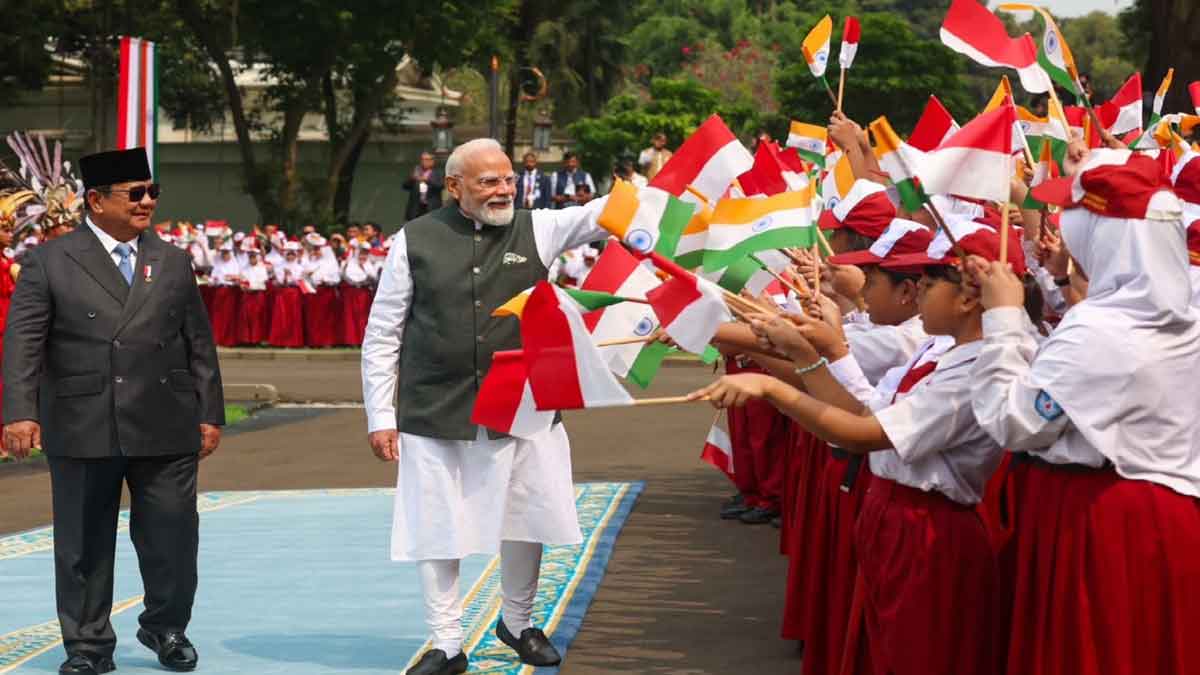
When Indian Prime Minister Narendra Modi steps off the plane in Jakarta for his high-stakes bilateral visit, the conversations inside the air-conditioned diplomatic chambers will center on defense pacts, technological transfers, and maritime infrastructure. To the casual observer reading a standard news feed, the bullet points look dry: Astra missiles, BrahMos supersonic systems, Electronic Voting Machines, and deep-sea port developments.
But look closer. This isn't just a list of line items on a diplomatic itinerary. It is the construction of a new geopolitical scaffolding across the Indo-Pacific, built by two democratic giants who suddenly realize they need each other to keep the oceans free. For another angle on this event, see the latest update from USA Today.
The Concrete and the Coral
To understand why a remote Indonesian port matters to a citizen in Delhi or a merchant in Mumbai, consider a hypothetical merchant captain named Thomas. Thomas commands a 150,000-ton cargo vessel carrying electronic components from East Asia to Europe. Currently, his route is predictable. He slips through the Malacca Strait, glances at the tiny dot of Sabang, and heads out into the open Indian Ocean.
Now, imagine a crisis. A localized conflict, a sudden block, or the aggressive posturing of a hostile navy shutting down the strait. Thomas is forced to reroute around the Lombok or Sunda straits, adding days of travel, burning millions of dollars in fuel, and disrupting global supply chains.
This is where the Sabang Port agreement transforms from blue-ink policy into grey-concrete reality. India and Indonesia are finalizing a framework to develop a deep-sea port right here, at the mouth of the strait.
[India / Andaman & Nicobar Islands]
              |
       (~90 Nautical Miles)
              |
       [Sabang Port, Indonesia] <---> (Mouth of the Malacca Strait)
The distance between India’s southernmost territory, the Andaman and Nicobar Islands, and Indonesia’s Sabang is less than ninety nautical miles. That is closer than New York is to Philadelphia. By investing in Sabang, India isn't just helping a neighbor build a dock. It is anchoring its own maritime security strategy directly outside the most critical chokepoint on earth. For Indonesia, it turns a forgotten northern frontier into a bustling economic hub. It is a shared insurance policy written in concrete and coral.
Speed That Bends the Mind
Step away from the docks and look at what these ships might soon be carrying for protection. The discussions in Jakarta aren't limited to dredging harbors; they are heavily focused on lethal hardware. Specifically, the BrahMos cruise missile and the Astra air-to-air system.
Military terminology often detaches itself from human sensory experience. We read "Mach 3" and our eyes glaze over. Let us ground that figure. A missile traveling at Mach 3 is moving at roughly one kilometer per second. If it is launched from a coastal battery, a human being standing on the deck of an intruding warship would hear nothing until the moment of impact. The sound of the missile's approach arrives long after the kinetic energy has already done its work.
Indonesia has watched the South China Sea grow increasingly crowded and tense. Traditional coast guard vessels are no longer enough to deter illegal incursions into exclusive economic zones. By looking to acquire the BrahMos—a joint venture between India and Russia—and exploring the indigenous Indian Astra missile for its fighter jets, Jakarta is sending an unmistakable signal.
The strategy is simple: create a ring of deniability. The presence of such systems changes the calculus for any adversarial navy. You do not sail carelessly into waters where the defender possesses a weapon that can close the distance before your radar operators can blink. It gives a sovereign nation its voice back.
The Paperless Safeguard of Choice
While missiles and ports dominate the headlines that whisper of conflict, another agreement on the table speaks directly to the quiet, internal machinery of peace. India is preparing to share its expertise in Electronic Voting Machines (EVMs) with Indonesia.
It seems like an odd pairing. Why discuss supersonic weapons and digital ballot boxes in the same breath?
Because both are instruments of sovereignty. Indonesia is the world’s third-largest democracy, an archipelago of over seventeen thousand islands stretching across three time zones. Managing an election there is a logistical nightmare that defies imagination. In past elections, thousands of polling officials suffered from severe exhaustion, and some even died, under the immense physical strain of manually counting hundreds of millions of paper ballots in remote, tropical locations. Boxes must be carried via canoes, horses, and on foot through dense jungles just to be tallied.
Democratic Logistics: The Archipelago Challenge
+-------------------------------------------------------------+
|  Indonesia: 17,000+ Islands | 3 Time Zones | 200M+ Voters   |
+-------------------------------------------------------------+
|  Paper System: High physical toll, slow count, fraud risks  |
|  EVM System: Instant tallying, localized security, mobility |
+-------------------------------------------------------------+
India solved this specific human crisis decades ago. The Indian EVM is a rugged, battery-operated device designed to survive the dust of Rajasthan, the humidity of Kerala, and the lack of electricity in rural Bihar. It does not connect to the internet. It cannot be hacked remotely.
When India offers this technology to Indonesia, it is not selling a commercial product. It is offering a blueprint for democratic endurance. It means an election worker on a distant island in the Maluku archipelago can log votes securely, seal the machine, and go home to their family before dawn, confident that the count is accurate and their health is intact.
The Shared Horizon
The true significance of this diplomatic meeting lies in a fundamental realization that both New Delhi and Jakarta have arrived at simultaneously. For centuries, the Indian Ocean and the waters of Southeast Asia were a shared cultural highway. Ships traveled with the monsoon winds, carrying spices, philosophy, and stories back and forth.
Somewhere during the colonial era and the rigid divisions of the Cold War, that connection frayed. The two nations looked inward, or they looked toward distant Western capitals for validation and security.
That era of isolation has ended. The pressures of the modern world have forced a return to historical geography. The oceans are growing smaller, the ships are growing larger, and the stakes are becoming entirely transparent.
When the ink dries on these agreements, the real work begins. It will look like engineers surveying the deep waters of Sabang, technicians calibrating missile radars under a tropical sun, and election officials testing buttons on a small grey box in a Jakarta convention center. These diverse efforts converge on a single, vital objective: ensuring that the passage through the deep navy waters of the Malacca Strait remains peaceful, predictable, and entirely within their own control.