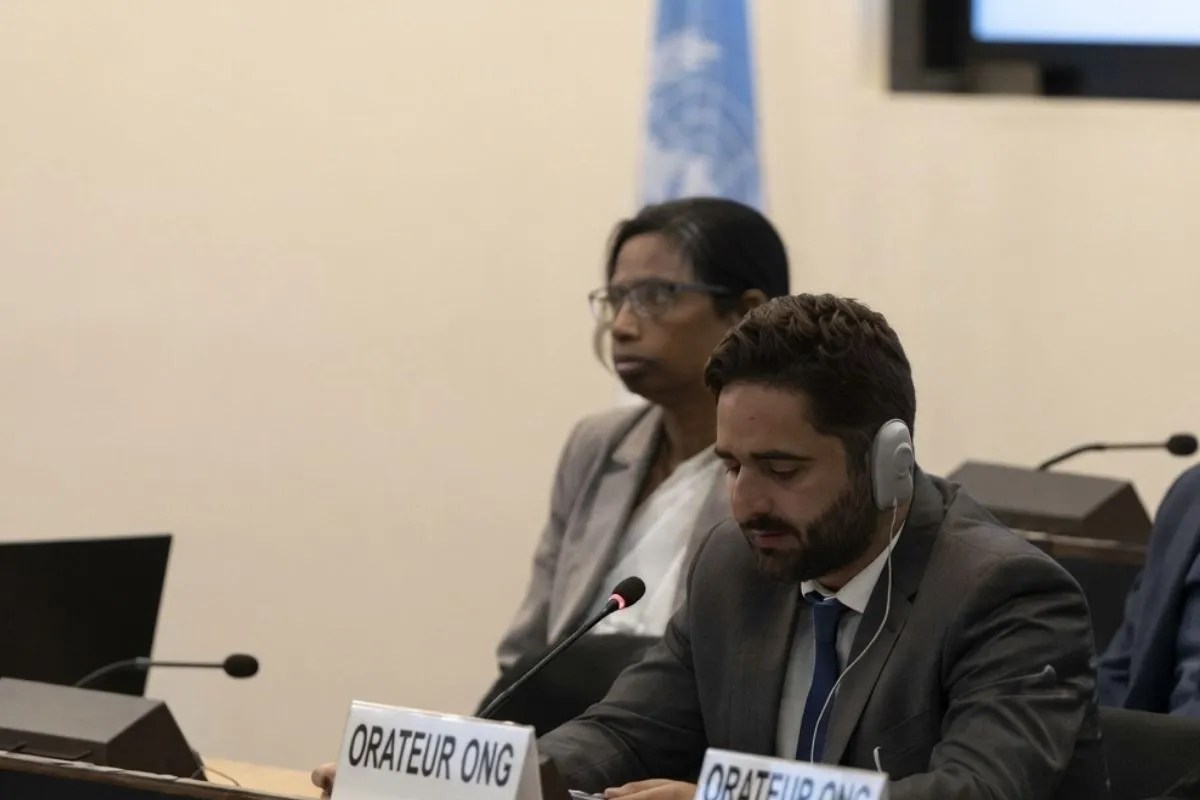
The marble halls of Geneva smell faintly of polished stone and quiet indifference. Outside, the Swiss air carries the crisp bite of an approaching winter, clean and untroubled. Inside Room XX of the United Nations Human Rights Council, the air is thick with the weight of unheeded petitions. Microphones click on. Papers rustle. Delegates sip water from glass pitchers, their expressions carefully neutral, professionally distant.
Then, a voice cuts through the bureaucratic hum. It is sharp, steady, and laden with the dust of high mountain passes thousands of miles away.
The speaker is a human rights defender from the margins of the world—a Kashmiri activist lifting the veil on Gilgit Baltistan. He does not speak in dry legal jargon. He speaks of shadows. He speaks of a territory caught in a perpetual legal purgatory, where democracy is not merely denied, but systematically disassembled piece by piece, law by decree, silence by intimidation.
To understand what is happening in those northern crags, you must first look past the postcards.
Postcards show the roof of the world. They show K2 slicing into an azure sky, apricot orchards exploding into pink blossoms every spring, and the emerald ribbon of the Indus River carving deep, ancient scars through colossal granite gorges. Tourists gaze at the peaks with awe, marveling at a wild frontier untouched by modern chaos. But beauty can be a cruel mask. Behind the towering summits and the glacier-fed streams lies a population suspended in a constitutional void, stripped of fundamental liberties, and governed by administrative fiat from a capital that views them neither as full citizens nor as an independent entity.
Consider what happens when a people have no voice.
In Gilgit Baltistan, the writ of everyday life is dictated not by elected representatives accountable to the public, but by executive orders originating from Islamabad. For decades, the local population has existed in a strange limbo. They are denied representation in the national parliament of the country that administers them, yet they are subjected to its tax laws, its security apparatus, and its judicial whims. When local residents demand constitutional recognition, they are met with a familiar playbook: midnight knocks, sedition charges under archaic anti-terrorism acts, and the chilling message that dissent is treason.
The activist at the podium holds up a sheaf of documents. They are not academic papers. They are arrest warrants, eviction notices, and testimonies of young men snatched from university dormitories simply for sharing a Facebook post about land rights.
He describes a quiet, methodical theft. For generations, the indigenous communities of Gilgit Baltistan have held ancestral claims over their forests, pastures, and mineral-rich valleys. Now, under the guise of national security and grand economic corridors, these lands are being transferred to federal control. Local farmers watch bulldozers carve up orchards planted by their great-grandfathers. When they protest, security forces disperse them with tear gas and batons. The message is blunt. Your heritage is negotiable. Our interests are not.
Silence is engineered here. It is not an accident of geography or a byproduct of poverty. It is a manufactured condition.
Journalists who try to report on police brutality find their press credentials revoked or their equipment smashed. Independent newspapers are starved of advertisements and pressured into self-censorship. If a brave editor manages to publish an investigative piece on electoral rigging or missing activists, the printing press is raided under the pretext of regulatory non-compliance. The judiciary offers little refuge. Local courts operate under severe constraints, with superior judicial appointments controlled entirely by the executive branch hundreds of miles away. A judge who rules against state interests rarely keeps his bench for long.
Why does this matter to the wider world?
Because the erosion of freedom in any corner of the globe sets a dangerous precedent. When a government can act with total impunity in a disputed, politically fragile territory, it normalizes tyranny. It proves that sovereign borders can be used as cages, sealing millions of people inside a zone of non-rights where international human rights conventions are treated as polite suggestions rather than binding obligations.
The activist’s testimony at the UNHRC lays bare the anatomy of this oppression. He recounts the story of Baba Jan, a prominent political worker who spent years behind bars simply for demanding compensation for families displaced by a massive landslide. He details the systematic gerrymandering of local legislative assembly elections, where opposition candidates are disqualified on frivolous grounds and ballot boxes are manipulated to ensure a subservient local administration.
He speaks of the youth. Thousands of bright, educated young men and women in Gilgit Baltistan face a bleak horizon. They graduate from universities only to find that government jobs and administrative posts are routinely handed to outsiders brought in from the plains. Economic opportunities are funneled away from local communities, leaving them economically dependent and politically marginalized. Frustration boils beneath the surface, yet every outlet for peaceful political expression is welded shut.
As the activist concludes his remarks, a heavy silence settles over the UN chamber. For a fleeting moment, the polished marble feels fragile, like thin ice over deep water. Delegates shift in their seats. Some scribble notes. Others stare fixedly at their tablets, eager to return to the safe abstraction of diplomatic protocol.
The microphone clicks off. The room moves on to the next agenda item.
Yet the words hang in the air, refusing to dissolve into the ventilation system. Somewhere in the high valleys of Gilgit Baltistan, the sun is setting behind jagged peaks, casting long, bruised shadows across the stone houses and winding roads. A young man sits in the dark, scrolling through a news feed on a cracked smartphone, watching a brief video clip of a man in a suit speaking truth to power in Geneva. For a second, he is not alone. The distance between the high Himalayas and the global stage shrinks, bridged by the simple, terrifying courage of someone who refused to stay quiet.
The mountains remain silent, watching over a land where justice is an exile and freedom is a smuggled commodity. But the secret is out in the open. The cold machinery of control has been named, laid bare under the harsh fluorescent lights of an international forum.
And long after the delegates have left the room and the microphones have gone cold, the echoes of that testimony continue to ricochet through the valleys, waiting for the day the shadows lift.


