The desert does not have a voice, but it has a weight. It is a heavy, pressing heat that sits on your chest until you forget what a cool breeze feels like. In the vast, undulating expanse of the Moroccan wilderness, where the borders of the known world bleed into the haze of the Sahara, two empty chairs now sit at a mess hall table. Two sets of gear remain unclaimed. Two names have shifted from the daily roll call to the whispered conversations of high-ranking officials in Washington and Rabat.
We talk about military operations in terms of logistics. We speak of "assets" and "service members" and "coordinates." But when two Americans vanish during a training exercise in North Africa, the story isn't about maps. It is about the sudden, terrifying transition from a presence to an absence.
The Geography of a Disappearance
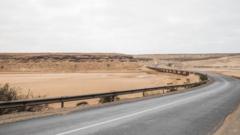
Morocco is a land of staggering beauty and brutal indifference. To the casual traveler, it is the spice markets of Marrakech or the blue walls of Chefchaouen. To a soldier, it is a crucible. The terrain is a jagged mosaic of limestone ridges and shifting dunes that can swallow a footprint in seconds. When the wind picks up, the horizon vanishes. You lose the sky. You lose your bearings.
The two individuals—whose identities are currently being shielded behind the veil of next-of-kin notifications—were part of a routine engagement. "Routine" is a dangerous word in the military. It breeds a false sense of security that the environment is quick to punish. They were there to build bridges, to train with Moroccan counterparts, and to ensure that the alliance between the United States and one of its oldest African partners remained rhythmic and steady.
Then, the rhythm broke.
Official reports from the U.S. Africa Command (AFRICOM) are sparse. They are designed to be. In the early hours of a disappearance, information is a currency that officials spend very carefully. We know they are missing. We know the search is "ongoing." What we don't see are the frantic hours in the operations center, the flickering monitors, and the local guides squinting at the sand, looking for the telltale signs of a disturbed path.
The Human Cost of the Horizon
Imagine a mother in a small town in the Midwest. She doesn't know the specifics of Moroccan topography. She doesn't care about the strategic importance of the "African Lion" exercises or the geopolitical nuances of North African stability. She only knows that the phone rang at an hour it shouldn't have.
For her, the "missing" status isn't a data point. It is a physical ache.
This is the invisible stake of global presence. We project power across oceans, but that power is carried on the shoulders of twenty-somethings who have favorite songs, unfinished books on their nightstands, and people waiting for them to come home. When a service member goes missing, the military machine grinds into a specific, high-intensity gear. Search and rescue is not just a protocol; it is a moral imperative. "Leave no man behind" is not a slogan for a recruitment poster. It is the only thing that makes the risk of the desert bearable.
The search area is likely a nightmare of heat and wind. Imagine walking through a furnace where every hill looks identical to the last. The sun acts as a blinding white weight, and the nights bring a cold that seeps into your bones. Without water, the clock doesn't just tick; it hammers.
Why We Are There
It is easy to wonder why American boots are on Moroccan ground in the first place. The answer lies in the messy, interconnected reality of modern security. Morocco is a gateway. It sits at the crossroads of Europe, Africa, and the Middle East. Stability there ripples outward. Chaos there does the same.
By training together, these forces learn to speak a common language of defense. They prepare for the threats that don't respect borders—insurgencies, smuggling routes, and the encroaching influence of extremist groups. This cooperation is the silent work of peace. It is the preventative medicine of foreign policy.
But medicine has side effects.
The side effect of being a global neighbor is that our people are exposed to the elements of every corner of the earth. We are currently witnessing the high price of that proximity. Every hour that passes without a sighting increases the tension in the halls of the Pentagon. They are checking satellite imagery, deploying drones with thermal sensors, and coordinate with Moroccan Royal Armed Forces who know these mountains and deserts better than any map could ever dictate.
The Uncertainty of the Search
There is a specific kind of silence that follows a report like this. It is the silence of waiting for a breakthrough that might not come, or a breakthrough that brings the wrong kind of news.
In past incidents, "missing" has meant many things. Sometimes it means a navigation error, a broken radio, and a long walk back to base. Sometimes it means an accident in a ravine, hidden by the shadows of the Atlas Mountains. The ambiguity is the cruelest part.
Search teams are currently battling more than just the terrain. They are battling time. The human body is resilient, but the Sahara is more resilient. It has outlasted empires. It has buried cities. To find two individuals in that vastness is like looking for a specific grain of sand while the wind is blowing it away.
Resources are being poured into the region. Helicopters are scouring the grid squares. Local villages are being questioned. Every lead, no matter how small, is being chased with a desperate intensity. The Moroccan government has been a steadfast partner in this, realizing that the disappearance of American guests on their soil is a matter of national honor as much as it is a tactical emergency.
Beyond the Briefing
When you read the headlines tomorrow, look past the cold terminology. Don't see "service members." See the faces of people who volunteered to go to a place they couldn't find on a map three years ago because they believed in a mission.
The story of the missing in Morocco is a reminder that the world is still very large, very dangerous, and very capable of hiding us from one another. We live in an era of GPS and constant connectivity, yet two people can still vanish into the folds of the earth. It humbles our technology. It mocks our sense of control.
As the sun sets over the Moroccan dunes tonight, the orange glow will be beautiful to the tourists in the coastal cities. But for the searchers, that sunset is a deadline. It marks the end of another day of looking, another day of hoping, and another night of the desert holding onto its secrets.
The gear is still in the tent. The mess hall table still has two empty spots. The world waits for the silence to break.