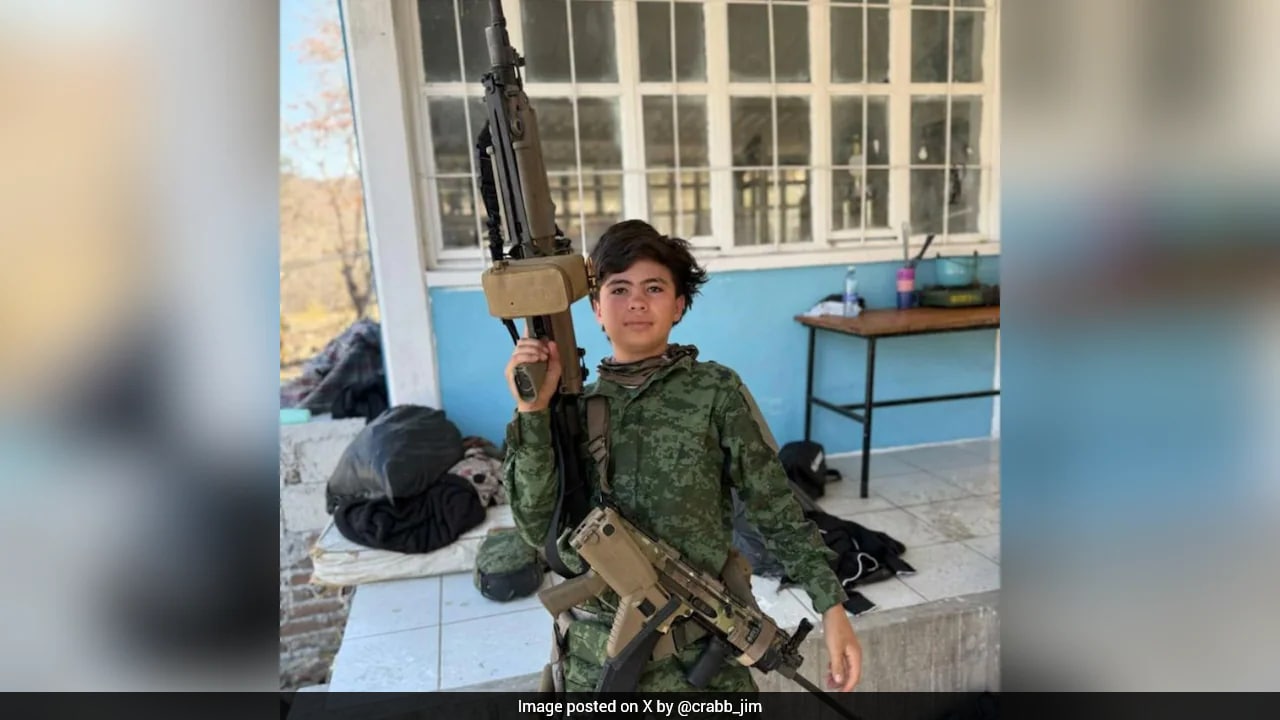
The air in the borderlands tastes of dust, burnt rubber, and copper. When you have spent enough years watching the periphery of Mexico from the dirt roads, you learn to read the silences. Silence does not mean peace here. Silence means the air is holding its breath before the gunfire cracks.
On a searing afternoon in Villa Union, Coahuila, the silence shattered. Read more on a similar issue: this related article.
It was a firefight like hundreds before it, yet unlike any that should ever exist. The tactical vehicles of the state police rolled up against a convoy of blacked-out pickups bristling with heavy weaponry. The cartel gunmen dug in, firing with rifles meant for open warfare. When the smoke finally cleared and the heat haze rose from the bullet-riddled asphalt, the bodies were counted. Among the fallen soldiers of the underworld lay a boy.
He was fifteen years old. Additional reporting by The Guardian delves into comparable perspectives on the subject.
Fifteen. An age defined elsewhere by algebra tests, clumsy text messages, and the awkward navigation of first crushes. Here, his milestone was a ceramic-plated tactical vest that hung too large on his narrow shoulders and an assault rifle with a barrel still hot to the touch.
We talk about cartels as monolithic corporate entities, moving billions of dollars across porous borders like phantom logistics firms. We study the flow of fentanyl, the smuggling routes, the shell companies, and the political corruption. But those are the spreadsheets of the war. The human cost is written in children.
To understand how a child becomes an assassin, you have to abandon the comfort of simple moral outrage. You have to look at the architecture of desperation.
Imagine, for a moment, a neighborhood where the local economy died a decade ago. The factories closed. The soil yielded little besides dry brush. The only employer offering cash that does not bounce is the plaza boss. He does not hand out job applications. He offers a bicycle first, then a pair of sneakers, then a smartphone, and finally, a pistol. By the time the boy realizes he has signed a contract written in blood, the ink is dry and the exit doors are welded shut.
They call them sicarios. The word rolls off news anchors' tongues with clinical detachment.
I remember talking to a former social worker in Monterrey who tried to pull kids out of the recruitment pipeline. She told me something that stayed in my chest like a swallowed stone. She said, "You think these boys are monsters. They are not monsters. They are children who were abandoned by the state, adopted by the cartel, and given a sense of belonging for the exact price of their souls."
The recruitment of minors by organized crime in Mexico is not an accidental byproduct of the drug war. It is an intentional, industrial strategy. Children are cheap. Children are fearless because their frontal lobes are unformed, blinding them to the permanence of death. Children are pliable. If a teenager is arrested, the juvenile justice system offers lighter sentences than the adult courts—at least in theory, before the cartels established their own brutal form of internal justice for anyone who considers surrendering.
Consider what happens on the ground when a cartel unit moves into a rural town. They do not just take over the drug trade; they take over the schools, the streets, and the imagination. When a twelve-year-old sees men with gold-plated firearms driving trucks worth more than his entire extended family will earn in a lifetime, the message is visceral. Power is the only currency that matters. Survival is the only law.
The boy in Villa Union was not born holding an automatic rifle. He was carried there by a cascade of systemic failures.
Poverty paved the road. Impunity built the walls. The romanticized narco-culture pumped through local radio stations and social media feeds provided the soundtrack. By the time he put on that tactical vest, he was already a ghost moving through a war he did not start and could not possibly comprehend.
We search for neat solutions to problems this deep. We talk about border walls, interdiction rates, and military surges. We look at numbers on a screen and treat them as progress. But every time a teenager is pulled from a battlefield wearing body armor too big for his frame, those numbers turn to ash.
The battle lines are not drawn solely on maps or along rivers. They are drawn inside the minds of children who are told they have no future, right up until the moment they are handed a weapon and told to defend a past that has already consumed them.
The sun set over Coahuila hours after the guns went silent. The dust settled back onto the desert floor, covering the shell casings, the oil stains, and the final resting place of a child who never stood a chance. The silence returned. It is waiting for the next reload.