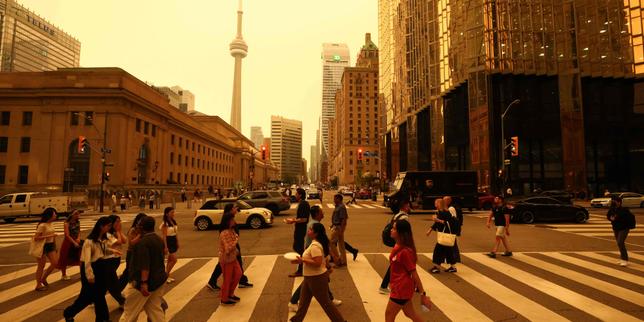
The media loves a good apocalypse visual. When wildfire smoke rolls into Toronto, New York, or any other major metropolis, newsrooms rush to post the exact same video: an orange, dystopian haze swallowing a famous skyline. It is instant clickbait. It triggers immediate panic.
But it completely misdiagnoses the problem.
The lazy consensus dominating the current narrative insists that urban smoke blankets are a sudden, unprecedented climate anomaly that can be solved by simply staring at air quality indexes and buying more indoor air purifiers. This view is wrong, short-sighted, and dangerous.
I have spent years analyzing environmental data and tracking the policy failures behind land management. The orange sky over Toronto is not a new apocalypse; it is the predictable bill coming due for a century of terrible policy. By focusing entirely on the dramatic visuals in major cities, we ignore the actual mechanics of why these fires burn, how our suppression tactics backfired, and why the current panic fixes absolutely nothing.
The Fire Suppression Paradox
For over a hundred years, forestry management followed a simple, flawed rule: put out every single fire immediately. If a flame appeared in the woods, stomp it out.
This sounds logical to a layman. To an ecologist, it is a nightmare.
Forests are designed to burn. Low-intensity, frequent fires are a natural cleaning mechanism. They clear out underbrush, dead wood, and leaf litter. When you eliminate these smaller, natural blazes, you do not stop forest fires; you just delay them. You turn the forest floor into a massive, unexploded tinderbox.
Decades of total suppression have left North American forests with a colossal accumulation of fuel. When a fire finally breaks through our suppression efforts now, it does not just burn—it explodes. The intensity is radically higher, creating the massive plumes of fine particulate matter ($PM_{2.5}$) that travel thousands of miles to choke out major cities.
The media frames the smoke over Toronto as an unavoidable natural disaster. In reality, it is an industrial-scale policy failure. We chose to store up a century’s worth of fire, and now we are surprised that the smoke is thicker than before.
The Mirage of Urban Victimhood
The coverage always centers on the city. We see endless b-roll of commuters in masks walking past the CN Tower. The underlying tone is one of shock that rural problems have dared to invade urban spaces.
This urban-centric panic distorts our response. City dwellers demand immediate, superficial fixes. They want localized air filtration, government warnings, and work-from-home declarations.
None of these actions touch the root cause.
Worse, this reaction funnels resource allocation into the wrong places. We pour billions into disaster response and reactive health measures instead of funding the one thing that actually mitigates the crisis: controlled burning.
Prescribed burns—deliberately lighting fires under controlled conditions to clear out accumulated fuel—are the only proven way to reduce the severity of these mega-fires. But prescribed burns are politically deeply unpopular. They create temporary smoke. They look bad on local news. They require politicians to actively defend setting fires near communities.
So instead of taking the calculated, temporary discomfort of controlled smoke in the spring, we opt for catastrophic, uncontrolled smoke in the summer. We choose the dramatic orange sky because we lack the political courage to manage the land correctly.
The Flawed Science of the Air Quality Index Panic
During any smoke event, everyone suddenly becomes an expert on $PM_{2.5}$ levels. People refresh their weather apps every five minutes, watching the Air Quality Index (AQI) fluctuate like day traders during a market crash.
This hyper-fixation is largely useless.
First, standard consumer-grade air quality sensors are notoriously inconsistent during extreme smoke events. They often miscalculate the concentration of organic carbon compounds versus black carbon, leading to wildly inaccurate readings that either overstate the immediate danger or understate it.
Second, the obsessiveness over AQI numbers masks a larger truth: your home is likely not the safe haven you think it is. Standard residential HVAC systems do not filter out fine wildfire smoke. Unless you have a sealed system with a dedicated MERV 13 filter or higher, the air inside your living room is rapidly equilibrating with the air outside.
Staring at an app does not clean your lungs. It just spikes your cortisol.
The Cost of the Counter-Intuitive Truth
To fix this, we have to accept a deeply uncomfortable truth: we need more fire, not less.
If we want to stop the catastrophic smoke events that paralyze cities, we have to allow millions of acres of forest to burn under controlled conditions. This means accepting haze in April so we do not choke in July. It means changing zoning laws to stop building suburbs deep into highly flammable wildland-urban interfaces.
But this approach has massive downsides. It requires writing off certain forestry assets. It means some vacation homes will become uninsurable. It means local tourist economies will take a hit during prescribed burn windows.
It is a hard, dirty, expensive trade-off.
But the alternative is what we have now: a cycle of panic, passive-aggressive finger-pointing, and endless media loops of a foggy skyline.
Stop looking at the orange sky as an act of God. It is an act of human management. Until we change how we treat the land, the smoke is not a temporary visitor—it is the new landlord.