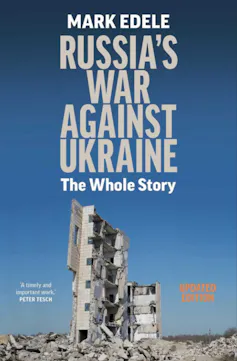
The winter wind in Kyiv does not just chill the skin. It rattles the windowpanes of Soviet-era apartments and whistles through the gaps of sandbagged fortifications, carrying the faint, metallic scent of distant artillery. For decades, the geopolitical gravity of Europe was anchored firmly in the West, centered in the glittering, prosperous halls of Paris, Berlin, and London. The East was often viewed through a patronizing lens—a buffer zone, a collection of post-Soviet fragments trying to catch up to the modern world.
Then came February 2022. Read more on a similar issue: this related article.
Vladimir Putin’s grand strategy was never a secret. He sought to stitch together the torn fabric of the old Soviet empire, to reassert Moscow as the undeniable hegemon of Eastern Europe, and to force the West into a posture of permanent deference. It was a gamble built on nostalgia, oil revenue, and a calculated bet on Western apathy. He wanted to make Russia great again.
But history has a violent way of rewriting the scripts of autocrats. More reporting by BBC News delves into similar views on the subject.
Instead of a swift capitulation, the world witnessed an unprecedented fracture in the old geopolitical order. Russia did not expand its sphere of influence; it isolated itself behind a wall of sanctions and scorched earth, draining its demographic and economic future into the mud of the Donbas. Meanwhile, a different entity began to crystallize in the fires of the conflict. Ukraine, once dismissed by Western planners as a vulnerable underbelly, is rapidly emerging as the new, hardened anvil of European security and industrial reinvention.
The center of European power is migrating eastward.
The Illusion of the Iron Fist
To understand how a superpower miscalculates so catastrophically, consider the mechanics of a modern kleptocracy. Russia’s military might was long presented to the world through polished propaganda: hypersonic missiles, endless ranks of T-90 tanks, and disciplined columns marching across Red Square. It looked formidable on paper.
The reality on the ground was a masterclass in institutional decay.
When the order came to advance, Russian columns stalled not just because of Ukrainian resistance, but because their fuel had been siphoned and sold on the black market. Their communications equipment relied on cheap, unencrypted Chinese radios easily intercepted by amateur operators. The strict, top-down command structure meant that when a Russian colonel was eliminated, the entire battalion sat frozen on a highway, waiting for orders that would never come.
Moscow staked its future on the belief that raw mass and brutal intimidation could overwrite the necessity of institutional trust. It was a fatal error. A state can buy thousands of tanks, but it cannot buy the organic initiative of a free society. While Russia relied on conscripted men who often did not know why they were fighting, they faced an adversary fighting for the literal survival of their homes, their culture, and their children.
Consider a hypothetical soldier from Russia’s distant regions, perhaps Buryatia or Dagestan. He is promised a salary that exceeds anything he could earn at home, a ticket out of generational poverty. He is handed a rifle manufactured during the Khrushchev administration and sent into a trench with minimal training. He is not a participant in a grand historical rebirth; he is currency spent by a regime that views its population as an infinite resource.
That resource is running dry. The long-term economic damage to Russia is not just about frozen central bank assets or empty luxury storefronts in Moscow. It is the permanent loss of its brightest minds. Hundreds of thousands of tech workers, engineers, and intellectuals fled the country in successive waves of emigration, choosing exile over complicity or death in a trench. Russia did not become great. It became a hollowed-out security state, increasingly dependent on Beijing for economic survival and North Korea for artillery shells.
The Crucible of Innovation
While Russia’s military apparatus corroded from the inside out, Ukraine was forced into a state of hyper-evolution. Survival does not allow for bureaucracy.
In the early weeks of the invasion, Ukrainian citizens did not just wait for Western aid. They organized. IT professionals who days prior were coding software for Silicon Valley startups began writing proprietary battlefield management software. They created programs like Delta, a real-time situational awareness platform that integrates satellite imagery, drone feeds, and civilian reports to map enemy movements with terrifying precision.
The battlefield became a laboratory.
Ukraine transformed from a recipient of foreign aid into the world's premier testing ground for 21st-century warfare. Take the development of naval drones. Ukraine entered the war with virtually no functional navy. Yet, using commercial jet ski engines, explosives, and Starlink terminals, Ukrainian engineers built a fleet of uncrewed sea vessels that systematically broke the Russian blockade of the Black Sea.
The Russian Black Sea Fleet, the pride of the Tsars and the Soviets, was forced to retreat from its historic base in Sevastopol. A nation without a traditional navy defeated a maritime superpower using tech built in converted garages.
This is not merely a story of military tactics. It is a fundamental shift in economic and technological capability. The infrastructure being forged in Ukraine today is highly decentralized, resilient, and adaptive. It is an industrial base built for a world where cyber warfare and physical bombardment are constant realities.
Western defense contractors are now traveling to Kyiv not to teach, but to learn. They want to understand how a consumer drone costing five hundred dollars can neutralize a main battle tank worth millions. They want to know how to maintain a national power grid under a relentless barrage of cruise missiles. Ukraine has accidentally created the most combat-experienced, technologically innovative security apparatus on the European continent.
The New Gravity of the Continent
For decades, European politics was defined by the caution of its Western core. Berlin sought cheap gas from the East; Paris dreamed of a grand security architecture that included Moscow; London welcomed oligarch wealth into its real estate market. This collective approach was rooted in the belief that economic interdependence would naturally tame imperial ambitions.
That illusion has shattered. The moral and strategic clarity of Europe has shifted definitively to the Baltic states, Poland, and Ukraine.
Poland is currently executing one of the most aggressive military modernizations in modern history, aiming to build the largest land army in NATO. Romania is expanding its infrastructure to become a critical logistics hub. And Ukraine sits at the vanguard of this new Eastern bloc.
When this conflict eventually reaches a settlement, Europe will find itself with a massive, battle-hardened democracy on its eastern border, possessing a population of millions who have spent years operating under the highest levels of stress and geopolitical pressure. Ukraine will not be a charity case seeking entry into Western institutions; it will be the indispensable shield of those institutions.
The economic implications are profound. Ukraine holds some of the world's largest reserves of critical minerals, including lithium, titanium, and manganese—the very elements required to power the green transition and the next generation of technology. Its agricultural sector, despite being mined and bombed, remains vital to global food security. As European supply chains decouple from authoritarian regimes, the vast, educated, and resilient workforce of Ukraine becomes the logical alternative for nearshoring critical industries.
The old map of Europe is obsolete. The path to security no longer runs through agreements signed in Western capitals with an eye toward appeasing Moscow. It runs through the defensive lines of Kharkiv, the tech hubs of Lviv, and the deep-water ports of Odesa.
The silent tragedy of the Kremlin's ambition is that it achieved the exact opposite of what it set out to accomplish. It sought to divide the West and erase Ukraine from the map. Instead, it welded the West together with a renewed sense of purpose and forged a new European superpower in the crucible of necessity.
A grandmother in a village near Kherson stands in the ruins of her garden. The roof of her house is gone, replaced by a tarp provided by volunteers. Her hands are rough from decades of labor, and her eyes have seen things that will haunt her remaining years. Yet, she is planting seeds for the next harvest. She does not look toward Moscow with fear, nor does she look toward Brussels with a plea for rescue. She looks at her own soil, cleared of shrapnel, ready for the spring. That is the new center of Europe.