The internet loves a cozy mystery. Currently, it’s obsessed with why NASA’s "splashdown" astronauts aren't immediately devoured by Great Whites the moment they bob into the Pacific. The standard explanation—the "lazy consensus" pushed by pop-science outlets—is a cocktail of noise, logistics, and chemistry. They tell you sharks are scared of the loud sonic booms. They tell you the recovery teams are too fast. They tell you the ocean is just too big.
It’s all technically true and entirely irrelevant.
Focusing on shark biology in the context of space travel is like worrying about a papercut while you're plummeting off a cliff. The real story isn't why sharks don't bite; it's why we are still using a recovery method designed in the 1960s that treats the world’s most elite explorers like a piece of high-tech fishing bait.
The Shark Repellent Myth
Let’s dismantle the "Shark Screen" narrative first. During the Mercury and Gemini eras, NASA actually issued shark repellent cakes to astronauts. These were essentially copper acetate blocks meant to mimic the smell of dead sharks. It didn't work. Sharks aren't deterred by the scent of their cousins; in some cases, it just makes them curious.
Modern NASA doesn’t even bother with chemical repellents anymore. Why? Because the physics of a splashdown is a violent, chaotic event that creates a "dead zone" of sensory input.
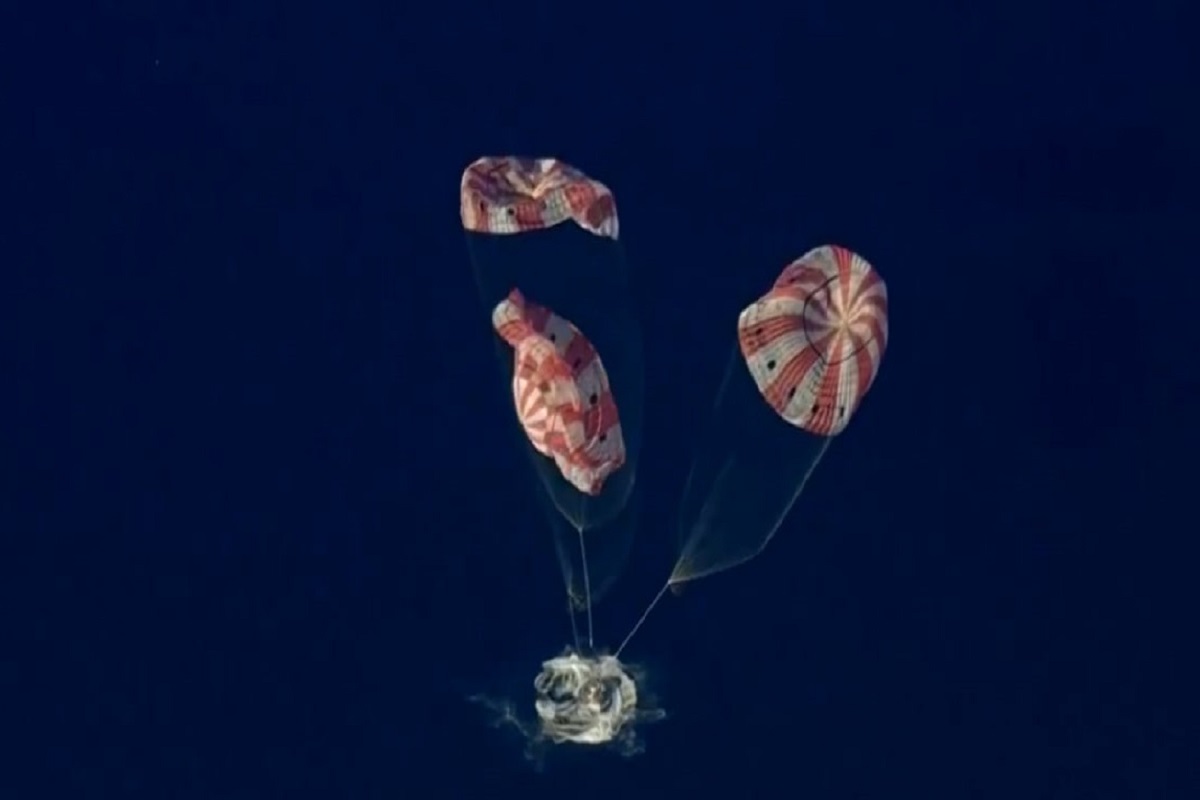
When a capsule like the SpaceX Dragon hits the water, it isn’t a gentle dip. It’s a multi-ton kinetic impact.
- Sonic Overload: The double sonic booms during reentry and the massive thud of impact create a pressure wave that clears the immediate area of sensitive marine life.
- Toxic Slosh: The capsule is often venting residual hypergolic fuels like nitrogen tetroxide or hydrazine. To a shark, which can detect a drop of blood in an Olympic pool, the chemical signature of a capsule doesn't smell like food. It smells like a caustic, burning poison.
- The Wait: Recovery ships are already loitering at the "X." The noise of heavy diesel engines and helicopter rotors creates an acoustic wall.
The "mystery" of why sharks don't attack is solved by basic industrial disturbance. We aren't being clever; we’re just being loud and toxic.
The Splashdown is a Relic
The obsession with "shark-infested waters" masks a deeper, more uncomfortable truth: the water landing is a failure of innovation.
We are currently witnessing a regression in aerospace recovery. While companies like SpaceX have mastered the vertical landing of boosters on solid ground or droneships, we are still dropping the actual humans into the salt water. Salt water is the literal enemy of engineering. It is corrosive, unpredictable, and turns a reusable spacecraft into a maintenance nightmare.
The industry insider’s perspective is this: we continue splashdowns because we are terrified of the mass-penalty of landing legs and thruster systems on the capsule itself. Every kilogram of landing gear is a kilogram of lost cargo or life support. We choose the ocean not because it's safe, but because it’s a "free" shock absorber that we don’t have to pay for in the mass budget.
Logistics vs. Biology
People ask: "What if the recovery team is late?"
If the recovery team is late, the shark is the least of the astronaut's problems. Let's look at the actual math of a post-splashdown scenario. The capsule is a sealed pressure vessel. Inside, the temperature begins to spike the moment the air conditioning—powered by the service module that was jettisoned—stops. This is the "Heat Soak" effect.
I’ve seen thermal models where the interior cabin temperature of a static capsule in the midday sun hits $40^\circ\text{C}$ to $50^\circ\text{C}$ within an hour. The astronauts are already dehydrated, physically weakened by $0g$ muscle atrophy, and dealing with the vestibular nightmare of moving waves after months of stillness.
A Great White Shark circling the capsule is a cinematic trope. The reality is a slow, sweltering bake inside a carbon-fiber oven.
The Predation Paradox
If you want to talk about "sharks," talk about the recovery zones. NASA and SpaceX don't just pick a random spot in the ocean. They use "Targeted Recovery Zones" (TRZs). These are areas characterized by low biological productivity—essentially oceanic deserts.
Why? Because where there are fish, there are birds. Where there are birds, there are waves and interference. By choosing deep-water, low-nutrient zones, they statistically minimize the presence of apex predators.
But here is the contrarian kicker: the more we "perfect" the splashdown, the more we ignore the moon.
If we are serious about being a multi-planetary species, we have to stop romanticizing the ocean recovery. There are no oceans on Mars. There is no Navy recovery team in the craters of the Moon. Every minute spent debating shark behavior and perfecting water-based recovery is a minute we aren't spent perfecting the propulsive landings required for the rest of the solar system.
The Real Danger is Human Error
While the public worries about a "Jaws" scenario, the industry worries about "Sea State."
A Sea State of 4 or 5—meaning waves of roughly $2$ to $2.5$ meters—is enough to flip a recovery boat or make the extraction of a capsule impossible. In 1961, Gus Grissom almost drowned not because of a shark, but because his hatch blew early and his suit started filling with water. He was fighting the ocean itself, not the things living in it.
The sea is a chaotic, non-linear environment. No amount of "shark logic" makes it a smart place to put a billion-dollar asset and three national treasures.
The Institutional Laziness of "Safe Enough"
We’ve fallen into the trap of "Safe Enough."
- The Consensus: Splashdowns are safe because we have a $100%$ success rate regarding animal interference.
- The Reality: Splashdowns are a logistical bottleneck that relies on the cooperation of the weather, the Navy, and the structural integrity of a heat shield that just survived $1600^\circ\text{C}$.
We don't need better ways to keep sharks away. We need to stop landing in their living room. The future of spaceflight isn't a capsule bobbing in the Atlantic; it's a vehicle that lands on a concrete pad with the precision of a Swiss watch.
Until we stop treating astronauts like high-velocity driftage, we aren't actually a spacefaring civilization. We're just throwing rocks into the pond and hoping they don't sink.
Stop asking why the sharks aren't biting. Start asking why we're still giving them the opportunity.