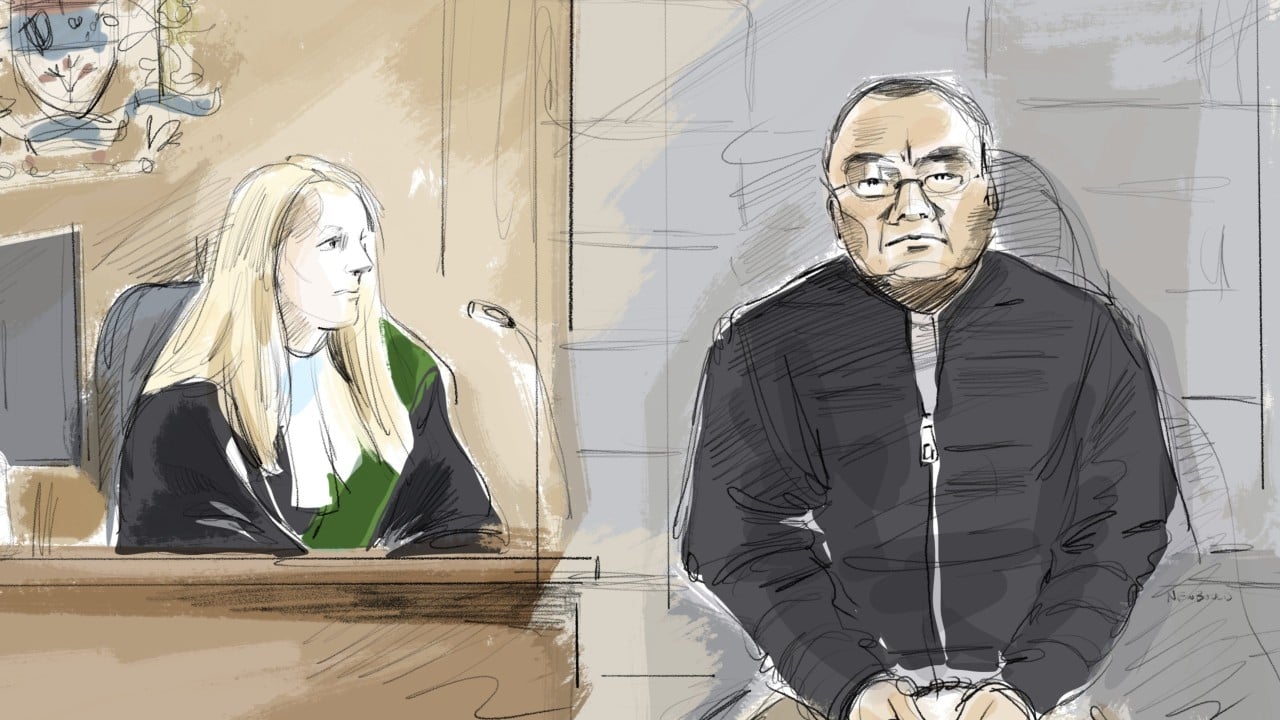
The courtroom in Ontario does not smell like sulfur or brimstone. It smells like damp wool, floor wax, and the exhausted sweat of people who have carried heavy grief through too many time zones. Outside, the Canadian air carries the crisp bite of late autumn, indifferent to the quiet devastation contained within these four walls. Inside, rows of wooden benches hold parents whose lives were fractured by a postal receipt.
They sit with their shoulders hunched, clutching framed photographs like shields against a reality they refuse to completely accept. On the other side of the glass sits Kenneth Law. To look at him is to look at someone remarkably ordinary—a man whose appearance suggests a retired engineer or a quiet accountant who spends his weekends tending to a modest garden. There is no cinematic villainy in his posture, no theatrical sneer. He looks like anonymity incarnate. And that is precisely what makes the silence in the room so heavy, so suffocatingly dense.
For months, the legal proceedings have churned through charges of counseling and aiding suicide. The cold legal documents speak in dry percentages and statutory clauses, charting a trail of small white parcels shipped from a nondescript suburban address to bedrooms across the globe. But numbers do not capture the sound of a mother opening a bedroom door to find an emptiness that echoes for the rest of her days. They do not measure the sudden, violent rupture of a family unit when a young mind, clouded by an invisible storm, finds an expedited exit packaged neatly in a brown cardboard box.
Consider what happens when desperation meets the frictionless efficiency of global commerce.
In our modern world, we have built pathways that allow a person sitting in a basement in Birmingham, a dormitory in California, or an apartment in Toronto to order almost anything with a few strokes of a keyboard. We praise this frictionless speed when it delivers books, groceries, or warm clothes. We rarely stop to look at the dark reverse of that same coin. We rarely examine what happens when that exact same logistics network is weaponized by someone willing to monetize human despair.
Kenneth Law did not invent human suffering. Suffering is as old as consciousness itself. The ancient Greeks wrote tragedies about it; poets have bled ink over it for millennia. What Law did was something entirely modern, something chillingly bureaucratic. He industrialized the final stop.
Let us be clear about the mechanics, stripped of sensationalism. The chemical at the center of this tragedy is sodium nitrite. In a commercial kitchen or a meat-processing plant, it is a common preservative, used in small, regulated quantities to cure cured meats. It has a legitimate, mundane industrial purpose. But when concentrated and shipped in lethal doses to people actively seeking a way out of life, it transforms from a compound into a catastrophe. Law allegedly operated a web of online storefronts, marketing this industrial substance directly to individuals who typed dark, lonely queries into search engines late at night.
To understand the human cost, imagine a hypothetical evening that plays out in millions of homes every single night. Let us call her Maya. Maya is nineteen, away at university, drowning in a profound sense of isolation that feels as permanent as a mountain. Her roommates see her smiling in the kitchen, but inside, her internal landscape has eroded into ash. To her, the future is not a blank canvas; it is a wall closing in.
In the quiet hours of 3:00 AM, when the rest of the world is asleep, Maya does not reach out to a friend because she fears being a burden. Instead, she opens a search bar. She types words of defeat. And because the modern internet is engineered to match supply with demand with terrifying efficiency, algorithms that usually sell shoes or airline tickets begin to whisper alternative solutions.
Before the digital age, someone in Maya’s position faced physical barriers. Impulsivity was often checked by the sheer difficulty of sourcing the means to an end. Those barriers bought time. Time is the one thing a suicidal mind cannot afford, because time allows the storm to break, the dawn to arrive, and the unbearable moment to pass. But online, those protective barriers were systematically dismantled. A transaction took place. A few clicks, a credit card number, a postal tracking code. A few days later, a small package arrived in the mail, blending seamlessly among textbooks and bills.
The postal worker who dropped that box onto the porch did not know what they were carrying. The delivery driver had no way of knowing. The system functioned with ruthless, unthinking efficiency.
When the news broke that a Canadian engineer had been arrested for allegedly sending hundreds of these packages to addresses across the United Kingdom, the United States, Australia, and beyond, the public reaction was a mixture of shock and incomprehension. How could one man, sitting at a computer in Ontario, reach so far across oceans? How could a postal service become an unwitting accomplice to so many quiet tragedies?
The answer lies in the terrifying democratization of harm. In the past, dangerous substances were guarded behind institutional gates. Today, anyone with a credit card and an internet connection can tap into global supply chains. Law allegedly realized that there was a hidden, desperate market of people looking for an easy exit, and he treated them not as human beings in crisis, but as customers. He allegedly provided instructions, reassurance, and product, operating with the cold detachment of a third-party logistics vendor fulfilling routine orders for office supplies.
This is where the narrative shifts from a local police blotter to a profound cultural reckoning.
We live in a society that is hyper-connected yet profoundly disconnected. We talk constantly about mental health awareness, slapping pastel-colored ribbons on corporate logos during designated months, while actual human beings slip through the cracks of a crumbling social fabric. We have built an economy that prioritizes speed over safety, scale over stewardship, and anonymity over accountability.
When the families of the victims speak in that Canadian courtroom, their words cut through the legal jargon like broken glass. They do not talk about statutes or jurisdiction. They talk about bedrooms that remain untouched, shoes left by the front door, and the agonizing guilt of replaying every conversation, wondering where they missed the warning sign.
One father stood before the press outside the courthouse, his voice trembling not with anger, but with an exhaustion that reached down to his bones. He spoke of his son—a bright, creative young man who loved music and had a laugh that could fill a room. A boy who, in a single moment of absolute darkness, found a shortcut that was marketed to him as an easy way out.
"It wasn't just a sale," the father said, his eyes fixed on the pavement. "It was an invitation to die."
That phrase lingers. An invitation to die.
For decades, society has grappled with how to regulate dangerous goods. We monitor precursors to explosives, restrict access to firearms, and place age limits on pharmaceuticals. Yet, the digital grey zones where lethal substances are repackaged and shipped directly to vulnerable bedrooms have remained largely unpoliced until the damage is already done. Law’s arrest exposed a glaring blind spot in our global regulatory framework—a blind spot where international borders, weak cyber oversight, and corporate liability intersect with fatal consequences.
Governments are now scrambling to close the gaps. Law enforcement agencies are learning to track cryptocurrency payments, encrypted chat logs, and international shipping manifests used by underground vendors. But regulation alone cannot fix a culture that allows people to feel so utterly alone that a package in the mail looks like the best option available.
The trial of Kenneth Law will eventually conclude. Judges will weigh evidence, lawyers will present closing arguments, and sentences will be handed down. But the deeper questions raised by his actions will not be resolved by a gavel.
Those questions remain in the empty chairs at kitchen tables across the world. They linger in the quiet hum of computer servers operating in the dead of night. They rest on the shoulders of every institution, every community, and every individual who walks past a neighbor in pain without stopping to ask if they are truly okay.
We cannot legislate away human despair, nor can we completely erase the dark corners of the internet. But we can refuse to let efficiency be an excuse for indifference. We can learn to recognize the subtle, quiet signals of a mind sinking beneath the surface. And we can demand that the systems connecting our world are designed not just to deliver packages faster, but to protect the fragile human lives on the receiving end.
The courtroom grows quiet as the judge prepares to speak. Outside, the autumn wind strips the final stubborn leaves from the maple trees, sending them spinning down into the cold Canadian earth. Somewhere across the ocean, a mailbox opens, and another routine delivery drops inside, carrying the ordinary mail of an ordinary day, reminding us how fragile our shared existence really is.