The air in London during early spring usually carries the scent of damp earth and the frantic, hopeful energy of a city shaking off winter. But for many families walking down the leaf-strewn streets of Golders Green or Stamford Hill lately, the air feels heavier. It is the weight of a glance held a second too long. It is the instinct to tuck a Star of David pendant inside a shirt collar before stepping onto the Tube.
It is a quiet, eroding fear.
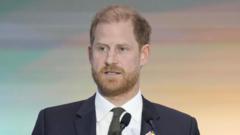
When Prince Harry recently spoke out about the "deeply troubling" rise of antisemitism in the United Kingdom, he wasn't just reading from a prepared script of royal platitudes. He was pointing at a fracture in the foundation of British society that has widened into a chasm. The statistics are clinical, cold, and terrifying. The Community Security Trust (CST) recorded over 4,000 antisemitic incidents in the UK in a single year—the highest total ever reported.
But numbers are bloodless. They don't capture the heartbeat of a mother who hesitates before sending her child to school in a blazer that bears a Jewish crest. They don't reflect the hollow feeling in the stomach of a shopkeeper scrubbing a slur off his window at dawn, his hands shaking not from the cold, but from the sudden realization that his neighbors might have watched it happen and said nothing.
The Anatomy of an Ancient Hate
Antisemitism is often called the "longest hatred." It doesn't function like other forms of prejudice. It is a shapeshifter. It adapts to the anxieties of the era. In the Middle Ages, it was religious. In the twentieth century, it was pseudo-scientific and racial. Today, it hides behind political discourse, masking itself in the chaotic flow of social media feeds where a lie can travel around the world before the truth has even found its shoes.
Consider a hypothetical student named Sarah. Sarah is twenty, studying history at a university in the Midlands. She grew up hearing stories from her grandfather about why their family name changed in 1946—a desperate attempt to blend in, to disappear, to be "safe." For decades, that fear seemed like a relic of a darker time, something to be honored in museums but never felt in the flesh.
Then came the messages.
It started with "memes" in a group chat. Then came the "just asking questions" comments during a seminar on Middle Eastern politics. Eventually, it became the sight of a masked group chanting slogans outside the library that felt less like political protest and more like a personal eviction notice. Sarah isn't a politician. She isn't a military strategist. She is a girl who likes vintage clothes and spends too much money on oat milk lattes. Yet, suddenly, she is being held accountable for every headline, every conflict, and every grievance associated with her heritage.
She is being reminded that, to some, she is an "other."
The Digital Echo Chamber
We live in an age of curated outrage. The algorithms that govern our digital lives are designed to reward intensity, not nuance. If you click on a video that makes you angry, the machine will give you ten more just like it. This creates a feedback loop where conspiracy theories—the lifeblood of antisemitism—can thrive.
The trope of the "shadowy elite" or the "globalist puppet master" isn't new. It’s a centuries-old poison repackaged for the TikTok generation. When a public figure like Prince Harry sounds the alarm, he is acknowledging that the guardrails are failing. The civility we took for granted is being replaced by a digital mob mentality where historical literacy is low and the desire for a scapegoat is high.
The danger isn't just the extremist with a spray can or a brick. The real danger is the "polite" antisemitism. It’s the silence of the dinner party when someone makes a comment about "Jewish influence." It’s the shrug of the shoulders when a Jewish colleague mentions they feel unsafe. This silence is a permission slip. It tells the aggressor that their targets are standing alone.
The Human Cost of Hyper-Vigilance
Living in a state of constant high alert changes a person. It alters the brain’s chemistry. It’s called hyper-vigilance, and it is exhausting.
Imagine walking into your place of worship and having to pass through a security gate guarded by men in tactical vests. Imagine your children’s nursery school having blast-proof glass. This is the reality for the UK’s Jewish community. It is a tax on their peace of mind that no one else is asked to pay.
When Harry speaks of the rise in hate being "troubling," he is touching on the psychological toll of this reality. It is the feeling of being a guest in your own home—a guest whose invitation is being slowly, visibly rescinded.
History teaches us that antisemitism is the canary in the coal mine. It is rarely the end of the story; it is usually the beginning of a broader collapse of social cohesion. When a society begins to tolerate the dehumanization of one group, it loses the ability to protect anyone. The rot spreads.
Beyond the Statistics
To understand the stakes, we have to look past the bar charts. We have to look at the empty chairs at community events where people stayed home because they were afraid of the walk to the station. We have to listen to the conversations happening at kitchen tables across North London, where parents are debating whether it’s time to renew their passports, just in case.
Is this the Britain we want?
The UK has long prided itself on being a sanctuary, a place of tolerance and the "fair go." But tolerance is not a static state. It is a muscle. If you don't exercise it, it withers. If you don't defend it when it’s under attack, it disappears.
The rise in antisemitism isn't a "Jewish problem." It is a British problem. It is a human problem.
Prince Harry’s intervention serves as a jarring reminder that status and privilege offer no immunity from the duty to speak. But the heavy lifting cannot be done by royals or politicians alone. It happens in the breakroom when a joke goes too far. It happens in the classroom when a teacher stops a slur in its tracks. It happens when a neighbor reaches out and says, "I see you, and you are not alone."
The shadows on the doorstep are growing longer. We can choose to turn on the lights, or we can wait until the darkness is total.
The silence is already loud enough.