The air in Guayaquil often tastes of salt and diesel, a heavy, humid weight that settles on the docks before the sun even clears the horizon. Down by the port, containers stack up like colored building blocks, carrying everything from Ecuadorian bananas to destinations unknown. But behind the logistics of global trade, another cargo moves through these streets in the dark. Fear.
For years, ordinary families in Ecuador have lived inside a slow-motion tightening of a noose. You hear the motorcycle engines first. Two men, helmets on, slowing down near a corner store or a neighborhood bakery. Then comes the demand for protection money. Pay, or your storefront burns. Pay, or your daughter doesn't come home from school.
This is not the plot of a fictional thriller. This is the daily arithmetic of survival in neighborhoods where the state's presence has frayed into a memory.
At the center of this localized terror sits Los Tiguerones.
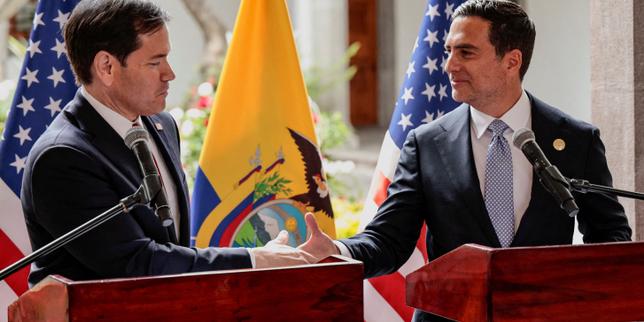
To understand what just happened, you have to look past the bureaucratic language coming out of foreign capitals. When the United States Department of State officially designated Los Tiguerones as a foreign terrorist organization, it was more than a legal stamp on a piece of paper. It was an acknowledgment of a terrifying reality: the line between local criminal enterprise and transnational terrorism has completely dissolved.
Consider what happens next when a gang gains this kind of cross-border gravity.
Los Tiguerones did not start as an international menace. They evolved from the brutal underbelly of Ecuador's prison system, growing out of older, sprawling street factions before splintering off into a leaner, more vicious entity. They mastered the art of cruelty, utilizing social media to broadcast executions, turning fear into a currency that spent very easily on the streets of Esmeraldas and Guayaquil.
They realized that control does not come from holding territory alone. It comes from owning the psychological landscape of a nation.
When a group like this begins hijacking state institutions, infiltrating courts, and assassinating presidential candidates—as the nation witnessed with the shocking murder of Fernando Villavicencio—the domestic police force alone is no longer fighting a crime wave. They are fighting an insurgency.
And that brings us to the diplomatic shift.
By applying the terrorist designation, Washington essentially severed the financial arteries of Los Tiguerones. Assets are frozen. International transactions become radioactive. Banks, shell companies, and illicit networks scattered across borders suddenly find themselves staring down the barrel of American federal prosecution.
Yet, designations do not arrest gunmen in the middle of a raid.
Walking through certain districts of Ecuador right now, you feel the tension in the way people lock their doors before twilight. Merchants lower heavy steel shutters hours earlier than they used to. Children play soccer in dusty lots, but their parents keep a watchful eye on the perimeter. The designation is a weapon, yes, but it is a distant one, fired from office buildings thousands of miles away while the people on the ground still have to live under the shadow of men with automatic weapons.
The fight against transnational gangs requires more than freezing bank accounts. It requires rebuilding the social contract from the bottom up. It requires courts that cannot be bought, prisons that do not serve as headquarters for criminal syndicates, and economic opportunities for kids who currently see joining a gang as the only viable career path.
For now, the label has been applied. The international community has named the ghost.
But back in the alleys of Guayaquil, as the diesel smoke mixes with the evening fog, the real test has only just begun. The ink on the declaration is dry, but the blood on the pavement is still very real.
The sun dips below the Pacific horizon, casting long, dark bars across the shipping containers, and the motorcycles start their engines in the distance.