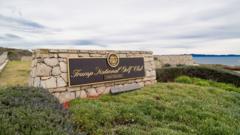
Morning arrives on the Florida coast with a heavy, bruised humidity. Long before the sun burns through the salt-choked fog, the grass on the fairways holds a dense, grey dew. It is a quiet time. The sprinklers hiss in rhythmic, hypnotic bursts. The palm fronds scrape softly against the stucco walls of estate homes. In this pocket of Palm Beach County, wealth creates an illusion of insulation, a belief that the noise of the outside world can be neatly trimmed back by manicured hedges and gated perimeters.
Then the radio crackles.
Silence shatters.
A checkpoint down the road tightens. Blue and red strobes bleed through the morning mist, turning the pale stucco an urgent, violent purple.
Security is not an abstract concept here. It is a physical weight. It smells of hot engine oil, damp canvas, and expensive gunmetal. When an armed man is intercepted near a presidential visit, the machinery of modern protection does not panic. It clicks. Gears mesh. Protocols written in blood and historical failure execute with cold, terrifying efficiency.
Consider what happens next: the public only sees the aftermath. They see the yellow tape fluttering like dying ribbons in the breeze. They see the anchors standing on the shoulder of the highway, microphones clutched in white-knuckled fists, reading bullet points handed down by public information officers. But the real story lives in the milliseconds before the trigger is pulled or lowered. It lives in the mind of the officer looking across a car hood, trying to decode the difference between an ordinary citizen having a catastrophically bad morning and an executioner waiting for a break in the trees.
We have normalized the abnormal.
Every single day, thousands of individuals walk the perimeter of modern American power. They push strollers, walk golden retrievers, jog in sweat-soaked shirts with earbuds pumping synth-pop into their skulls. They are background noise to history. But beneath that casual exterior lies a simmering undercurrent of volatile grievance. The distance between an anonymous digital rant posted in the dark of a basement and a loaded firearm sitting on the passenger seat of an SUV in Florida has collapsed.
It used to take months to organize an assassination attempt. It used to require shadowy networks, smuggled funds, and whispered conspiracies. Now, it takes an internet connection, a radicalizing echo chamber, and a credit card capable of purchasing a rifle online.
The suspect in this latest breach of the perimeter did not need a grand army. He needed a grievance and a highway map. That is the terrifying reality of contemporary security logistics. The threat surface is infinite. Every fence line has a blind spot. Every motorcade route has an overpass. Every golf course has a tree line where the manicured landscaping gives way to dense, tangled Florida scrub.
Fear is a poor architect, yet we let it design our world.
Walk through any major American city, or stand near the cordoned-off boundaries of a political rally, and you can taste the collective paranoia in the air. It tastes like copper and ozone. It is the feeling of walking across a frozen lake in early spring, listening for the faint, sickening sound of ice cracking beneath your boots. You keep moving because stopping is a form of surrender. But you know the ground beneath you is unstable.
The Secret Service agents, local sheriff's deputies, and highway patrol troopers who swarm these perimeters are not acting out of political alignment. They are actors in a grim, silent play of probability. They spend their entire working lives running calculations that no human being should have to compute. If I look away for two seconds, what walks out of the treeline? If I hesitate, who dies?
The man caught near the green was not a master spy. Reports paint a portrait of a fractured life, a trajectory defined by erratic choices, mounting frustrations, and a dangerous drift toward political extremism. This is the new face of peril. It is not an organized legion marching in formation. It is a lone figure in a vehicle, sitting in a parking lot, waiting for the alignment of the stars and the opening of a gate.
When the arrest finally came down, there was no cinematic shootout. There was no slow-motion dive behind a marble pillar. Just the sharp, unromantic snap of heavy-duty zip ties, the gravel grinding under combat boots, and the heavy, muffled thud of a suspect being pressed against the warm metal of a cruiser.
Routine.
And that is what should terrify us more than anything else. That stopping an armed intruder near a former president has become just another Tuesday shift for law enforcement.
We have built a society where extreme danger wears the mask of the mundane. We scroll past headlines of intercepted weapons and foiled plots while drinking our morning coffee, treating them like weather reports or sports scores. We sigh, we swipe to the next app, and we return to our emails. We tell ourselves that the system held, that the shield did its job, that everything is fine.
The shield held this time.
The deputies were sharp. The intelligence was processed. The vehicle was spotted. The intervention was clean. But a security apparatus can fail ninety-nine times and survive; the attacker only needs to be right once.
The sun burns higher now, cutting through the coastal fog, baking the asphalt until the air shimmers with heatwaves. The media vans are packing up their cables. The anchors are adjusting their ties, recording their evening stand-ups, ready to move on to the next breaking crisis. The golf course will be mowed again. The greenskeepers will blow away the stray clippings.
Yet out there, past the perimeter fence, the scrub oak still casts its long, jagged shadows across the grass.