Deep Water
Salt eats everything eventually. It devours steel, dissolves canvas, and turns human memory into something faint and distorted. For nearly three-quarters of a century, the wreckage of a massive flying boat lay entirely undisturbed in the cold darkness of the Pacific, smothered under hundreds of feet of water, silent while the world above moved on.
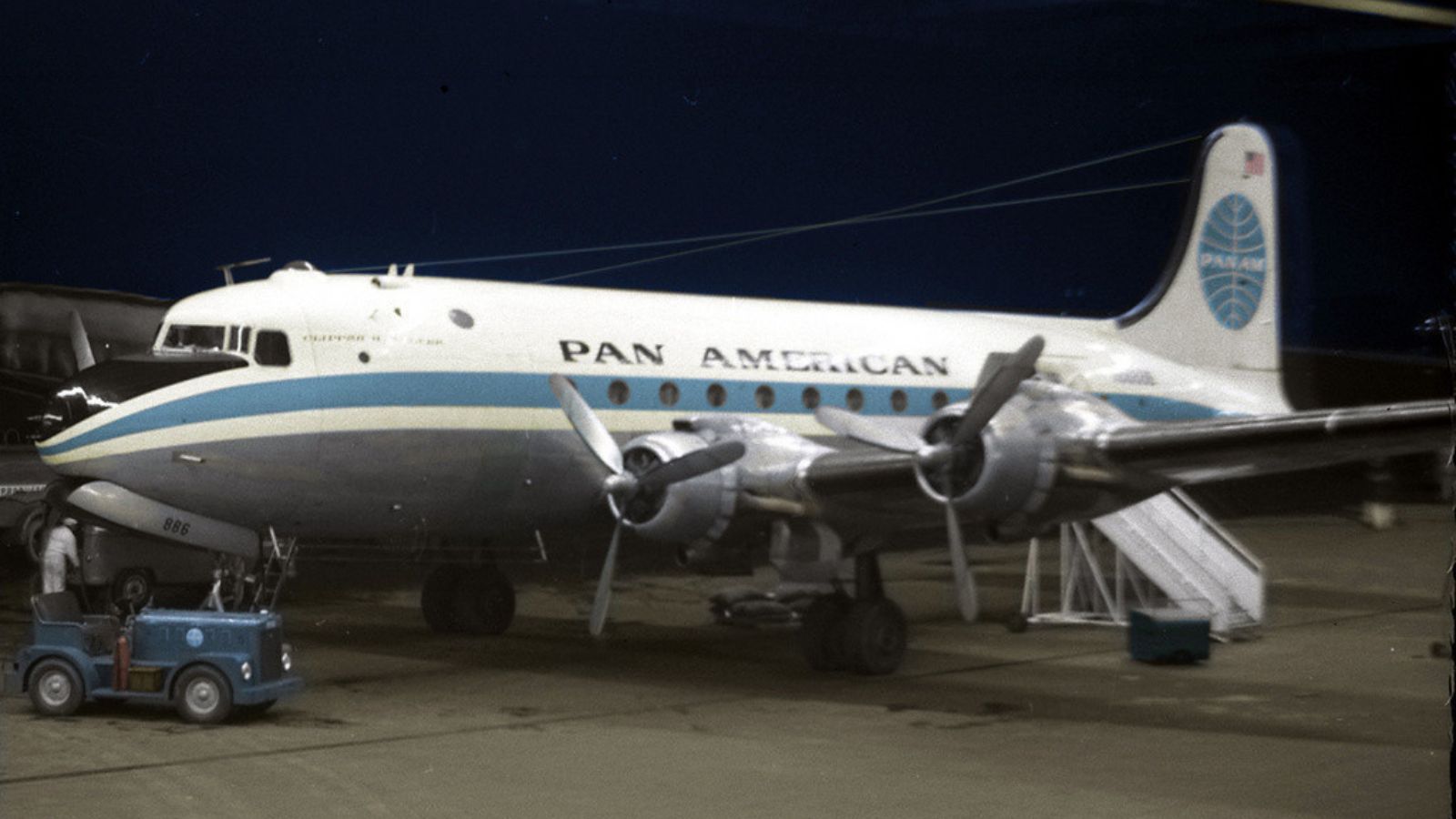
Imagine standing on a dock in the late 1940s. The air smells of aviation fuel and ocean mist. A Pan American Airways flying boat—a leviathan of silver metal and humongous radial engines—idles on the swell, its hull slicing through gray tide. These machines were the luxury liners of the sky. They carried diplomats, movie stars, and high-stakes mail across vast, terrifying expanses of open ocean before radar and GPS existed to guide them home.
Then came a catastrophic mistake. A hard landing, a structural failure, or an unforeseen storm—the exact sequence of panic lasts only seconds before the hull yields to the sea. The water rushes in, heavy and unyielding. The giant sinks.
And for 74 years, nobody knew precisely where it went.
The Ghost Fleet of the Golden Age
Long before jet engines screamed across the stratosphere, international air travel belonged to the seaplane. Pan Am built an empire on these soaring behemoths. They were engineering marvels of their day, floating palaces equipped with dining salons and private berths.
When one vanished, it didn't just crash into dirt; it settled into an abyssal vault. Search parties in the mid-twentieth century lacked the tools to scan the ocean floor with true precision. They dragged cables, scanned horizons with binoculars, and ultimately closed the ledger, leaving families with unresolved grief and aviation historians with empty maps.
[Image of hydrogen fuel cell]
To find a needle in a haystack is hard enough. Finding a shattered hull in a pitch-black underwater canyon requires something beyond persistence. It demands technology that sees through mud, pressure that would crush an engine block, and human obsession.
Search crews returned decades later armed with advanced side-scan sonar and deep-diving autonomous vehicles. They swept the sea floor, grid by agonizing grid. Day after day, the monitors showed nothing but uniform, rolling sand. Monotony. Failure.
Then, a shadow appeared on the screen.
Anatomy of a Discovery
Sonar doesn't give you a photograph. It gives you whispers of density. A sharp angle where nature only creates curves. A straight line of metal protruding from a sea bed formed over millennia.
+-------------------------------------------------------+
|  [Sonar Beam]                                         |
|       \                                               |
|        \   Silt / Ocean Floor                         |
|~~~~~~~~~\~~~~~~~~~~~~~~~~~~~~~~~~~~~~~~~~~~~~~~~~~~~~~|
|          \      ____[ Wreckage ]____                  |
|           \    /                    \                 |
|            \  /                      \                |
+-------------------------------------------------------+
When the remotely operated vehicle descended, cutting through the twilight zone into absolute blackness, its high-intensity lights illuminated a sight frozen in time.
The propellers sat half-buried in marine silt. Aluminum skin, corroded but unmistakably shaped by human hands, glinted under artificial light. Fish darted through structural frames where passengers once sat sipping hot coffee, looking out at the clouds.
Finding this wreckage isn't merely a win for underwater archaeology. It provides closure to an era. It transforms a tragic footnote into an anchor of real, tangible history.
What the Ocean Keeps
Every wreck is a capsule of human decision. Someone checked a gauge. Someone pulled a lever. Someone looked out a portal window and watched the ocean rise up to meet them.
The discovery of this Pan Am flying boat after 74 years bridges a gap between the wild, early days of commercial aviation and our modern, hyper-connected skies. We fly now with near-absolute certainty, guided by satellite networks and automated flight controls. But that safety was bought, piece by piece, by the pioneering crews who flew giant metal hulls into the unknown.
The silt has settled again over the metal frame. The cameras have turned off. The flying boat remains in the dark, but it is no longer lost.