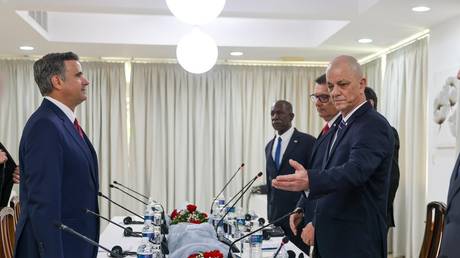
The mainstream media is treating the CIA director’s backdoor message to Havana as a masterstroke of high-stakes diplomacy. They are painting a picture of a bold, covert maneuver straight out of a Cold War thriller.
They are entirely wrong.
When Washington relies on the Central Intelligence Agency to deliver a diplomatic ultimatum, it is not a demonstration of power. It is an admission that the official channels of American foreign policy are broken. Using the nation’s top spy as a glorified courier does not project strength to the Cuban regime; it signals that the State Department has been hollowed out, leaving the United States with only two gears in its foreign policy machine: economic strangulation and covert threats.
For decades, the consensus in Washington has been that isolating Cuba and relying on backchannel pressure will eventually force a democratic transition. The data shows otherwise. Sixty years of the embargo and a rotating door of secret envoys have yielded exactly zero structural changes in Havana.
Let us look at the mechanics of how this dynamic actually plays out, rather than the romanticized version fed to the press.
The Mirage of the Backchannel Breakthrough
The lazy consensus suggests that clandestine meetings yield results because they bypass the political theater of public diplomacy. Proponents point to the historical precedent of the 1962 Cuban Missile Crisis, where secret letters between John F. Kennedy and Nikita Khrushchev averted disaster.
But this is a flawed historical parallel.
In 1962, both superpowers possessed massive, functioning diplomatic corps that were actively negotiating. The backchannel was a pressure valve, not the entire engine. Today, sending a intelligence chief to Cuba is a desperate attempt to patch a sinking ship with duct tape.
When an intelligence official delivers a message, the recipient does not hear an invitation to negotiate. They hear a threat. In the rigid hierarchy of the Cuban Communist Party, a visit from the head of the CIA reinforces the regime’s oldest and most effective domestic narrative: that the United States is an imminent, existential security threat. This narrative is the precise justification the Cuban government uses to crack down on internal dissent and ration resources. By playing the spy card, Washington hands Havana the exact propaganda victory it needs to maintain domestic control.
The High Cost of Bypassing the State Department
I have watched successive administrations strip authority away from career diplomats and hand it to political operators and intelligence agencies. The result is always the same: short-term headlines followed by long-term strategic decay.
Diplomacy requires continuity. It requires desk officers who understand the generational nuances of Cuban military leadership, the shifting dynamics of the emerging private sector on the island, and the exact leverage points within the Ministry of Foreign Affairs.
An intelligence agency operates on a different mandate. Its job is to collect information, analyze threats, and execute covert actions. It is not built to build lasting, verifiable diplomatic frameworks.
Consider the structure of American influence in Latin America over the past decade. While the United States has focused on sporadic, heavy-handed interventions, competitors have taken a different route.
| Nation | Strategic Approach to Cuba | Primary Lever of Influence |
|---|---|---|
| United States | Isolation, Sanctions, Intelligence Envoys | Economic Pain & Security Threats |
| China | Infrastructure Investment, Telecommunications | Sovereign Debt & Data Infrastructure |
| Russia | Energy Subsidies, Military Cooperation | Geopolitical Leverage & Fuel Supply |
While Washington sends a spy chief to deliver a verbal warning, Beijing is quietly financing the modernization of Cuba’s telecommunications grid. Moscow is renegotiating oil shipments to secure naval access in the Caribbean. We are bringing a knife to a chess match.
Dismantling the Premise of the Cuba Question
If you look at public forums and policy debates, the questions being asked are fundamentally flawed.
Flawed Question: "What message should the administration send to Cuba to make them stop supporting adversarial regimes?"
The Reality: Cuba does not support Venezuela or Russia out of ideological purity; they do it because Washington has left them with no other economic survival options.
Flawed Question: "Will tougher sanctions finally break the Cuban regime's grip on power?"
💡 You might also like: The $120 Million Sovereignty TrapThe Reality: Sanctions do not break authoritarian regimes; they fortify them. They crush the independent middle class—the very group capable of driving organic political change—while allowing the ruling elite to monopolize the black market and control the distribution of scarce goods.
Imagine a scenario where the United States completely lifted the travel ban and allowed American citizens to flood the island with hard currency, direct business investments, and open communication lines. The Cuban government’s state-run tourism apparatus would be overwhelmed by decentralized, private enterprise. The regime would lose its monopoly on the economy within twenty-four months.
Instead, Washington adheres to a failed strategy because it satisfies domestic political constituencies in Florida. It is a foreign policy dictated by regional electoral math, executed by intelligence agencies, resulting in complete strategic stagnation.
The Risk of the Intelligence Trap
There is a distinct downside to criticizing this backchannel approach. It requires admitting that open engagement with an adversarial regime is a more effective tool for subversion than isolation. It means accepting the uncomfortable truth that talking to your enemies is not a sign of weakness, but a prerequisite for victory.
Relying on the CIA to do the work of the State Department creates an intelligence trap. Because the interactions are secret, there is no public accountability. There is no mechanism to verify if the message delivered was the message received, or if the response from Havana was interpreted accurately. It filters diplomacy through the paranoid lens of the intelligence community, where every gesture is a deception and every concession is a trap.
The United States has the most powerful economy on earth and an ideological model that has outlasted empires. Yet, when dealing with an island ninety miles off the coast of Florida, Washington acts from a position of profound insecurity. Sending a spy chief to Cuba is not a display of dominance; it is the act of a country that has forgotten how to use its actual power. Stop treating intelligence operations as a substitute for foreign policy. Open the embassies, flood the island with commerce, and let the weight of the American system do the work that a secret message never could.