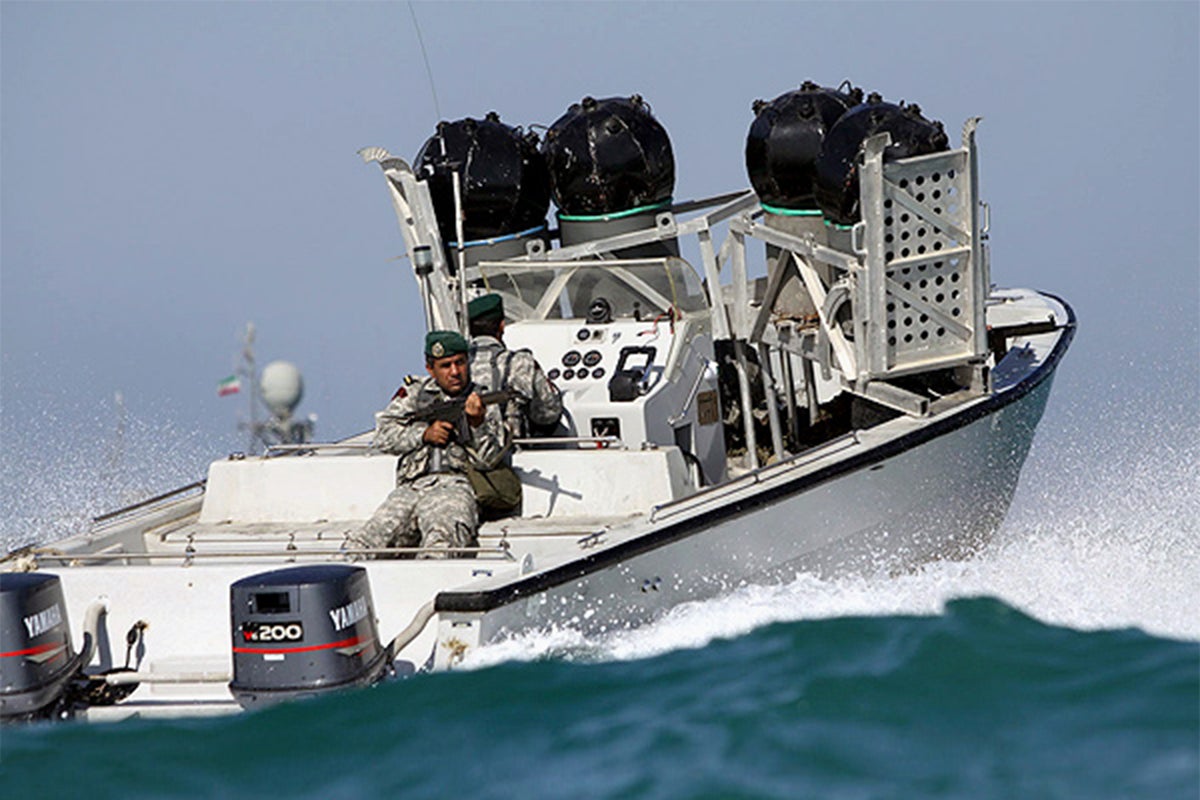
The maritime industry is currently paralyzed by a ghost story. If you read the headlines concerning the Strait of Hormuz or the Red Sea, you would think the ocean is carpeted with invisible, high-tech death traps capable of collapsing the global economy by Tuesday. The "lazy consensus" among armchair geopolitical analysts is that sea mines are a low-cost, high-impact "game-changer" (to use a term they love) that can choke off $15$ trillion in annual trade with the push of a button.
They are wrong.
The terror surrounding sea mines is based on 1940s logic applied to 2026 logistics. We are being sold a narrative of vulnerability that ignores the physical reality of modern naval warfare, the sheer incompetence of most non-state actors, and the math of ocean displacement. The threat isn't the mine; it's the insurance premium.
The Myth of the "Cheap" Blockade
The standard argument goes like this: a naval mine costs $2,000 to $20,000, while a destroyer costs $2 billion. Therefore, the mine wins.
This is a fundamental misunderstanding of economic friction. Dropping a handful of "dumb" contact mines into a shipping lane doesn't create a blockade. It creates a temporary navigational hazard. To actually shut down a strait like Hormuz—which is roughly 21 miles wide at its narrowest point—you don't need dozens of mines. You need thousands. And you need to keep replacing them as the current moves them, the salt water corrodes their firing mechanisms, or specialized mine-countermeasure (MCM) vessels pluck them out of the water.
Logistics wins wars. Deploying thousands of mines requires a massive, sustained surface operation. You cannot do this "discreetly" with a few speedboats in the middle of the night. It requires minelaying ships, which are slow, bulky, and exceptionally easy to sink with a single drone or missile. The moment a nation starts a large-scale minelaying operation, they have effectively declared a conventional war they are destined to lose.
Your Ship is Bigger Than the Problem
We need to talk about the physics of the modern merchant fleet. In the world of VLCCs (Very Large Crude Carriers) and Ultra Large Container Ships, the scale of the vessel is its own form of armor.
A standard moored contact mine contains roughly $200$ to $300$ kg of explosives. If that mine hits a 300,000-ton tanker, it is the equivalent of a firecracker hitting a moving truck. Will it cause damage? Yes. Will it sink the ship? Rarely. Modern tankers are double-hulled beasts designed to survive groundings and high-energy collisions.
The goal of a sea mine in a commercial context isn't to sink the ship; it’s to make the insurance company blink. When Lloyd’s of London designates a region as a "Listed Area," the Additional War Risk Premium spikes. That is the actual weapon. The mine is just the marketing material for a financial shakedown. If you want to solve the "mine crisis," stop looking at the water and start looking at the actuarial tables in London.
The High-Tech Delusion
Critics will point to "smart" mines—influence mines that trigger based on acoustic, magnetic, or pressure signatures. They claim these are impossible to sweep.
I have spent years looking at the telemetry of these systems. Here is the reality: smart mines are temperamental. They require sophisticated sensors that often fail in the harsh, high-salinity environment of the Middle East. Furthermore, they are incredibly susceptible to "spoofing."
If an adversary deploys acoustic mines tuned to the frequency of a tanker’s propeller, the response isn't a billion-dollar sweeping operation. It's a $50,000 autonomous underwater vehicle (AUV) broadcasting that exact frequency 500 meters away from the actual hull. We aren't fighting ghosts; we are fighting sensors that can be tricked by the maritime equivalent of a flashlight in a dark room.
The "Silent" Counter-Revolution
While the media focuses on the threat, they ignore the absolute dominance of modern mine-hunting technology. We are no longer in the era of wooden ships dragging chains through the water.
Today’s mine countermeasures involve:
- Synthetic Aperture Sonar (SAS): Providing high-resolution imagery that can distinguish a mine from a discarded washing machine at significant depths.
- Expendable Neutralizers: Small ROVs (Remotely Operated Vehicles) that identify a mine and detonate a shaped charge to destroy it without risking a single human life.
- Pockmarked Mapping: Navies now maintain "bottom maps" of critical chokepoints. They know where every rock and shipwreck is. When a new object appears, it stands out like a neon sign on a digital overlay.
The "insider" truth is that the US Navy and its allies have become so good at this that the only way a mine succeeds is if the political will to clear it evaporates. The bottleneck isn't the technology; it’s the cowardice of politicians who treat a single floating object as a reason to halt $100 billion in commerce.
Why We Should Stop "Fixing" the Problem
The current strategy is to react with "increased patrols" and "international task forces." This is exactly what the minelayer wants. They want the optics of a militarized sea. It justifies their narrative of resistance and drives up the price of the oil they are likely exporting themselves.
If we wanted to actually disrupt this cycle, we would move toward a "Hardened Trade" model:
- State-Backed Insurance: Governments should provide a sovereign guarantee for ships traversing these waters, bypassing the private insurance markets that panic at the mention of the word "mine."
- Convoy Resilience: Instead of hunting for every single mine, we move ships in convoys led by a single, high-resolution sensor vessel.
- Brutal Proportionality: If a mine is found, you don't just clear the mine. You destroy the facility that manufactured it. The "asymmetric" advantage of the mine disappears the moment the response becomes symmetric and overwhelming.
The Psychological Anchor
The sea mine is a psychological weapon, not a tactical one. It relies on the "fear of the unknown." You can see a missile on radar. You can see a pirate in a skiff. You cannot see the mine.
But "unseen" does not mean "all-powerful." In the history of naval warfare since 1945, sea mines have damaged more US Navy ships than any other weapon, yet they have failed to win a single conflict or permanently close a single trade route. They are the "IKEA furniture" of warfare: cheap, annoying to deal with, and ultimately disposable.
The next time you see a chart showing the "devastating" reach of a potential minefield in the Gulf, remember that the ocean is vast, the ships are enormous, and the math is on our side. The only thing keeping the threat alive is our willingness to believe it's credible.
Stop treating the ocean like a minefield and start treating it like a highway. If there’s a pothole, you drive around it or you fill it in. You don't abandon the car.


