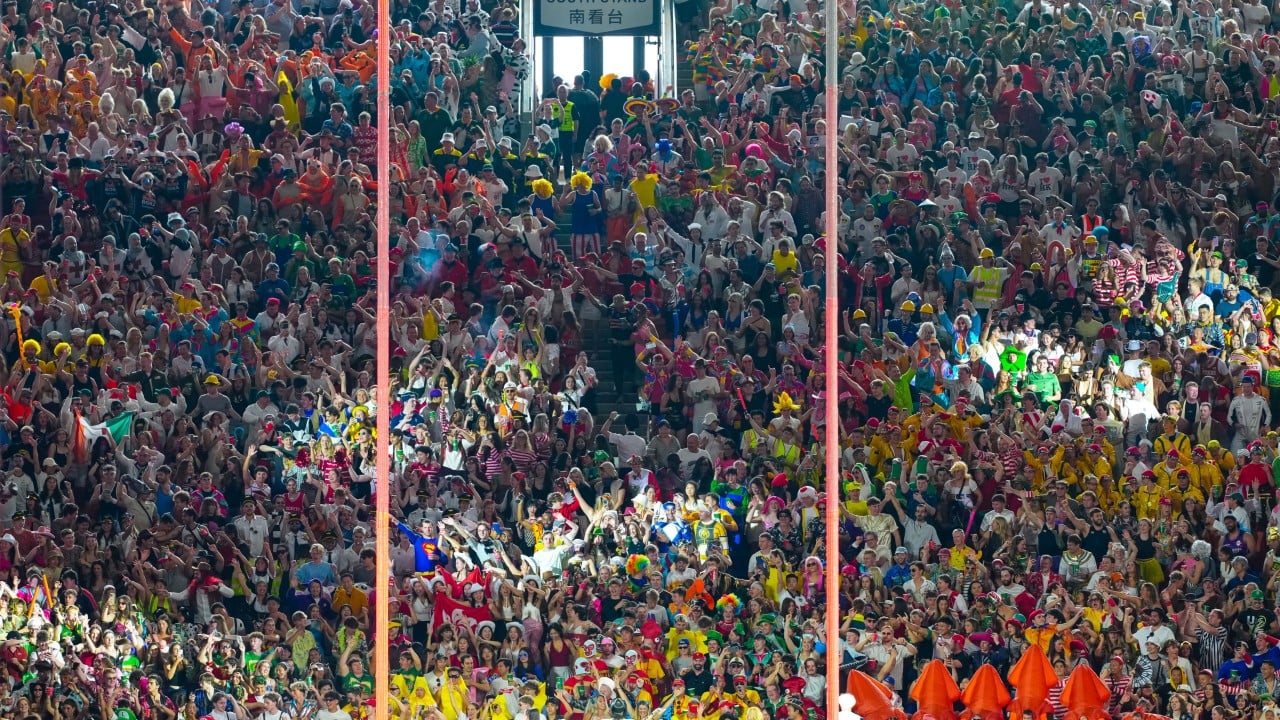
The evolution of the Hong Kong Sevens from a localized 12-team invitational in 1976 to a global benchmark for commercial sports entertainment represents a 50-year case study in Institutional Resilience and Product-Market Fit. While casual observers focus on the spectacle of the South Stand, a structural analysis reveals that the tournament’s "pinnacle" status is the result of three specific operational drivers: the optimization of high-velocity match formats, the conversion of a sporting event into a critical node for corporate hospitality, and the successful navigation of the transition from the Government Stadium to the Kai Tak Sports Park.
The Velocity Multiplier of the Sevens Format
The primary engine of the tournament's success is the Efficiency Ratio of Rugby Sevens compared to the 15-a-side game. A standard rugby union match requires 80 minutes of play and significant recovery time, limiting a venue's daily throughput. In contrast, the Hong Kong Sevens utilizes a 14-minute match cycle ($7 \text{ minutes per half} + 2 \text{ minute intervals}$).
This high-frequency scheduling creates a specific psychological effect on the spectator:
- Dopamine Density: The shorter timeframes force a higher rate of scoring attempts per minute, maintaining audience engagement levels that traditional sports struggle to replicate.
- Variability Reduction: Because the games are short, the "underdog" has a statistically higher chance of an upset, increasing the perceived stakes of every match in the pool stages.
- Content Throughput: A three-day window accommodates dozens of international matches, allowing the tournament to aggregate multiple distinct fanbases simultaneously.
Peter Duncan, a foundational figure in the tournament’s coaching history, identifies this as a "pinnacle" state, but from a strategic perspective, it is more accurately described as Format Optimization. The game has reached its maximum theoretical speed; any further compression would sacrifice the athletic integrity required for Olympic-level competition.
The Hospitality Revenue Engine
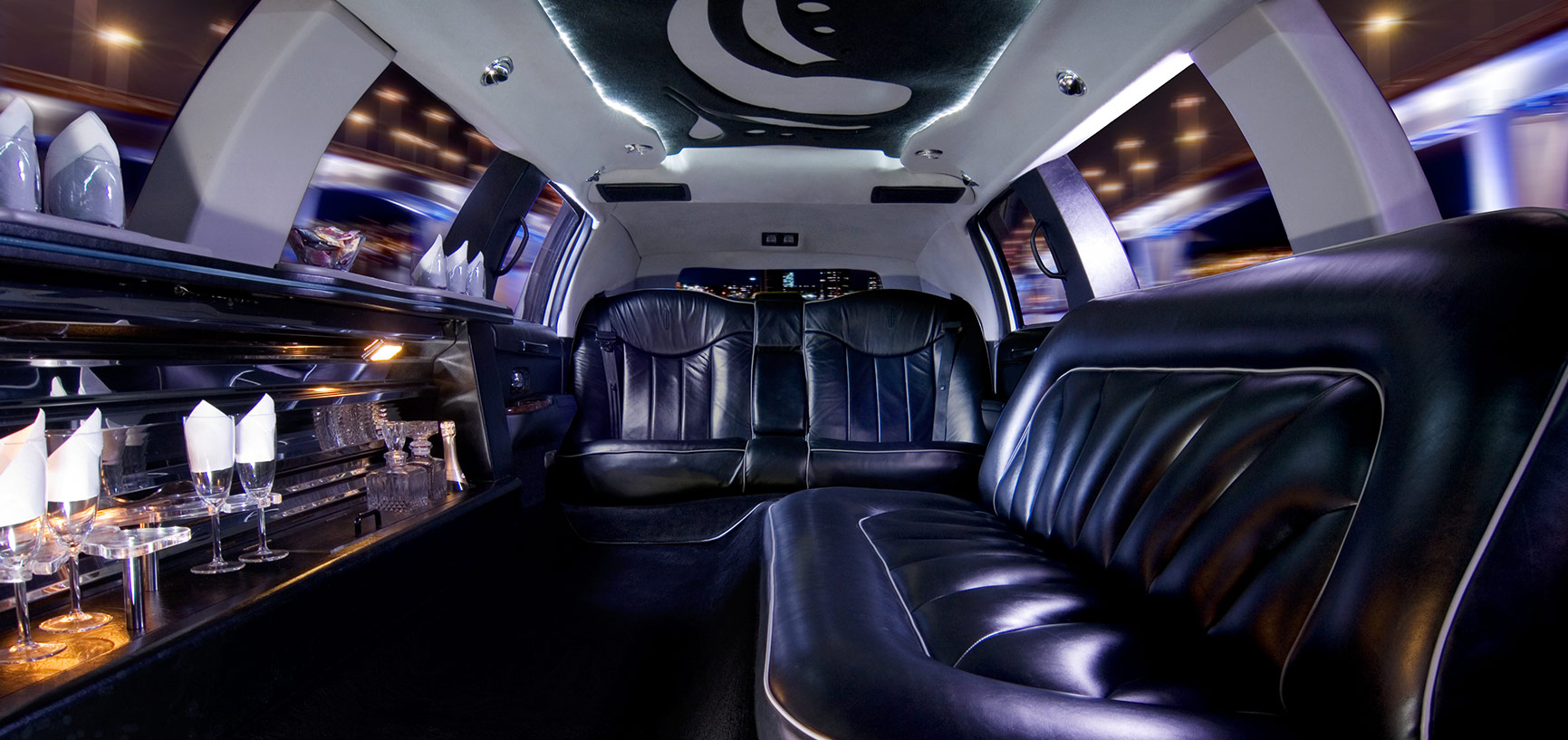
The Hong Kong Sevens does not function primarily as a ticket-sale business; it operates as a High-Value Networking Platform. The physical layout of the stadium—specifically the corporate boxes—serves as the primary revenue driver. The "Hong Kong Model" pioneered the integration of sport and commerce by treating the pitch as the background for the negotiation of regional trade and financial services contracts.
The economic moats protecting this event include:
- Exclusivity Tiers: The separation of the "South Stand" (high-energy, lower-price point, brand visibility) from the corporate suites (high-margin, private, decision-maker density) allows the event to capture the entire demand curve.
- The 50-Year Lindy Effect: The tournament has survived long enough that its value is self-reinforcing. In the Lindy Effect, the future life expectancy of a non-perishable thing—like a tradition—is proportional to its current age. At 50 years, the Hong Kong Sevens is an entrenched component of the global sporting calendar, making it a "must-attend" for sponsors seeking long-term brand association.
Structural Transition and the Kai Tak Risk Profile
As the tournament moves into its 50th year, it faces a Critical Infrastructure Pivot. The transition from the historic Hong Kong Stadium in So Kon Po to the new 50,000-seat Kai Tak Sports Park introduces a significant variable into the tournament’s success equation.
The move involves a fundamental shift in Spatial Economics:
- Capacity Expansion: Moving from 40,000 to 50,000 seats increases the supply of tickets by 25%. Without a commensurate increase in global demand, this risks diluting the "scarcity premium" that has allowed the tournament to maintain high prices.
- Acoustic and Atmospheric Engineering: The "pinnacle" status described by Duncan is largely atmospheric. The So Kon Po stadium acted as a natural amphitheater. Kai Tak, being a modern multi-purpose facility, must prove it can replicate the dense, high-pressure environment that defines the Hong Kong Sevens brand.
- Logistical Friction: The previous stadium benefited from its proximity to the Causeway Bay commercial district. Kai Tak’s success depends on the efficiency of the MTR and surrounding transport infrastructure to move 50,000 people within the narrow windows created by the high-velocity match schedule.
The Coaching Evolution and Tactical Professionalization
The transition from the "pioneer" era of Peter Duncan to the current professional era reflects the broader Institutionalization of Sport. In the 1970s and 80s, Sevens was often viewed as a post-season exhibition. Today, it is a specialized discipline with unique physiological requirements.
The modern Sevens player is optimized for Anaerobic Capacity and Spatial Coverage. In 15s, a player covers roughly 70-90 meters per minute; in Sevens, this increases to over 120 meters per minute, often in high-heat conditions. This shift has forced the Hong Kong Sevens to evolve from a social "festival" into a laboratory for elite sports science. The tournament is no longer just a celebration; it is a high-stakes data-gathering exercise for national Olympic committees.
Supply Chain of Talent: The Local Integration Gap
A significant bottleneck in the tournament’s long-term growth is the Conversion Rate of local interest into elite playing talent. While the event is a commercial triumph, the disparity between the tournament's global prestige and the domestic participation rate remains a structural weakness.
The "Pillars of Growth" for the next 50 years must include:
- Infrastructure Democratization: Ensuring that the move to Kai Tak isn't just for the elite 1%, but serves as a hub for local rugby development.
- Media Rights Diversification: Shifting away from a reliance on physical attendance toward a digital-first global broadcast strategy that captures the "South Stand Energy" for a remote audience.
The Hong Kong Sevens has reached its 50th anniversary not by accident, but by successfully balancing the conflicting demands of a high-performance sporting event and a chaotic cultural festival. The current "pinnacle" is a fragile equilibrium. Maintaining this status at Kai Tak requires a ruthless focus on the fan experience while ensuring the commercial "hospitality engine" remains the tournament's financial anchor.
The strategic priority for the Hong Kong China Rugby (HKCR) is to de-risk the relocation by over-investing in transport logistics and "atmosphere engineering" during the inaugural Kai Tak year. If the tournament loses its sense of place, it loses its premium. The focus must shift from "more seats" to "higher engagement per seat."