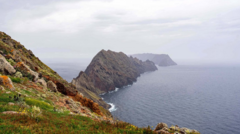
Conservation is messy. It rarely looks like a pristine documentary with smooth narration and happy endings on schedule. Sometimes it looks like a team of tired biologists dangling from ropes on a vertical limestone cliff, squinting in the wind, trying to spot a creature smaller than a fingernail before it disappears forever.
People love to talk about saving charismatic megafauna. Pandas get billboards. Tigers get prime-time television specials. But snails? Snails usually get ignored until they are completely gone. That mistake nearly cost the world some of its most irreplaceable invertebrate species. When zoo staff launched a high-stakes mission to rescue near-extinct snails from a remote, windswept rock face, they weren't just collecting empty shells. They were fighting a desperate race against invasive species, habitat destruction, and pure extinction mathematics.
Let's look at why these rescue operations matter, how they actually happen on the ground, and what most people misunderstand about protecting the smallest residents of our ecosystems.
The silent crisis facing island invertebrates
Island ecosystems are fragile laboratories of evolution. When species evolve on isolated rocks or remote archipelagos, they often lose defenses against mainland predators. They specialize. They adapt to hyper-specific microclimates.
Then humans introduce rats, predatory flatworms, or aggressive plant species. The ecosystem flips overnight.
You see, invertebrates make up the vast majority of animal biodiversity, yet they receive a tiny fraction of conservation funding. When a bird or a mammal drops in population, alarm bells ring. When a unique land snail species drops to its last fifty individuals clinging to a single vertical cliff, nobody notices until an ecologist happens to check the rock face.
This isn't an abstract theory. Conservation teams working with institutions like the Zoological Society of London and various Pacific and Atlantic conservation trusts have watched entire lineages vanish within a decade because invasive predators ate their way through the understory. Snails can't run away. They can't fly. They move at the speed of, well, a snail. If their specific patch of rock gets overrun, they are sitting ducks. Or rather, sitting targets.
What a real cliffside snail rescue looks like
Forget what you've seen in movies. Field biology is exhausting, repetitive, and often physically dangerous.
When teams target a remote rock stack for a rescue mission, the logistics are staggering. You can't just stroll up with a cardboard box. You need climbing gear, permits, quarantine protocols, and precise tracking equipment.
First comes the survey. Biologists scale vertical limestone towers or volcanic spires where goats or invasive rats haven't managed to graze every leaf. Every square centimeter of moss and leaf litter gets inspected under hand lenses. You have to find the snails without crushing them or disturbing the fragile substrate they rely on for moisture and calcium.
Next comes the collection, which requires intense precision. Staff members place individuals into specialized transport containers designed to maintain humidity and temperature. They record GPS coordinates for every single specimen. Why? Because genetics matter. If you take all your founders from the exact same square meter, you end up with severe inbreeding depression down the road.
Once secured, these animals face a terrifying journey. They must be transported off the rock, often via boat or helicopter, and taken into strict biosecurity quarantine.
Inside the breeding labs
Getting the snails off the rock is only half the battle. Keeping them alive in human care is where the real stress begins.
Most people assume zoos just throw animals in a glass tank and feed them lettuce. For endangered micro-snails, that approach is a death sentence. Zoologists have to reverse-engineer entire micro-ecosystems in climate-controlled rooms. They replicate specific humidity levels, seasonal temperature shifts, and natural diets—often culturing specific types of native algae and fungi that the snails graze on in the wild.
I talked to a keeper a while back who spent months trying to figure out why a clutch of captive-born endangered snails wouldn't feed. The problem wasn't the food. It was the texture of the moss. They refused to eat unless the moss had a specific moisture film thickness. Once the team tweaked the misting system, the population finally stabilized.
That is the level of obsession required. You have to think like a snail. You have to obsess over calcium carbonate availability, soil pH, and fungal growth. One fungal outbreak in the breeding room can wipe out fifty percent of the global population of a species in forty-eight hours.
Why saving ugly animals keeps ecosystems running
You might wonder why we bother spending thousands of dollars to save a brown, unassuming snail that lives on a rock nobody will ever visit.
It is easy to dismiss invertebrates as irrelevant. That view will destroy our life support systems. Snails are nutrient cyclers. They break down decaying organic matter, recycle calcium into the soil, and serve as a crucial food source for larger native predators. When you pull a keystone species out of an island habitat, the soil quality drops. Plant growth slows. The ripple effects travel all the way up the food chain.
Furthermore, these organisms hold evolutionary secrets we haven't decoded yet. Their mucus, their shell structures, and their metabolic adaptations to extreme environments could hold answers for medicine and materials science.
More than that, we have a moral obligation. Extinction is permanent. Once a species of snail blinks out because we brought rats to its island home, it is gone forever. No app can bring it back. No laboratory can synthesize its unique genetic code from scratch.
How conservation is changing for the better
We are moving past the era where conservation meant putting a fence around a park and hoping for the best. Modern conservation is active, interventionist, and often radical.
Organizations now use environmental DNA sampling to detect hidden snail populations before they vanish. Captive breeding programs are no longer just static museums of last resort; they are dynamic reservoirs designed to pump healthy populations back into the wild once habitat restoration is complete.
Eradicating invasive rats from entire islands used to sound impossible. Now, conservationists pull it off using targeted aerial baiting and biosecurity protocols. Once an island is cleared of rats, the native vegetation bounces back. The soil recovers. And those captive-bred snails can finally go home.
If you want to support this work, look past the big-name charities and find organizations funding invertebrate conservation and habitat restoration. Donate directly to local trusts that manage island biosecurity. Pay attention to the small things, because the big things cannot survive without them.
The next time you walk past a patch of garden and see a snail sliding across a damp leaf, don't just brush it aside. Remember that somewhere out there, people are hanging off cliffs by ropes just to make sure the world doesn't lose the quietest creatures we share it with.