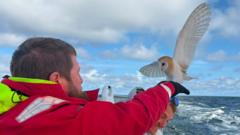
The internet erupted over the viral rescue story of a collapsed owl hauled aboard a naval vessel seventy miles out to sea. Social media feeds flooded with applause for the empathetic sailors who dried the exhausted bird, fed it scraps, and released it back into the wild once they hit port.
It makes for a heartwarming headline. It also completely misunderstands how nature actually functions. For an alternative perspective, check out: this related article.
Every single person praising this maritime wildlife rescue operation is falling for a lazy sentimental narrative. They see a feathered creature in distress and assume human intervention is a moral imperative. They ignore the brutal reality of biological selection, the stress imposed on wild animals by well-meaning human captors, and the broader ecological cost of treating isolated anomalies as conservation triumphs.
Stop cheering for accidental tourist birds that have no business being in the middle of the ocean. Further reporting on the subject has been shared by The Guardian.
The Myth of the Universal Rescue
We suffer from a profound anthropomorphic bias. When humans see a mammal or a bird struggling against the elements, our instinct is to project our own survival values onto an organism that operates entirely on instinct and environmental feedback loops.
Seventy miles out to sea is not an arbitrary distance. It is an evolutionary dead end for a terrestrial raptor. Owls do not migrate across open oceans. When an owl ends up that far from land, it represents a catastrophic navigational failure. Strong offshore winds, disorientation during coastal hunting, or simple juvenile inexperience usually explain these maritime detours.
By pulling the bird onto a steel ship, feeding it foreign food, and subjecting it to the sensory hell of a human-dominated environment, those soldiers did not save a life. They likely prolonged a slow, disoriented decline or introduced a compromised predator back into a local ecosystem where it does not belong.
Let us look at the mechanics of avian exhaustion. A raptor that has burned every calorie of its fat reserve trying to cross a marine expanse is a broken machine. Even if you dry its feathers and hand-feed it pieces of fish or canned meat, its systemic physiological shock is severe. The corticosterone levels—the primary stress hormone in birds—spike through the roof around humans. Capture myopathy, a metabolic condition brought on by extreme stress and exertion, frequently kills animals days after a rescue, even when they appear outwardly healthy and rested.
The mainstream narrative tells you that every saved feather is a victory for biodiversity. The data says otherwise.
The Ecological Cost of Sentimentality
Conservation is not about individuals. It is about populations, habitats, and evolutionary pressures.
When you pluck a genetically compromised or navigationally incompetent animal out of a harsh natural filter, you interfere with the weeding-out process that keeps wild gene pools functional. Nature is entirely indifferent to individual suffering. That indifference is precisely what drives adaptation.
I have watched well-funded wildlife organizations spend tens of thousands of dollars rehabilitating single displaced birds while local habitats fragment and entire macro-populations collapse due to habitat loss and chemical runoff. It is an emotional shell game. We focus on the cute, photogenic vertebrate that triggers our parental instincts while ignoring the systemic destruction of the landscape right behind it.
Furthermore, dumping a stressed, disoriented raptor onto a dock seventy miles from its original territory creates a new set of problems. Where does it hunt? Does it infringe on the territory of resident owls that already occupy every square foot of suitable habitat near the port? Territorial exclusion in raptors is vicious. A displaced, weakened outsider dropped into an established urban or rural fringe often starves to death anyway, or it gets displaced by local territorial pairs after enduring days of harassment.
We perform these rescue theater acts to make ourselves feel better, not because the intervention yields a net positive ecological outcome.
The Uncomfortable Truth About Wild Survival
We need to confront our addiction to rescue porn. Every time a story like this circulates, it reinforces the dangerous notion that human intervention is always beneficial, always appropriate, and always required.
This mindset bleeds into how people interact with local wildlife daily. People kidnap perfectly healthy baby fawns left alone by their foraging mothers. They interfere with nesting shorebirds. They feed urban coyotes until the animals lose their natural fear of humans and have to be exterminated by animal control.
The soldier on that ship acted with kindness. Kindness, however, is a poor substitute for ecological literacy.
If you truly care about owls, stop worrying about the statistical anomaly blown out to sea by a gale. Focus your energy on stopping rodenticide poisoning, preserving old-growth nesting cavities, and halting the conversion of marginal farmlands into suburban asphalt sprawl. Those threats kill millions of raptors every year. A stray bird on a destroyer is nothing more than a distraction from the real work.
Nature is harsh, chaotic, and fundamentally unconcerned with your feelings. Leave it alone.