You think you know what a television feud looks like. You expect slammed doors, angry fence-line disputes, maybe some shouting over the garden wall. You don't expect a simple borrowed house key to spark a descent into radicalisation, online toxicity, and physical violence.
Russell T Davies has built his legendary status on making us feel things we aren't always prepared for. From the raw visibility of Queer as Folk to the devastating heartbreak of It’s a Sin, his writing acts as a mirror to modern Britain. But with his five-part Channel 4 drama, Tip Toe, he isn't trying to make us cry. He's trying to make us terrified.
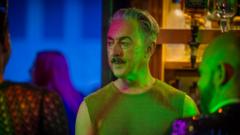
The story drops us right into Manchester, a familiar playground for Davies. Leo Struthers, played by Alan Cumming, is the vibrant owner of Spit & Polish, a bar on Canal Street. Next door lives Clive Goss, played by David Morrissey, a quiet, grumpy, and deeply struggling electrician with a wife and two sons. They've been neighbours for fifteen years. They should be settled. Instead, they go to war.
The Horrifying Reality Moving Next Door
The premise sounds almost like a dark comedy at first. Leo gets locked out of his house in his underwear and slippers. He turns to Clive for help, uses his phone, and eventually asks Clive to keep a spare key and his alarm code. It seems like ordinary suburban neighborliness. But that key becomes a literal and metaphorical violation of privacy.
This isn't a story about fictional monsters. It’s about how ordinary people change when fed a steady diet of internet bile. Davies wrote this script out of pure fury, driven by the creeping hostility he has noticed in modern society. Political rhetoric, bad-faith online discourse, and targeted misinformation act as jet fuel on Clive's existing resentment.
The title itself comes from a line spoken by Melba, a regular at Leo’s bar played by Paul Rhys. He notes that where he used to walk into a room shouting "Ta-da!", he now finds himself tip-toeing. Just in case. That anxiety of existence is the core engine of the series.
Why This Thriller Feels Too Real
Davies didn't pull these themes out of thin air. The domestic intrusion at the heart of the plot was directly inspired by a terrifying incident in his own life. After an appearance on a BBC documentary, a viewer tracked down his home, and an over-friendly neighbour with a spare key once walked into his house without knocking. That sudden realization of how porous a home can be shook him.
He took that personal violation and multiplied it by the current political climate. The show isn't abstract. It targets the rise of the "manosphere," transphobia, and far-right radicalisation. Davies has been open about the abuse he receives online, noting the shocking frequency with which people label him a groomer for supporting trans rights.
He channels that exact poison into Clive’s household. We watch as minor annoyances mutate through algorithms into genuine hatred. The tragedy is that it feels completely plausible. Look around at the news. Look at the rising statistics of violence against marginalized groups. The drama reflects a culture that has moved past simple ignorance into active, intentional malice.
The Messy Human Middle Ground
What saves the series from being a preachy lecture is the cast and the nuance of the writing. Alan Cumming returns to British drama with a performance that balances showmanship with deep vulnerability. David Morrissey plays Clive not as a cartoon villain, but as a deeply troubled, insecure man whose silence masks a dangerous reservoir of resentment.
The supporting cast builds a rich, chaotic community around the central conflict.
- Elizabeth Berrington plays Stephanie, navigating the fallout of her husband’s unraveling.
- Iz Hesketh stars as Zee, a bar staff member dealing with housing precarity.
- Denise Welch and Pooky Quesnel add layers of local texture.
Davies avoids making the world entirely black and white. He includes characters with gender-critical views, noting that in real life, people with massive ideological differences usually have a chat, sigh, and tolerate each other. The horror of the show is watching how that real-world tolerance breaks down under the weight of digital radicalisation.
How To Watch Tip Toe
The rollout for this series doesn't let you catch your breath. Channel 4 is burning through the five episodes quickly, matching the urgent energy of the script.
The first two episodes air on Sunday 31 May and Monday 1 June at 9pm on Channel 4, becoming instantly available to stream as a boxset on the night of 31 May. The final three episodes land the following week, broadcasting from Sunday 7 June to Tuesday 9 June.
Don't go into this expecting a cozy Sunday night thriller. It features moments of graphic violence and confronting prejudice that will make you want to look away. If you want to understand how modern radicalisation works, queue up the first episode on Channel 4 streaming tonight. Watch how quickly a neighborhood can turn. Pay attention to how easily boundaries blur when digital hatred spills onto a quiet suburban street.