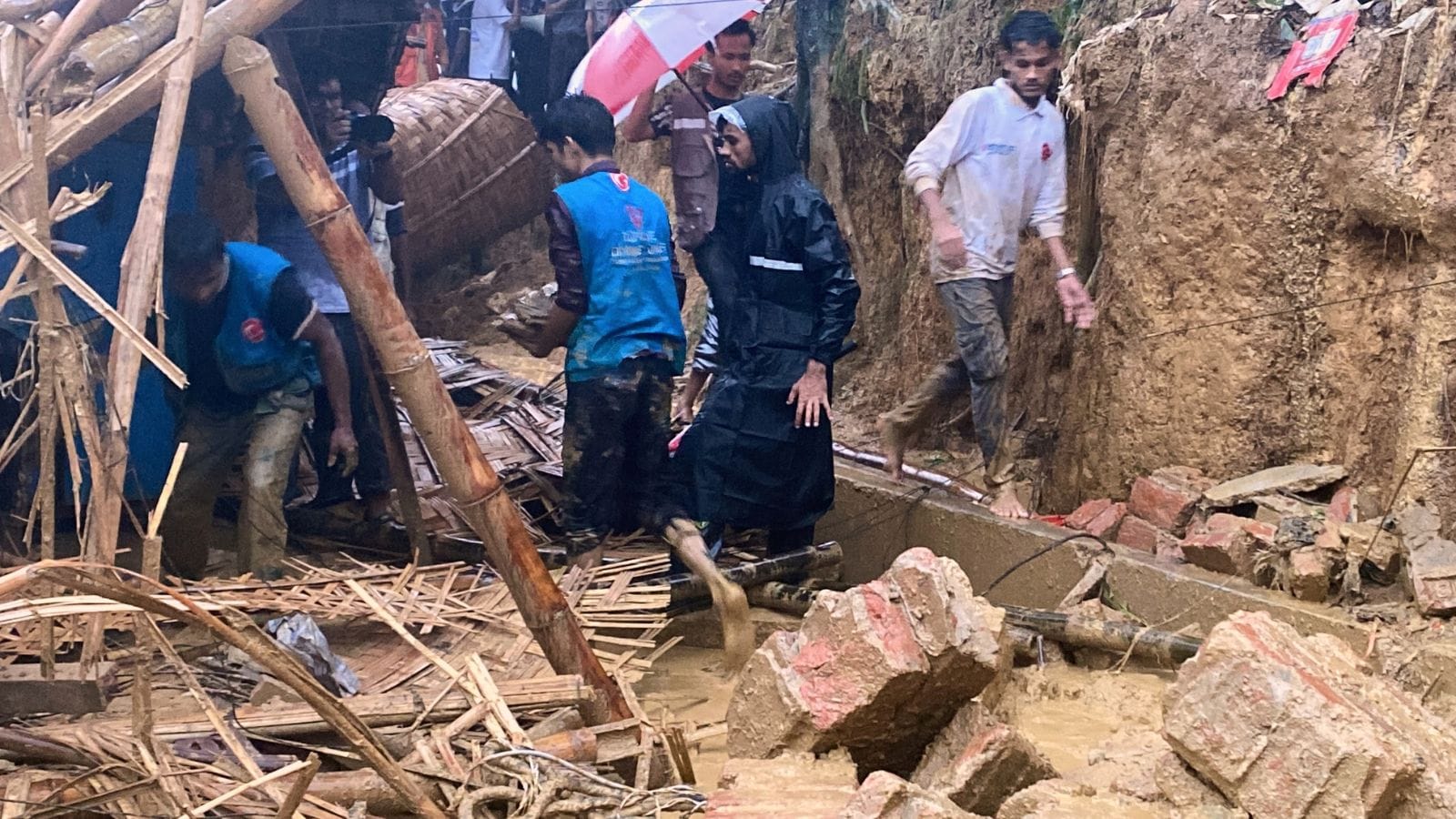
The media cycle follows a predictable, lazy script every monsoon season in Bangladesh. Heavy rains hit Cox's Bazar. A hillside gives way. Mud buries shelters, killing Rohingya refugees—often children. Mainstream outlets rush to publish heartbreaking headlines, followed immediately by reports that the Bangladeshi government is "taking action" by relocating thousands of survivors to safer ground or the isolated island of Bhasan Char.
The narrative is always the same: a natural disaster occurred, and bureaucratic relocation is the humane, logical solution.
It is a lie.
Relocating refugees after a fatal landslide is not a solution; it is a performative, reactive band-aid that ignores the structural reality of how these camps were built and how humanitarian aid operates. Bureaucrats shift bodies across a map to look proactive while ignoring the foundational engineering and geopolitical failures that guarantee the next hill will collapse. If we keep pretending that musical chairs with refugee tents solves structural vulnerability, more people will die.
The Myth of the Natural Disaster
Let’s dismantle the first premise. The landslides killing Rohingya refugees in places like Balukhali and Kutupalong are routinely framed as acts of God—unavoidable tragedies fueled by climate change and torrential rains.
They are not. They are man-made engineering failures.
When nearly a million Rohingya fled Myanmar in 2017, the hills of Cox's Bazar were stripped of virtually all vegetation within months to construct makeshift shelters. Trees anchor soil. Roots act as natural rebar. When you clear-cut hundreds of acres of hilly terrain and replace deep root networks with plastic tarps and bamboo poles, you don't just invite erosion; you guarantee it.
The soil in Cox's Bazar is largely sandy loam. It absorbs water quickly, becomes heavy, and loses shear strength. Without deep-rooted vegetation to bind the layers together, heavy rainfall liquefies the hillside. International agencies and local authorities knew this in 2017. They knew it in 2021. They know it now.
Shifting five hundred families to a different part of the same deforested ridge line does nothing to change the underlying physics of slope stability. It merely resets the clock until the next saturated hillside reaches its tipping point.
The High Cost of the Relocation Theatre
Humanitarian operations consume millions of dollars every time a mini-migration is triggered within the camp network. Resources that should be spent on permanent slope stabilization, retaining walls, and deep-drainage infrastructure are instead diverted into logistics, temporary tents, and emergency rations for the displaced.
I have watched international organizations burn through budgets on emergency responses that could have been prevented by basic civil engineering months prior. It is far easier to secure emergency donor funding when pictures of mudslides hit the international wire than it is to raise capital for boring, preventative retaining walls.
Furthermore, forced or highly pressured relocation disrupts the fragile socio-economic ecosystems the refugees have built to survive. Even within a camp, proximity to markets, distribution centers, and informal community networks matters. Arbitrarily moving families because a bureaucrat drew a circle around a "hazardous zone" strips refugees of their agency and cuts them off from their meager livelihoods, forcing them back into total dependency on aid distribution.
Bhasan Char is an Island of Isolation, Not a Sanctuary
Whenever land runs out in Cox's Bazar, the government points to Bhasan Char—a silt island in the Bay of Bengal formed only a few decades ago. The official line is that this engineered island offers a safer, modern alternative to the crowded hillsides.
The reality is a trade-off between two different types of environmental peril. While Bhasan Char features concrete flood embankments and multi-story storm shelters, it sits directly in the path of major cyclones in the Bay of Bengal. It is geographically isolated, hours away from the mainland by boat.
More importantly, it functions as a geopolitical holding pen. By moving refugees to an island, authorities reduce their visibility to the global community. Out of sight, out of mind. The underlying crisis—the denial of citizenship by Myanmar and the lack of a viable repatriation framework—gets buried beneath a layer of concrete on a remote sandbar. Safety isn't just the absence of mud; it is the presence of rights, mobility, and economic survival. Bhasan Char offers none of the latter.
Dismantling the Practical Logistics Flaw
Let’s address the "People Also Ask" consensus: Why can't Bangladesh just build stronger houses for the Rohingya?
The answer is brutally political, not financial. The Bangladeshi government explicitly bans the use of permanent building materials like concrete and brick for refugee shelters in Cox's Bazar. The official stance is that permanent structures would signal that the Rohingya are staying indefinitely, impeding repatriation efforts.
Consequently, aid agencies are forced to build using bamboo and tarpaulins—materials that decay rapidly in a tropical climate and offer zero resistance to rushing mud. We are demanding that engineers protect a million people on steep slopes while forbidding them from using concrete. It is an impossible mathematical equation.
If the international community refuses to challenge this policy, every dollar spent on post-landslide relocation is a waste. We are moving people from one flimsy bamboo cage to another, expecting a different physical result when the sky opens up.
The Actionable Order: Fix the Dirt, Stop Moving the People
If the goal is actually to save lives rather than manage public relations after a tragedy, the playbook must change entirely.
First, civil engineering must supersede humanitarian logistics. Stop funding temporary relocation camps. Redirect those millions into immediate, widespread terracing, bio-engineering—specifically planting vetiver grass, which has deep, dense root systems that stabilize slopes—and constructing proper masonry drainage channels to guide monsoon runoff away from living sectors.
Second, the international community must condition financial aid on the allowance of semi-permanent building materials. Bamboo cannot hold back a mountain. If host governments want international funds to manage the crisis, they must allow the infrastructure to be structurally sound.
Stop treating the monsoon like an unexpected visitor. Stop treating relocation like a victory. Fix the slopes or admit that the loss of life is an acceptable cost of political stalling. Turn off the cameras, bring in the structural engineers, and anchor the earth.