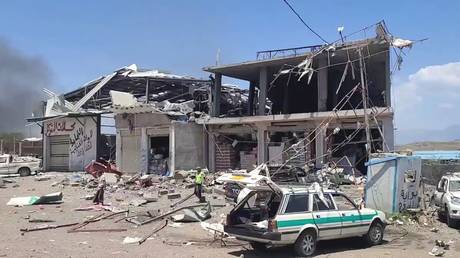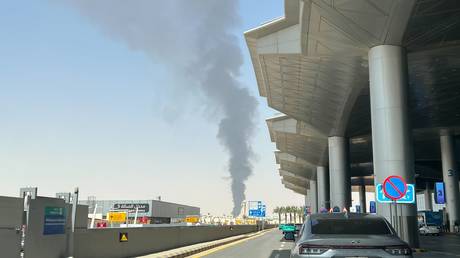
The explosions over Riyadh did not merely shatter the midnight quiet of Saudi Arabia's primary aviation hub; they exposed a structural vulnerability that multi-billion-dollar defense procurement programs have repeatedly failed to seal. When a second major strike hit King Khalid International Airport barely twenty-four hours after a deadly assault attributed to Houthi forces, it signaled an alarming operational shift. This was no longer a sporadic cross-border harassment campaign. It was a calculated strategy targeting economic infrastructure, aviation security, and the psychological bedrock of the Gulf state's modernization ambitions.
For years, regional capitals operated under the assumption that advanced missile defense batteries could construct an impenetrable dome over critical assets. That assumption is now crumbling. The reality on the ground—and in the contested skies above the Arabian Peninsula—reveals a stark economic and tactical asymmetry. Asymmetric warfare has evolved past conventional deterrence. When low-cost, delta-wing loitering munitions and modified ballistic systems can repeatedly bypass or exhaust sophisticated interceptor arrays, the cost curve heavily favors the attacker. A missile battery interceptor costs millions of dollars per launch. The threat vector often costs a fraction of that amount to manufacture and deploy.
This financial imbalance has transformed airspace defense into a war of attrition.
King Khalid International Airport is not just a transit hub. It is the logistical artery of a diversifying economy that relies on uninterrupted global connectivity, foreign direct investment, and massive tourism projects. When commercial flights are abruptly grounded, departure boards flash cancellations, and international carriers begin reassessing risk profiles, the ripple effects hit far beyond the tarmac. Insurance premiums for regional air carriers spike. Cargo operations face costly rerouting. Investor confidence, already sensitive to geopolitical friction, absorbs an immediate shock.
Military analysts watching the telemetry from Riyadh point to persistent gaps in low-altitude radar coverage and the geometric limitations of point-defense systems. Traditional anti-ballistic missile systems are engineered for high-arc trajectories, leaving them vulnerable to low-flying cruise missiles and autonomous drones that hug terrain contours or exploit radar horizons. The operational challenge is compounded by the sheer geographic expanse of the kingdom. Protecting every square kilometer of critical infrastructure is a logistical impossibility, forcing military planners into a perpetual game of defensive triage.
The diplomatic fallout matches the tactical severity. Each successful strike undermines the credibility of regional deterrence frameworks and complicates ongoing backchannel negotiations. For international observers, the repeated targeting of civilian aviation infrastructure underscores the inadequacy of current ceasefire mechanisms. It demonstrates that armed factions operating outside state control retain the capability to dictate the tempo of regional escalation at will.
Air travelers stepping off long-haul flights into Riyadh see a gleaming metropolis built on ambition and capital. Yet beneath that polished surface lies a starkly volatile security landscape. Until the fundamental calculus of air defense shifts—moving beyond reactive interception toward proactive disruption of launch networks and supply chains—commercial aviation hubs in the region will remain on the frontline of an unresolved conflict. The smoke rising over the airfield is a permanent reminder that modern economic power remains dangerously tethered to the skies, and the skies over the capital are far from secure.